
Red-crowned Barbet
Psilopogon rafflesii
Order: Piciformes / Family: Megalaimidae
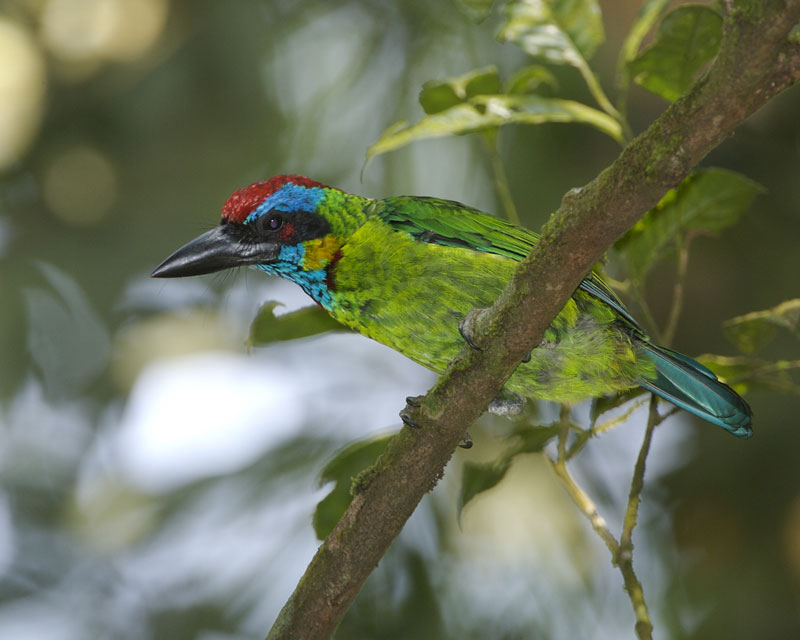
Wikimedia Commons
About the Red-crowned Barbet
The Red-crowned Barbet (Psilopogon rafflesii) is a striking bird native to the tropical forests of Southeast Asia. This species, belonging to the family Megalaimidae, is primarily found in lowland and montane forests across the Malay Peninsula, Sumatra, and Borneo. Its vibrant plumage, characterized by a red crown, green body, and touches of yellow and blue, makes it a visual spectacle. The Red-crowned Barbet plays an important ecological role as a seed disperser. By consuming a variety of fruits, it aids in the propagation of several forest plants, contributing to the biodiversity and health of its habitat. This bird's presence in primary and secondary forests underscores its adaptability, although it prefers areas with dense foliage and a rich understory.
The Red-crowned Barbet's significance extends beyond its ecological role. As an indicator species, its presence or absence can signal changes in the health of its forest environment. Due to deforestation and habitat fragmentation, the species faces threats that could affect its populations. The bird's dependence on mature forests makes it vulnerable to logging activities, which reduce its habitat and food sources. During the breeding season, which typically occurs during the wet months, the Red-crowned Barbet becomes more vocal and conspicuous, engaging in complex social interactions and territorial displays.
In addition to its ecological and environmental importance, the Red-crowned Barbet holds cultural significance in some indigenous communities, where it is often associated with folklore and traditional beliefs. Birdwatchers and ecotourists visiting the lush regions of Southeast Asia are often rewarded with sightings of this colorful bird, making it a highlight of their natural excursions. Its presence in protected areas like Taman Negara in Malaysia and Gunung Leuser National Park in Indonesia provides opportunities for conservationists to study and protect this remarkable species. The Red-crowned Barbet, with its vibrant colors and ecological role, remains a vital part of the intricate tapestry of Southeast Asian forests.
The Red-crowned Barbet belongs to the family Megalaimidae, within the order Piciformes. These birds typically live average 5-7 years, with a maximum recorded of 9 years..
How to Identify a Red-crowned Barbet
The Red-crowned Barbet is a medium-sized bird with unmistakable features that make it relatively easy to identify. Adults exhibit a bright red crown, which gives the species its name. The rest of the plumage is predominantly green, with striking accents of blue on the throat and yellow around the eyes and cheeks. Males and females are similar in appearance, though subtle differences in the intensity of the colors can sometimes be noted, with males occasionally appearing slightly more vibrant. Juveniles resemble adults but tend to have duller coloration, particularly in the red crown, which becomes more pronounced with maturity.
In terms of silhouette, the Red-crowned Barbet has a stocky build typical of barbets, with a short neck and a large head that accentuates its colorful features. Its bill is robust and slightly curved, well-adapted for its fruit-based diet. When perched, the bird often adopts a horizontal posture, showcasing its vibrant plumage against the backdrop of green foliage. In flight, its rounded wings and short tail distinguish it from other similarly sized birds. Confusion with other barbet species is possible, but the red crown and distinctive color pattern help differentiate it.
The bird's unique combination of colors and features means that, once seen, it is unlikely to be mistaken for any other species within its range. Its vocalizations also aid in identification, as it frequently announces its presence with a series of loud calls, which can be heard echoing through its forest habitat.
Having trouble telling birds apart? Upload a photo to our bird identification tool for an instant species match.
Red-crowned Barbet Habitat and Range
Preferred Habitat
The Red-crowned Barbet thrives in lowland and montane tropical forests, preferring areas with dense vegetation and a rich canopy. It is typically found at elevations up to 1,500 meters but is most common in lowland regions. This species favors primary forests, where the diversity of fruiting trees supports its dietary needs. However, it can also inhabit secondary forests and selectively logged areas, demonstrating some adaptability to altered landscapes.
Despite this adaptability, the Red-crowned Barbet is less commonly found in urban or heavily agricultural areas, where the loss of forest cover reduces its habitat suitability. Seasonal habitat shifts are minimal, as the species is largely sedentary, remaining within its preferred forested environments year-round. Its presence in notable conservation areas, such as Malaysia's Taman Negara and Indonesia's Bukit Barisan Selatan National Park, highlights its reliance on protected forest environments.
The species' preference for forested habitats underscores the importance of conserving mature and regenerating forests. Without these environments, the Red-crowned Barbet would struggle to find adequate food and breeding sites, emphasizing the critical need for effective forest management and conservation efforts.
Geographic Range
The range of the Red-crowned Barbet primarily encompasses parts of Southeast Asia, including the Malay Peninsula, Sumatra, and Borneo. It is a resident species, meaning it does not undertake significant migrations. Instead, it remains year-round in its tropical forest habitats, which provide the necessary resources for feeding and breeding.
Within these regions, the bird is found in both primary and secondary lowland forests. Although generally uncommon, it can be locally abundant in areas where suitable habitat exists. Population density tends to be higher in protected areas, where forest conditions are optimal for its needs. In countries like Malaysia and Indonesia, key locations such as Taman Negara, Gunung Leuser, and Danum Valley Conservation Area are known hotspots for the species.
While the Red-crowned Barbet's range does not extend beyond Southeast Asia, its presence in diverse forest types across its range makes it a valuable component of the ecosystem. The species' limited distribution increases its vulnerability to habitat loss, making regional conservation efforts crucial for its continued survival.
Want to know which birds visit your area? Browse our backyard birds by location guides for region-specific species lists.
What Does the Red-crowned Barbet Eat?
The Red-crowned Barbet primarily feeds on a diet rich in fruits, with figs being a particularly favored choice. Its strong, curved bill allows it to efficiently consume various fruiting bodies, which it plucks from trees while perched. This frugivorous diet means that the bird plays a vital role in seed dispersal, helping to maintain the health and diversity of its forest ecosystem.
In addition to fruits, the Red-crowned Barbet occasionally supplements its diet with insects and small invertebrates. This dietary flexibility enables it to adapt to seasonal variations in fruit availability. During times when fruit is scarce, the bird may be observed foraging more frequently for insects. Its foraging technique often involves hopping along branches and deftly maneuvering among foliage to access hidden food sources.
Feeding primarily occurs during daylight hours, with periods of intense activity in the morning and late afternoon. The Red-crowned Barbet's feeding habits underscore its reliance on diverse and undisturbed forest environments, where a wide array of fruiting plants and insects can support its dietary needs.
Red-crowned Barbet Behavior and Social Structure
The Red-crowned Barbet exhibits a range of social and territorial behaviors that reflect its complex interactions within its forest habitat. Typically, this species is observed alone or in pairs, though small family groups may form, especially during the breeding season. The bird maintains a defined territory, which it defends vigorously against intruders, using both vocal and visual displays to assert dominance.
Courtship involves elaborate displays, with males showcasing their colorful plumage and engaging in synchronized movements to attract females. These displays often occur at the edges of territories, where potential mates can easily observe them. The Red-crowned Barbet also demonstrates notable vocalizations during courtship, with males producing a series of loud calls that serve to both attract females and ward off rival males.
In response to predators, the Red-crowned Barbet employs a variety of strategies, including remaining motionless within dense foliage or quickly retreating to a more concealed perch. Its camouflaged plumage aids in avoiding detection. Daily activity patterns reveal peak periods of vocalization and foraging in the early morning and late afternoon, with quieter periods during the heat of the day when the bird often rests in shaded areas.
Red-crowned Barbet Nesting and Reproduction
The nesting behavior of the Red-crowned Barbet involves the excavation of nest cavities in decaying trees or branches, a task usually undertaken by both members of a breeding pair. These cavities provide protection from predators and environmental elements. The entrance hole is often small and round, leading to a deeper chamber where the eggs are laid.
Typically, a clutch consists of two to four eggs, which are incubated by both parents. The incubation period lasts approximately 14 to 17 days. During this time, the parents alternate between incubating the eggs and foraging for food. Once the eggs hatch, both parents share the responsibility of feeding the chicks, bringing a steady supply of fruits and insects to the nest.
Fledging occurs after about 30 to 35 days, when the young birds leave the nest to begin their independent lives. The Red-crowned Barbet usually raises one brood per year, although in particularly favorable conditions, a second brood may be attempted. Parental care continues for a short period after fledging, as the young birds learn essential survival skills.
Red-crowned Barbet Sounds and Vocalizations
The Red-crowned Barbet's primary vocalization is a series of resonant, rhythmic calls that can be described as a repetitive 'poop-poop-poop,' often lasting several seconds. These calls serve multiple purposes, including territory establishment and mate attraction. The bird's song is characterized by a consistent rhythm and moderate pitch, making it distinctive among the forest soundscape.
Call notes are shorter and more abrupt, used for communication between individuals, especially during foraging or in response to potential threats. Alarm calls are sharper and more urgent, alerting nearby birds to the presence of predators. During the dawn chorus, the Red-crowned Barbet's calls contribute to the rich aural tapestry of the forest, with its vocalizations often carrying over long distances due to the bird's preference for high perches when calling.
Comparatively, the sounds of the Red-crowned Barbet can be likened to the rhythmic drumming of a woodpecker, although distinctly more melodic and sustained, providing a recognizable auditory signature in its habitat.
Interesting Facts About the Red-crowned Barbet
- 1The Red-crowned Barbet can consume up to 100 small fruits per day, making it a vital seed disperser.
- 2This barbet species often nests in cavities it excavates itself, a skill shared with woodpeckers.
- 3The Red-crowned Barbet's calls can echo through the forest for distances up to 1 kilometer.
- 4Despite its vibrant colors, the barbet's green plumage provides excellent camouflage in the forest canopy.
- 5The bird's strong bill not only aids in fruit consumption but also in creating nesting sites in tree trunks.
- 6Red-crowned Barbets are known to engage in mutual grooming, strengthening pair bonds.
- 7The species has been featured in local folklore, symbolizing renewal due to its role in forest regeneration.
Red-crowned Barbet Conservation Status
The Red-crowned Barbet is currently listed as Near Threatened on the IUCN Red List. Its population trend indicates a decline, primarily due to habitat loss from deforestation and land conversion for agriculture. Logging and the expansion of palm oil plantations in Southeast Asia significantly reduce the availability of suitable habitats for this species. Conservation efforts focus on preserving remaining forest habitats and establishing protected areas where the Red-crowned Barbet can thrive. Initiatives by local and international conservation organizations aim to promote sustainable land use practices and raise awareness about the importance of forest conservation. Historically, the species had a wider distribution, but ongoing habitat destruction has fragmented its range, leading to isolated populations. Conservation strategies must address these challenges to prevent further declines and ensure the species' long-term survival.
Other Megalaimidae Species


Birds Similar to the Red-crowned Barbet
These species are often confused with the Red-crowned Barbet due to similar appearance or overlapping range.

