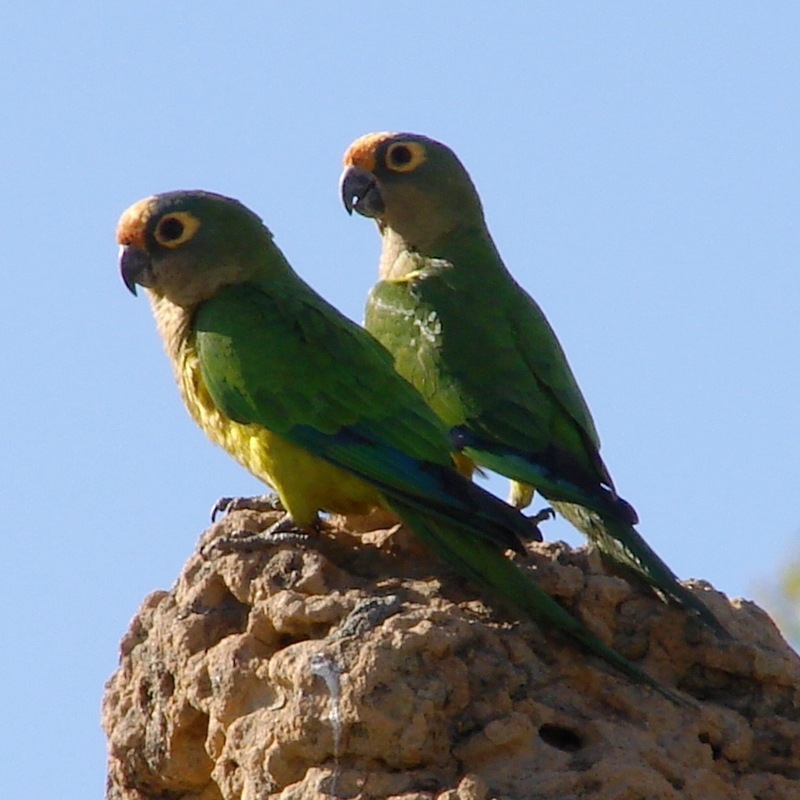
Red-fronted Conure
Aratinga wagleri
Order: Psittaciformes / Family: Psittacidae

Wikimedia Commons
About the Red-fronted Conure
The Red-fronted Conure, scientifically known as Aratinga wagleri, is a striking parrot species recognized for its vivid red forehead and largely green body. This bird is native to the forests of Central and South America, primarily found in regions ranging from western Mexico to parts of Colombia and Venezuela. It inhabits tropical and subtropical forests, favoring areas with abundant fruit trees. The species plays a crucial ecological role as both a seed disperser and a pollinator, contributing to the health and regeneration of forest ecosystems. During the breeding season, which aligns with the wet season in many parts of its range, the Red-fronted Conure becomes particularly vocal and active, engaging in elaborate courtship displays. These parrots typically form small flocks that can be observed foraging together, although they may pair off during the breeding season. Climate and habitat changes have impacted their population in some areas, but they remain relatively common within their range. The Red-fronted Conure is an essential part of the avian communities where it resides, and its presence is indicative of healthy forest environments. Researchers and conservationists continue to monitor its status due to habitat degradation and trapping pressures, although its population is currently not considered threatened. Understanding the habits and habitats of the Red-fronted Conure allows for better conservation planning and highlights the importance of preserving tropical forests.
The Red-fronted Conure belongs to the family Psittacidae, within the order Psittaciformes. These birds typically live average 20 years, with a maximum recorded of 30 years..
How to Identify a Red-fronted Conure
The Red-fronted Conure can be easily recognized by its red forehead, contrasting sharply with its predominantly green plumage. Adult birds display a vibrant green body, with the red coloration extending to the lores and occasionally the crown. Juveniles resemble adults but often show less extensive red on the forehead. Males and females are similar in appearance, although some subtle differences in size may occur, with males typically being slightly larger. In flight, the Red-fronted Conure showcases a distinctive silhouette, with long, pointed wings and a tapered tail. The underwing coverts are yellowish-green, providing a flash of color during flight. When perched, these conures exhibit an upright posture, often seen in small groups or pairs. Confusion may arise with other green conures, such as the Green-cheeked Conure, but the Red-fronted Conure's characteristic red forehead is a reliable differentiator.
Having trouble telling birds apart? Upload a photo to our bird identification tool for an instant species match.
Red-fronted Conure Habitat and Range
Preferred Habitat
The Red-fronted Conure inhabits a range of forested environments, from lowland tropical forests to montane cloud forests. Typically found at elevations between 600 to 2000 meters, they adapt to various forest types, including secondary growth and forest edges. In some regions, they may be seen in subtropical dry forests or even semi-open areas with scattered trees. Seasonal habitat shifts occur as they move to exploit fruiting trees, but generally, they prefer areas with dense canopy cover. While primarily a forest-dwelling species, the Red-fronted Conure occasionally ventures into urban parks or plantations, particularly if food sources are available.
Geographic Range
The Red-fronted Conure's range extends from western Mexico through Central America, reaching as far south as northern Colombia and northwestern Venezuela. Within this range, they are a year-round resident, showing little to no significant migratory movement. They are most densely populated in regions with extensive forest cover, such as the Pacific slopes of Costa Rica and Panama. Population densities may vary, with higher concentrations in undisturbed forest areas. Conservation efforts focus on these regions to ensure habitat preservation and mitigate threats from deforestation.
Want to know which birds visit your area? Browse our backyard birds by location guides for region-specific species lists.
What Does the Red-fronted Conure Eat?
The diet of the Red-fronted Conure primarily consists of fruits, seeds, and flowers. They forage in the forest canopy, using their strong beak to crack open seeds and access the pulp of fruits. Common food sources include figs, palm fruits, and various berries. Seasonal changes affect their diet, with a preference for fruit during the wet season when it is most abundant. They also consume nectar and occasionally insects, particularly during the breeding season to provide additional protein. Their feeding schedule is generally diurnal, with peak activity occurring in the early morning and late afternoon.
Red-fronted Conure Behavior and Social Structure
The Red-fronted Conure exhibits social behavior, often forming small, noisy flocks outside the breeding season. These flocks provide protection from predators and enhance foraging success. During the breeding season, they become more territorial, with pairs defending nesting sites. Courtship involves mutual preening and synchronized displays of flight. They respond to predators with alarm calls and evasive flight. Daily activity patterns include periods of foraging interspersed with rest, often during the hottest part of the day. At dusk, they gather in communal roosts, typically in large trees.
Red-fronted Conure Nesting and Reproduction
Red-fronted Conures nest in tree cavities, preferring large, mature trees that provide adequate shelter. They may also use abandoned woodpecker holes or human-made nest boxes. The nesting materials consist primarily of wood shavings or leaf litter, which they gather themselves. A typical clutch contains three to five eggs, with an incubation period of about 23 days, primarily undertaken by the female. Both parents participate in feeding the chicks, which fledge approximately 50 days after hatching. Generally, they produce one brood per year, although in optimal conditions, a second brood may occur.
Red-fronted Conure Sounds and Vocalizations
The vocalizations of the Red-fronted Conure include a variety of harsh, loud calls. Their primary song consists of rapid, high-pitched notes that carry well through the forest. Call notes often serve as contact calls within flocks or between mates. Alarm calls are sharper and faster, indicating potential threats. During the dawn chorus, their vocal activity peaks, adding to the symphony of forest sounds. Compared to other conures, their calls have a slightly metallic quality, aiding in identification.
Interesting Facts About the Red-fronted Conure
- 1The Red-fronted Conure can live up to 30 years in captivity, making it a long-term companion for bird enthusiasts.
- 2These conures are known for their intelligence and can be trained to mimic human speech, although not as extensively as larger parrots.
- 3In the wild, Red-fronted Conures play a crucial role in seed dispersal, contributing to forest regeneration.
- 4Their strong beaks are not only for cracking seeds but also for manipulating objects, showcasing their dexterity.
- 5Fossil evidence suggests that parrots have been present in South America for over 50 million years, showcasing their long evolutionary history.
Red-fronted Conure Conservation Status
The IUCN currently lists the Red-fronted Conure as Least Concern, with its population trend considered stable. However, ongoing habitat loss due to deforestation poses a significant threat, alongside illegal trapping for the pet trade. Conservation efforts focus on habitat protection and legal enforcement to prevent trapping. Historically, population declines occurred in heavily logged areas, but some populations have rebounded following local conservation initiatives. Continued monitoring and habitat restoration remain critical for long-term survival.
Other Psittacidae Species


Birds Similar to the Red-fronted Conure
These species are often confused with the Red-fronted Conure due to similar appearance or overlapping range.