
Red-headed Lovebird
Agapornis pullarius
Order: Psittaciformes / Family: Psittacidae
Wikimedia Commons
About the Red-headed Lovebird
The Red-headed Lovebird, or Agapornis pullarius, is a vibrant member of the Psittacidae family, notable for its distinct coloration and sociable behavior. An inhabitant of the tropical forests of central Africa, this lovebird thrives in regions such as Ghana, Nigeria, and the Democratic Republic of Congo. Its presence in these regions contributes to the complex tapestry of avian biodiversity. The Red-headed Lovebird plays a critical role in seed dispersal, particularly for native fruit-bearing trees and shrubs, assisting in the maintenance of forest ecosystems. During the breeding season, which typically spans from March to July, these lovebirds exhibit heightened activity and social interactions. They form strong pair bonds, often engaging in mutual preening and synchronized movements. The vibrant red head of Agapornis pullarius makes it a striking presence in its habitat, allowing it to stand out against the lush green foliage of African forests. Its ecological role extends beyond seed dispersal; these birds also serve as prey for larger avian predators, thus participating in the balance of the food web. While the Red-headed Lovebird is primarily a resident species, some local movements occur in response to rainfall patterns and food availability. These seasonal behaviors ensure the species can exploit varying resources across their range, maintaining population stability. Despite the pressures of habitat loss and the pet trade, the Red-headed Lovebird remains a common sight in its native range, a testament to its adaptability and resilience.
The Red-headed Lovebird belongs to the family Psittacidae, within the order Psittaciformes. These birds typically live average 10-15 years, with some living up to 20 years..
How to Identify a Red-headed Lovebird
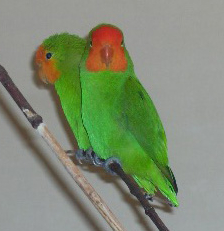
Characterized by its bright red head, the Red-headed Lovebird features a contrasting green body that aids in camouflage among the leaves. Adult plumage exhibits a vivid red on the forehead, cheeks, and throat, while the rest of the body is predominantly green with a slight yellowish tinge on the underparts. Juveniles, in contrast, are paler with less pronounced red coloration, making them less conspicuous. Sexual dimorphism is not prominent, although females may have slightly duller hues compared to their male counterparts. This lovebird might be confused with the Red-faced Lovebird; however, the Red-headed Lovebird's distinctive red head provides a clear differentiator. In flight, the Red-headed Lovebird exhibits agile and swift movements, with a rounded tail and rapid wingbeats. When perching, it often sits upright with a slightly forward-leaning posture, facilitating quick takeoffs if threatened.
Having trouble telling birds apart? Upload a photo to our bird identification tool for an instant species match.
Red-headed Lovebird Habitat and Range
Preferred Habitat
The Red-headed Lovebird primarily inhabits lowland tropical forests, often found at elevations ranging from sea level up to 1,500 meters. It prefers regions with dense tree cover and abundant fruiting trees, such as those found in the Congo Basin. While primarily a forest species, it can also be spotted in wooded savannas and forest edges, where it forages for food. Unlike some other parrots, it rarely ventures into urban areas, preferring the tranquility and resources of rural and wild environments. Seasonal habitat shifts occur minimally, primarily driven by the availability of food sources rather than temperature variations.
Geographic Range
The Red-headed Lovebird’s range spans several central African countries, with breeding populations concentrated in Ghana, Cameroon, and the Democratic Republic of Congo. It does not engage in long-distance migrations, maintaining a relatively stable presence year-round within its preferred habitats. Populations are densest in areas where primary forests and secondary growth provide ample food and nesting opportunities. The bird's range does not extend beyond Africa, making it an endemic species to the continent.
Want to know which birds visit your area? Browse our backyard birds by location guides for region-specific species lists.
What Does the Red-headed Lovebird Eat?
The diet of the Red-headed Lovebird consists mainly of seeds, fruits, and berries, with a preference for figs and other native fruits. Seasonal changes influence its diet, as certain fruits become more abundant during specific times of the year. Foraging typically occurs in the early morning and late afternoon, when the birds are most active. They employ a methodical technique, using their strong beaks to crack open seeds and access the nutritious contents. Occasionally, they may feed on insects and larvae, particularly during the breeding season when protein demand increases.
Red-headed Lovebird Behavior and Social Structure
As highly social creatures, Red-headed Lovebirds form monogamous pairs that remain together throughout the year. These pairs often join small flocks, sometimes numbering up to 20 individuals, fostering a communal atmosphere. Territorial behavior is mild, with aggressive displays being rare. Courtship involves mutual preening and gentle nibbling, strengthening the bond between mates. In the presence of predators, such as hawks or eagles, the lovebirds emit loud alarm calls, seeking refuge in dense foliage. Daily activities are predominantly diurnal, with peak foraging and social interactions occurring in the cooler hours of the day.
Red-headed Lovebird Nesting and Reproduction
Red-headed Lovebirds nest in tree cavities, often selecting sites high above the ground to minimize predation risks. They utilize a variety of materials for nest construction, including leaves, bark, and twigs. A typical clutch consists of 3-5 eggs, with an incubation period of approximately 23 days. Both parents share responsibilities, with the female primarily incubating the eggs while the male forages for food. Fledging occurs around 42 days post-hatching, with young birds staying close to their parents for several weeks thereafter. The species typically raises one or two broods per year, depending on environmental conditions.
Red-headed Lovebird Sounds and Vocalizations
The primary song of the Red-headed Lovebird is a series of high-pitched, melodious chirps that vary in rhythm and intensity. Call notes are sharp and piercing, often serving as alerts or communication between mates. Alarm calls are louder and more urgent, designed to warn the flock of approaching threats. During the dawn chorus, these lovebirds add a harmonious layer to the soundscape, their calls blending with those of other forest dwellers.
Interesting Facts About the Red-headed Lovebird
- 1Red-headed Lovebirds can live up to 20 years in the wild, a testament to their resilience in natural habitats.
- 2These lovebirds are known to use their beaks and feet skillfully when foraging, showcasing impressive dexterity.
- 3During courtship, pairs engage in a unique dance, involving synchronized movements and mutual feeding.
- 4Red-headed Lovebirds have a strong preference for figs, which make up a significant portion of their diet.
- 5They have been observed using leaves to line their nests, a behavior that demonstrates their resourcefulness.
- 6The species' vocalizations are so loud that they can be heard from over a mile away in dense forests.
- 7Despite their vibrant colors, Red-headed Lovebirds blend well with their surroundings, aiding in predator avoidance.
Red-headed Lovebird Conservation Status
The Red-headed Lovebird is currently classified as Least Concern by the IUCN, with a stable population trend. However, habitat destruction and the illegal pet trade pose significant threats. Conservation efforts focus on habitat preservation and stricter enforcement of wildlife trade regulations. Historical data indicate a moderate decline in some areas due to deforestation, emphasizing the need for continuous monitoring and conservation action.


