
Red-headed Malimbe
Malimbus rubricollis
Order: Passeriformes / Family: Ploceidae
Wikimedia Commons
About the Red-headed Malimbe
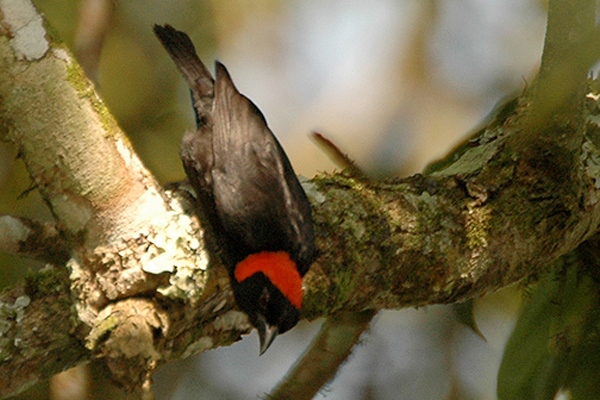
The Red-headed Malimbe (Malimbus rubricollis) is a visually striking bird known for its vibrant crimson head contrasted with a predominantly black body. As a member of the family Ploceidae, it is closely related to weavers, sharing their complex social behaviors and intricate nesting abilities. The Red-headed Malimbe thrives in the dense forests of sub-Saharan Africa, particularly in countries like Nigeria, Ghana, and Cameroon, where it plays a vital role in the ecosystem as both a seed disperser and insect predator.
In the lush canopies of West and Central African forests, the Red-headed Malimbe makes its home. This species is particularly drawn to secondary growth and forest edges, where it can often be seen foraging in small groups or family units. The bird's preference for such habitats makes it a key player in maintaining the biodiversity of these regions, as it helps control insect populations and facilitate seed dispersal through its diet.
Seasonally, the Red-headed Malimbe's behavior adapts to the availability of food resources. During the rainy season, when insect abundance is at its peak, these birds become more active and visible as they forage relentlessly. Conversely, in the drier months, they may rely more heavily on fruits and seeds, showcasing their adaptability and resilience. The species' vibrant plumage and active foraging make it a favorite among birdwatchers visiting African forests.
Ecologically, the Red-headed Malimbe plays a significant role in its environment. As an insectivore, it helps control the populations of various insect species, some of which are agricultural pests. Furthermore, by consuming fruits and seeds, the Malimbe aids in the dispersal of several plant species, promoting forest regeneration and health. This interconnectedness highlights the bird's importance in sustaining the biodiversity of its native habitats.
The Red-headed Malimbe belongs to the family Ploceidae, within the order Passeriformes. These birds typically live average 5-7 years, with some reaching up to 9 years..
How to Identify a Red-headed Malimbe
The adult Red-headed Malimbe is unmistakable due to its bright red head and nape, which sharply contrast with its glossy black body and wings. Its plumage provides excellent camouflage among the red flowers and fruits it frequents in its forest habitat. Juveniles, on the other hand, display a more subdued coloration, with a duller red head and brownish-black body, making them less conspicuous.
Sexual dimorphism is subtle in this species, with males generally exhibiting slightly more intense red coloration on the head. In terms of size, the Red-headed Malimbe measures approximately 18-20 cm in length, with a wingspan of about 28-30 cm, making it a medium-sized songbird. Its slender build, coupled with its agile movements, aids in navigating the complex forest environments it inhabits.
Confusion with other species can occur, particularly with other Malimbes. However, the Red-headed Malimbe's distinctive head coloration and vocalizations often help in accurate identification. In flight, the bird displays a rapid, undulating pattern typical of many Ploceidae, while its perch posture is often upright and alert, allowing it to quickly react to potential threats or opportunities for foraging.
Having trouble telling birds apart? Upload a photo to our bird identification tool for an instant species match.
Red-headed Malimbe Habitat and Range
Preferred Habitat
The Red-headed Malimbe is primarily associated with tropical and subtropical moist broadleaf forests. It thrives in lowland rainforests, particularly in secondary growth and forest edges where its preferred feeding grounds are abundant. These habitats offer the bird a rich supply of insects and fruits, crucial for its diet.
The species is found at elevations ranging from sea level up to about 1500 meters. While it predominantly inhabits rural and less disturbed areas, it can occasionally be spotted in urban parks and gardens, especially where mature trees provide shelter and feeding opportunities.
Seasonal habitat shifts are minimal, as the Red-headed Malimbe is largely sedentary and non-migratory. However, it may move locally within its range to exploit food resources more effectively. Its adaptability to various forest types, including degraded areas, highlights its resilience in the face of habitat changes.
Geographic Range
The Red-headed Malimbe's range extends across much of West and Central Africa. It is commonly found in countries such as Nigeria, Cameroon, Ghana, and the Ivory Coast. These regions host the dense forests and secondary growth areas that the species favors.
This bird's breeding range is largely confined to these humid forested areas, where it remains throughout the year. Unlike many other bird species, the Red-headed Malimbe does not undertake long-distance migrations. Instead, it may exhibit local movements within its range to follow food availability.
Population density is typically higher in regions with abundant food supplies and suitable nesting sites. The bird's range overlaps with various protected areas and national parks, where conservation efforts help maintain its habitat. While its range is relatively stable, deforestation and habitat fragmentation pose ongoing challenges to its continued presence in some areas.
Want to know which birds visit your area? Browse our backyard birds by location guides for region-specific species lists.
What Does the Red-headed Malimbe Eat?
The diet of the Red-headed Malimbe primarily consists of insects and other small invertebrates. It forages actively in the forest canopy and understory, using its sharp bill to glean insects from leaves and bark. Common prey items include beetles, ants, and caterpillars, which provide essential protein and nutrients.
During the rainy season, when insect populations boom, the Red-headed Malimbe focuses heavily on this food source. In drier periods, it shifts its diet to include more fruits and seeds, demonstrating its dietary flexibility. This adaptation is crucial for survival in environments where food availability fluctuates seasonally.
The bird employs a variety of foraging techniques, often seen hopping and flitting agilely between branches as it searches for food. It may also join mixed-species foraging flocks, taking advantage of the collective vigilance and increased foraging efficiency these groups provide.
Red-headed Malimbe Behavior and Social Structure
The Red-headed Malimbe exhibits complex social behaviors typical of the Ploceidae family. It often forms small flocks, particularly during the non-breeding season, enhancing foraging success and predator detection. These flocks can include other bird species, creating a dynamic and interactive community.
Territoriality is most prominent during the breeding season, when pairs establish and defend nesting sites from intruders. Males perform intricate courtship displays to attract females, involving wing flicking and singing. These displays serve both to attract mates and to reinforce pair bonds.
In response to predators, the Red-headed Malimbe employs alarm calls and mobbing behavior. It frequently uses its agility and quick reflexes to evade aerial and terrestrial threats. The bird's daily activity pattern includes periods of intense foraging during the early morning and late afternoon, with rest and preening taking place during the hotter midday hours.
Red-headed Malimbe Nesting and Reproduction
The nesting habits of the Red-headed Malimbe are fascinating and complex. It constructs woven nests from grass, plant fibers, and twigs, skillfully suspended from branches high in the forest canopy. These nests resemble elongated bags with a side entrance, providing security from predators.
Nesting sites are chosen based on both safety and proximity to abundant food sources. The female typically lays a clutch of 2-3 eggs, which she incubates for about 14-16 days. Both parents play active roles in feeding and caring for the chicks, ensuring a high chance of fledgling success.
Chicks fledge approximately 18-21 days after hatching, though they remain dependent on parental care for some time. The Red-headed Malimbe may raise 1-2 broods per year, depending on food availability and environmental conditions. This species' nesting behavior underscores its adaptability and resourcefulness in diverse forest habitats.
Red-headed Malimbe Sounds and Vocalizations
The primary song of the Red-headed Malimbe is a series of melodious, rhythmic whistles that vary in pitch and intensity. These songs serve to establish territory and attract mates, often performed from prominent perches within the bird's range.
Its call notes are sharp and distinctive, often described as 'tsee-tsee' sounds. These calls are used for communication between flock members and as alarm signals in the presence of predators.
During the dawn chorus, the Red-headed Malimbe's voice joins that of other forest birds, creating a rich tapestry of sounds that fills the air. Its vocalizations, while not as loud or complex as some other species, are nonetheless a vital component of its social interactions and environmental awareness.
Interesting Facts About the Red-headed Malimbe
- 1The Red-headed Malimbe's nests are architectural marvels, intricately woven to withstand the elements.
- 2Despite its vivid plumage, the Red-headed Malimbe is adept at avoiding predators through its agile movements.
- 3This bird is a skilled insect hunter, consuming a variety of invertebrates that help control pest populations.
- 4Red-headed Malimbes often join mixed-species flocks, enhancing their foraging success and predator vigilance.
- 5The species' adaptability to secondary growth areas aids in its survival amid habitat changes.
Red-headed Malimbe Conservation Status
The Red-headed Malimbe is currently listed as Least Concern by the IUCN, with a stable population trend across its range. Despite its relative abundance, the species faces threats from habitat loss due to deforestation and agricultural expansion. Conservation efforts focus on preserving forest habitats and promoting sustainable land-use practices. Protected areas and national parks in countries like Nigeria and Ghana play crucial roles in safeguarding the bird's habitat. Historically, the Red-headed Malimbe has shown resilience in adapting to secondary forests and disturbed habitats, which has helped maintain its population levels. Continued conservation attention is necessary to ensure its long-term survival in the face of ongoing environmental changes.
Other Ploceidae Species



Birds Similar to the Red-headed Malimbe
These species are often confused with the Red-headed Malimbe due to similar appearance or overlapping range.

