
Red-pate Cisticola
Cisticola ruficeps
Order: Passeriformes / Family: Cisticolidae
Wikimedia Commons
About the Red-pate Cisticola
The Red-pate Cisticola, scientifically known as Cisticola ruficeps, is a small, energetic songbird belonging to the family Cisticolidae. This bird inhabits a range of open grassland environments across sub-Saharan Africa, particularly favoring areas with tall grasses and scattered shrubs. It plays an essential ecological role by controlling insect populations and serving as a prey species for larger birds. The Red-pate Cisticola is especially notable for its adaptability to various grassland habitats, including savannas and agricultural fields. Its presence is a good indicator of healthy grassland ecosystems.
Throughout the year, the Red-pate Cisticola demonstrates intriguing seasonal behaviors. During the breeding season, which varies geographically but generally occurs during the rainy months, these birds become more conspicuous as males engage in elaborate display flights and vocalizations to attract mates. Outside of the breeding season, they tend to be more secretive, foraging close to the ground and relying on their cryptic plumage for concealment. Their adaptability to different grassland types allows them to thrive in both natural and human-modified landscapes, making them a common sight across their range.
Ecologically, the Red-pate Cisticola contributes to the health of its habitat by participating in seed dispersal and providing a food source for predators. This species has adapted to various disturbance regimes, often benefiting from moderate grazing and fire regimes that maintain open grassland structure. As a result, the Red-pate Cisticola is not only a resilient species but also an important indicator of grassland ecosystem dynamics.
The Red-pate Cisticola belongs to the family Cisticolidae, within the order Passeriformes. These birds typically live average 3-4 years with a maximum recorded of 6 years.
How to Identify a Red-pate Cisticola
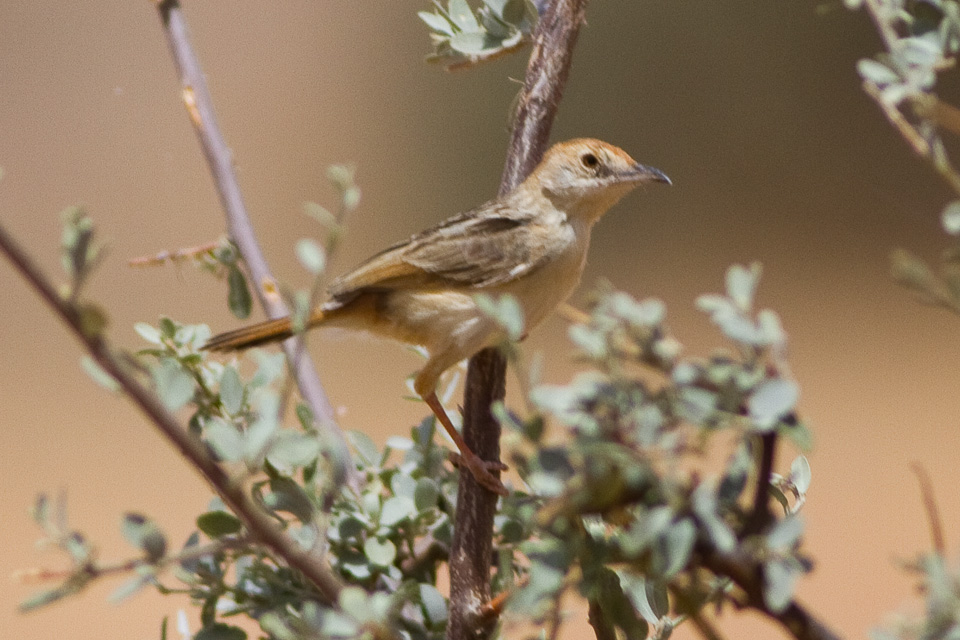
Identifying the Red-pate Cisticola involves noting its striking rufous crown, from which it derives its common name. Adult Red-pate Cisticolas display a warm brown back with subtle streaking, while their underparts are a pale buff, often appearing somewhat washed out. The sides of their heads are marked with a faint, broken eye-ring, and their tails are relatively short, often flicked upwards when perched. Males and females show little sexual dimorphism, being similar in plumage, although males may appear slightly brighter during the breeding season.
Juvenile Red-pate Cisticolas resemble adults but tend to have a more muted coloration, lacking the distinct vibrancy of the adults' crown. They also feature more pronounced streaking on their backs, which provides additional camouflage in their grassy habitats. In flight, the Red-pate Cisticola's silhouette is characterized by rapid, jerky wing beats and a slightly undulating flight pattern.
In terms of confusion with similar species, the Zitting Cisticola (Cisticola juncidis) might pose an identification challenge due to its widespread presence in similar habitats. However, the Zitting Cisticola typically lacks the distinctive bright red crown of the Red-pate Cisticola. Observing their behaviors, such as the characteristic tail flicking and flight patterns, aids in distinguishing the Red-pate Cisticola from its relatives.
Having trouble telling birds apart? Upload a photo to our bird identification tool for an instant species match.
Red-pate Cisticola Habitat and Range
Preferred Habitat
The Red-pate Cisticola prefers open grassland habitats, often with tall grasses and sparse shrubbery. They are commonly found in savannas, light woodlands, and agricultural fields. This species can thrive at varying elevations, from sea level to highland regions reaching up to 2,000 meters. Seasonal shifts in habitat preference occur, with these birds showing a tendency to move to denser vegetation during the non-breeding season for better protection from predators.
In urban and rural landscapes, the Red-pate Cisticola adapts well, often seen in overgrown pastures, along roadsides, and in fallow agricultural land. Despite their adaptability, they are less commonly found in densely forested areas, as they prefer the open environments where their foraging and nesting habits are best suited. Their presence in urban edges and rural farmland is a testament to their ability to coexist with human activities, provided that these areas maintain sufficient grass cover.
Geographic Range
The Red-pate Cisticola boasts an extensive range across sub-Saharan Africa. It is a resident breeder in countries such as Nigeria, Tanzania, and South Africa, with populations also found in the Democratic Republic of the Congo, Kenya, and Ethiopia. While not migratory in the traditional sense, some local movements occur in response to changes in rainfall and grassland conditions.
During the breeding season, these birds are more frequently observed in higher densities within optimal grassland habitats, particularly in regions with regular rainfall patterns that promote lush vegetation. These areas include the Serengeti in Tanzania and the savannas of southern Africa. Outside the breeding season, the Red-pate Cisticola may shift to areas where grass cover remains sufficient, ensuring continued access to food and suitable shelter.
Population density hotspots include regions with a mixture of native grassland and agricultural land, where these adaptable birds can exploit the varying resources. While they are not considered migratory, their ability to move across the landscape to find suitable habitats makes them less vulnerable to localized habitat changes.
Want to know which birds visit your area? Browse our backyard birds by location guides for region-specific species lists.
What Does the Red-pate Cisticola Eat?
The diet of the Red-pate Cisticola primarily consists of insects and other small invertebrates, which they actively forage for among the grasses. Grasshoppers, beetles, and caterpillars constitute the bulk of their diet. Their foraging activity is most intense during the early morning and late afternoon, when insect activity peaks.
In addition to insects, they occasionally consume seeds, particularly during the dry season when insect availability decreases. This dietary flexibility helps them endure periods of scarcity and maintain their populations across diverse environments.
The Red-pate Cisticola employs a foraging technique characterized by quick, darting movements through grasses and low shrubs, often hanging upside down to reach prey. They show a preference for foraging on the ground or in the lower strata of vegetation, where their cryptic plumage provides effective camouflage from predators. This opportunistic feeding strategy allows them to exploit a variety of prey sizes, from small ants to larger grasshoppers, depending on availability.
Red-pate Cisticola Behavior and Social Structure
Socially, the Red-pate Cisticola often forms small, loose groups outside of the breeding season, although they are primarily seen in pairs during the breeding period. Males become territorial during this time, performing complex aerial displays to deter rivals and attract females. These displays involve a series of steep ascents and descents accompanied by distinctive vocalizations.
The Red-pate Cisticola is generally non-migratory, remaining within its established territory year-round. However, they may shift their locations slightly in response to changing environmental conditions, such as the availability of food and nesting sites. When threatened by predators, these birds rely on their cryptic plumage and swift flight to evade capture.
Daily activity patterns include intensive morning and late afternoon foraging sessions, with periods of rest and preening during the hotter midday hours. Their vocal communications are complex, consisting of a variety of calls and songs used to maintain contact between mates and signal alarm. These vocalizations are particularly prominent during dawn and dusk, when the birds are most active.
Red-pate Cisticola Nesting and Reproduction
The Red-pate Cisticola constructs its nest close to the ground, typically in dense grass or low shrubs. The nest is a cleverly woven cup made from grass and lined with softer materials such as plant down or feathers. This structure provides excellent camouflage from predators.
A typical clutch consists of 2 to 4 eggs, with the female primarily responsible for incubation, which lasts approximately 11 to 13 days. Both parents participate in feeding the chicks, which fledge about 10 to 14 days after hatching. The Red-pate Cisticola often raises two broods per year, taking advantage of the abundant resources available during the rainy season.
The proximity of nests to the ground makes them vulnerable to predation, and the parents are known to employ distraction displays to lead potential threats away from the nesting site. The role of both parents in feeding and protecting the young underscores the cooperative breeding strategies of this species.
Red-pate Cisticola Sounds and Vocalizations
The primary song of the Red-pate Cisticola is a rhythmic series of high-pitched notes, often described as a repetitive 'tsip-tsip-tsip' that accelerates towards the end. This song is frequently delivered during display flights and serves as both a territorial proclamation and courtship lure.
Call notes include sharp 'tik' sounds used for communication between mates and within family groups. Alarm calls are harsher and more rapid, alerting others to the presence of predators. During the dawn chorus, the Red-pate Cisticola's song is a prominent feature of the soundscape, often joined by other grassland species.
The vocal repertoire of the Red-pate Cisticola is extensive, reflecting its social nature and the complex dynamics of its environment. Its song and calls are effective tools for maintaining territory and facilitating social interactions within its habitat.
Interesting Facts About the Red-pate Cisticola
- 1The Red-pate Cisticola's intricate nests are often lined with spider silk, providing additional strength and flexibility.
- 2Despite their small size, Red-pate Cisticolas are known for their loud and complex vocalizations, which can be heard over long distances.
- 3Their breeding season coincides with the rainy season, ensuring ample food supply for their chicks.
- 4Red-pate Cisticolas can adjust their nesting height from 20 to 60 cm above the ground, depending on grass height.
- 5They exhibit a unique behavior known as 'foot-quivering' to flush insects from the grass, making them easier to catch.
- 6The species has over 30 recognized subspecies, each adapted to specific regional habitats across Africa.
- 7Red-pate Cisticolas are sometimes referred to as 'grass warblers' due to their preference for grassy habitats.
Red-pate Cisticola Conservation Status
Currently, the Red-pate Cisticola holds a status of Least Concern according to the IUCN Red List. Its population trend remains stable, owing to its adaptability to various grassland environments and tolerance of moderate habitat disturbance. However, ongoing threats include habitat loss due to agricultural expansion and overgrazing, which can lead to a reduction in suitable nesting and foraging sites. Conservation efforts focus on preserving grassland ecosystems, ensuring sustainable land management practices that maintain habitat quality. Historical population data indicate that the Red-pate Cisticola has maintained stable numbers, benefiting from its ability to exploit both natural and altered landscapes. To ensure the continued survival of this species, conservationists emphasize the importance of habitat preservation and the implementation of agricultural practices that support biodiversity. By promoting awareness and engaging local communities in conservation initiatives, the Red-pate Cisticola can continue to thrive in its diverse habitats.


