
Restless Flycatcher
Myiagra inquieta
Order: Passeriformes / Family: Monarchidae
Wikimedia Commons
About the Restless Flycatcher
The Restless Flycatcher (Myiagra inquieta) belongs to the family Monarchidae under the order Passeriformes. This small, agile songbird displays a remarkable adaptability to various habitats across Australia. Unlike many other avian species, the Restless Flycatcher thrives in both natural and modified environments, including woodlands, forests, and even urban areas. Its adaptability plays a crucial role in its widespread presence throughout the continent.
The Restless Flycatcher primarily inhabits southeastern and eastern Australia, with its range extending from Cape York down to Tasmania. This bird is known for its distinctive vocalizations, most notably a peculiar, mechanical-sounding call that resembles a motorized whirring. These calls play an essential role in communication, especially during the breeding season.
Ecologically, the Restless Flycatcher contributes significantly to insect population control. As an insectivorous species, it employs a unique foraging technique known as 'hawking,' where it captures insects mid-flight. Its quick, darting movements and keen eyesight make it an effective predator, helping to maintain a balance in various ecosystems. Seasonal behaviors of the Restless Flycatcher include local migrations to more favorable climates during the winter months and returning to breeding territories in the spring.
The Restless Flycatcher's significance extends beyond its immediate environment. Its presence in urban areas provides opportunities for birdwatchers and nature enthusiasts to observe and appreciate the diversity of avian life even in developed regions. Its adaptability and resilience highlight the broader ecological roles birds play in both natural and human-altered landscapes.
The Restless Flycatcher belongs to the family Monarchidae, within the order Passeriformes. These birds typically live average 5-8 years, with a maximum recorded of 10 years..
How to Identify a Restless Flycatcher
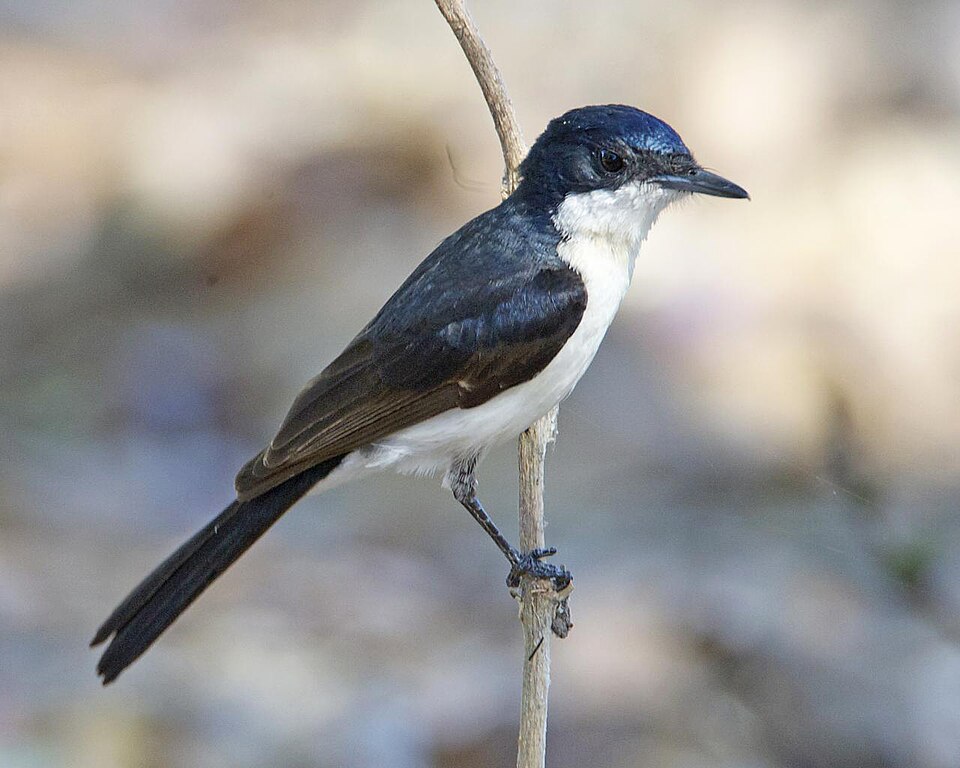
The Restless Flycatcher is a small bird, measuring about 16-19 cm in length with a wingspan of approximately 26-28 cm. Its plumage is characterized by a striking contrast between the glossy blue-black upperparts and the white underparts, creating a distinctive appearance. The head, throat, and upper chest are blue-black, while the lower chest and belly are pure white, making it relatively easy to identify in its native habitats.
Juvenile Restless Flycatchers differ slightly from adults, possessing a more subdued plumage with brownish tones replacing the glossy blue-black seen in mature birds. This difference can sometimes lead to confusion with similar species, such as the Satin Flycatcher. However, a closer examination of the Restless Flycatcher's more pronounced white belly and unique call can help in accurate identification.
Males and females appear similar, though the male often exhibits slightly more vibrant coloration. In flight, the Restless Flycatcher displays rapid, agile movements, with a flight silhouette that includes a relatively short tail and pointed wings. When perching, it often appears alert and active, frequently flicking its wings and tail, a behavior that is a useful field mark for identification.
Having trouble telling birds apart? Upload a photo to our bird identification tool for an instant species match.
Restless Flycatcher Habitat and Range
Preferred Habitat
The Restless Flycatcher inhabits a wide range of habitats, showcasing its adaptability. Commonly found in open forests and woodlands, it also frequents riparian zones and mangrove areas. These birds thrive in eucalypt forests and acacia-dominated woodlands, where they forage for insects.
While they prefer lower elevations, Restless Flycatchers can be observed up to 1000 meters in some regions. In urban environments, they adapt to parks and gardens, taking advantage of planted trees and shrubs. Seasonal habitat shifts occur as the Restless Flycatcher moves towards coastal areas during colder months, searching for milder climates and abundant food sources.
The presence of this species in both rural and urban settings highlights its adaptability and resilience, making it a familiar sight across much of its range. Despite its broad adaptability, the Restless Flycatcher tends to avoid dense, closed-canopy forests, preferring more open areas where it can effectively hunt for insects.
Geographic Range
The breeding range of the Restless Flycatcher primarily encompasses southeastern and eastern Australia. It is found from Cape York Peninsula in the north down to Victoria and Tasmania in the south. During the breeding season, this bird establishes territories in open forests and woodlands, favoring regions with abundant insect life.
In the non-breeding season, Restless Flycatchers exhibit local migratory behavior, often moving towards coastal areas where conditions are milder. They are absent from the arid interior of Australia, favoring instead the more temperate and tropical regions where food is more readily available year-round.
Population density tends to be higher in areas with suitable habitat such as eucalypt and acacia woodlands. While they are primarily sedentary, some individuals undertake partial migrations, especially those residing on the fringes of their range where seasonal changes in temperature and food availability prompt movement.
Want to know which birds visit your area? Browse our backyard birds by location guides for region-specific species lists.
What Does the Restless Flycatcher Eat?
The Restless Flycatcher primarily feeds on insects, employing a hunting technique known as 'hawking.' This involves capturing prey mid-air with swift, acrobatic flights. Their diet includes a variety of flying insects such as beetles, flies, and wasps. Occasionally, they may also feed on spiders and small invertebrates found on foliage.
Seasonal changes influence the Restless Flycatcher's diet. During warmer months, when insect abundance peaks, they exhibit increased foraging activity, often seen darting through the air or sallying from perches to snatch prey. In colder months, their diet may shift slightly as they exploit different insect types available in coastal and riparian habitats.
The size of prey consumed by the Restless Flycatcher varies but generally includes small to medium-sized insects. Their feeding schedule is mostly diurnal, with heightened activity in the early morning and late afternoon when insects are most active. This efficient foraging behavior underscores their role in controlling insect populations within their habitats.
Restless Flycatcher Behavior and Social Structure
Restless Flycatchers exhibit a range of intriguing behaviors, particularly during the breeding season. They are typically solitary or found in pairs, establishing and defending territories through vocalizations and displays. Their territorial behavior is most pronounced during breeding, where they actively chase away intruders.
Courtship involves a series of elaborate displays, with males performing aerial acrobatics and singing to attract females. Once paired, they exhibit strong pair bonds, working cooperatively during nesting and chick-rearing. Outside the breeding season, these birds may form small, loose flocks, especially when migrating or in areas with abundant food resources.
In terms of predator response, Restless Flycatchers rely on their agility and vocal alarms to alert nearby birds of potential threats. They show a preference for perching in open, elevated locations, providing a vantage point to spot predators and prey alike. Their daily activities include periods of rest interspersed with vigorous foraging, with peak activity observed during cooler parts of the day.
Restless Flycatcher Nesting and Reproduction
Restless Flycatchers construct cup-shaped nests composed of grasses, bark strips, and spider webs, creating a sturdy yet lightweight structure. Nests are typically situated on horizontal branches or in tree forks, often 2-10 meters above the ground, providing protection from ground predators.
The clutch size ranges from 2 to 3 eggs, which are incubated primarily by the female for about 14-16 days. During this period, the male assists by bringing food to the incubating female. Once hatched, both parents take part in feeding the chicks and maintaining the nest.
The fledging period lasts approximately 14-16 days, after which the young birds leave the nest but remain dependent on their parents for several weeks. Restless Flycatchers may produce up to two broods per year, particularly in regions where conditions remain favorable throughout the breeding season.
Restless Flycatcher Sounds and Vocalizations
The Restless Flycatcher is renowned for its unique vocalizations, particularly its primary song, which resembles a mechanical, whirring sound. This distinctive call, often likened to a 'scissor-grinder' or 'motorized whir,' serves multiple purposes, including mate attraction and territorial defense.
In addition to its primary song, the Restless Flycatcher emits a variety of call notes, including sharp, metallic 'tick' sounds and softer, conversational chirps used in social interactions. Alarm calls are more rapid and higher-pitched, designed to alert others to potential threats.
During the dawn chorus, the Restless Flycatcher's mechanical song can be heard echoing through its habitat, contributing to the symphony of sounds that characterize early morning in Australian woodlands. These vocalizations are not only crucial for communication but also aid birdwatchers in locating and identifying this species in the field.
Interesting Facts About the Restless Flycatcher
- 1The Restless Flycatcher's unique call is often described as sounding like a 'scissor-grinder' due to its mechanical quality.
- 2This bird is also known as the 'razor grinder' or 'dishlicker' in reference to its peculiar vocalizations.
- 3Restless Flycatchers use spider webs not only for nest construction but also to help secure their nests to branches.
- 4They exhibit a behavior called 'wing-quivering,' where they shake their wings rapidly while perched, possibly to startle prey.
- 5The Restless Flycatcher can hover in place, a behavior uncommon in most flycatchers, allowing it to catch insects in mid-air.
- 6Despite their adaptability, Restless Flycatchers are rarely found in dense rainforests, preferring more open habitats.
- 7Their mechanical-sounding song can often be heard during the dawn chorus, adding a distinctive note to the morning symphony.
Restless Flycatcher Conservation Status
The Restless Flycatcher is currently listed as Least Concern on the IUCN Red List, indicating a stable population trend across its range. Its adaptability to various habitats, including modified landscapes, contributes to its resilience and widespread distribution. Despite this stable status, the Restless Flycatcher faces potential threats from habitat destruction and fragmentation, particularly in regions undergoing urban expansion and agricultural development. Conservation efforts focus on preserving natural habitats and promoting biodiversity-friendly practices in urban planning. Historically, the Restless Flycatcher has maintained a relatively stable population, although localized declines have occurred due to habitat loss. Continued monitoring and conservation initiatives will be essential to ensure this species remains secure in its natural habitats.


