
Ring-necked Francolin
Scleroptila streptophora
Order: Galliformes / Family: Phasianidae
Wikimedia Commons
About the Ring-necked Francolin
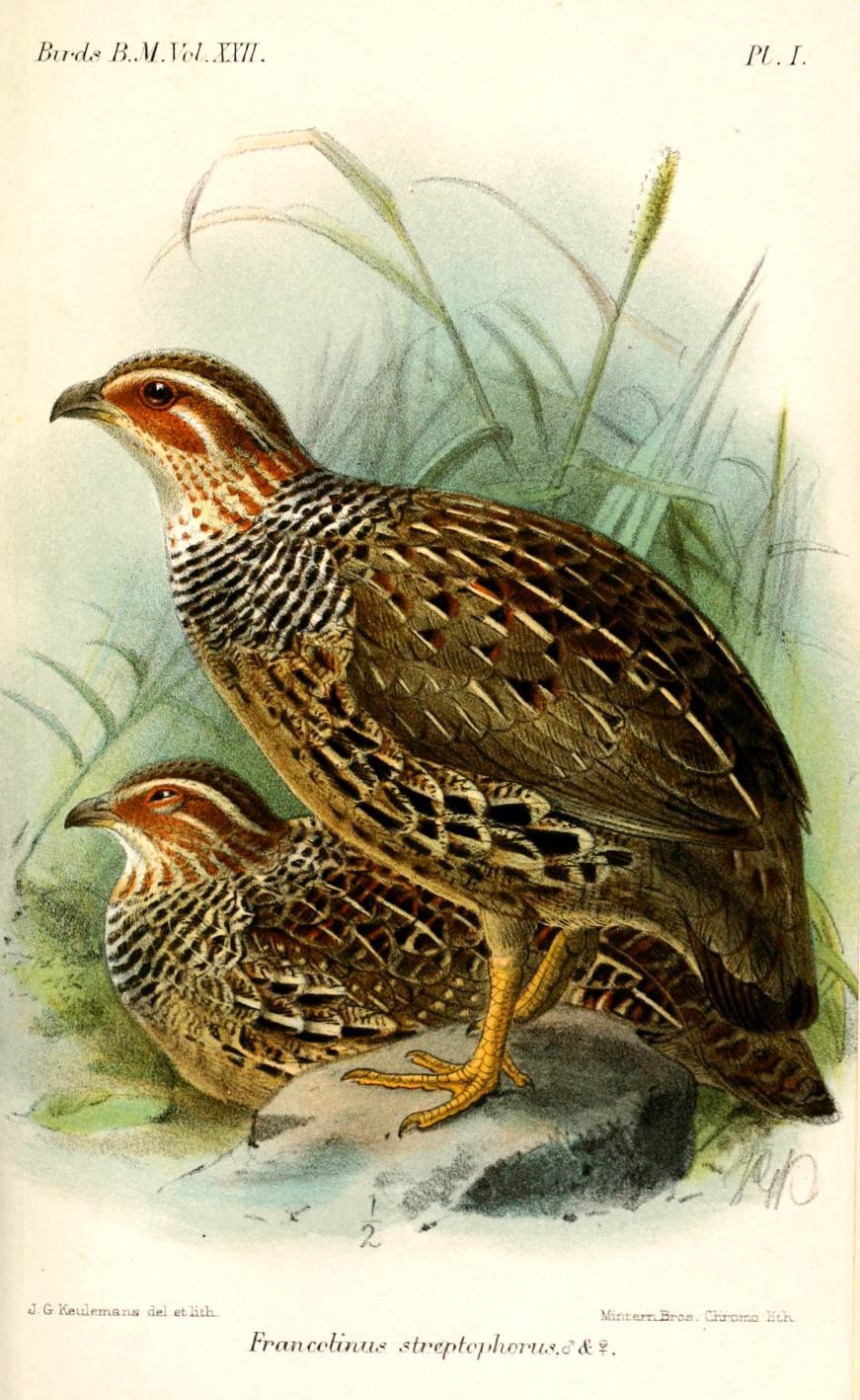
The Ring-necked Francolin (Scleroptila streptophora) is a medium-sized bird found predominantly in the grasslands and savannas of sub-Saharan Africa. This species plays a significant role in its ecosystem, acting as both predator and prey within its environment. Francolins are known for their robust bodies and strong legs, adapted for foraging on the ground. The Ring-necked Francolin's distinctive plumage helps it blend seamlessly into its surroundings, providing both camouflage from predators and an advantage when ambushing unsuspecting invertebrates and seeds. The bird is most commonly observed in countries like Kenya, Tanzania, and Uganda, where it thrives in open grassland habitats and occasionally ventures into cultivated areas. During the breeding season, typically aligned with the rainy season, males become more vocal and territorial, often engaging in elaborate displays to attract mates. The Ring-necked Francolin's ecological role cannot be understated, as it helps control insect populations and disperses seeds, contributing to the health of its habitat. Its presence indicates a healthy, balanced ecosystem, as it requires specific habitat conditions to thrive. Observing the seasonal behaviors of this francolin offers insights into the broader ecological patterns within its range. As the seasons change, so too does its behavior, adapting to the availability of food and the demands of breeding and raising young.
The Ring-necked Francolin belongs to the family Phasianidae, within the order Galliformes. These birds typically live 6-8 years in the wild.
How to Identify a Ring-necked Francolin
The Ring-necked Francolin stands out with its characteristic neck band, a striking feature that contrasts with its otherwise mottled brown and gray plumage. Adult males and females are similar in size, though males may exhibit slightly brighter coloration. The body is predominantly brown with intricate white and black barring, providing excellent camouflage in its grassy habitat. Juveniles resemble adults but are duller and lack the full development of the neck band seen in mature individuals. Differentiating between males and females can be challenging, but males tend to have longer spurs on their legs, a trait often used in territorial disputes. In flight, the Ring-necked Francolin displays a robust silhouette with rounded wings and a short tail, features that help distinguish it from similar species. When perched, it adopts a horizontal posture, its strong legs and compact body clearly visible. It's important to note the difference in call between this species and other francolins, as vocalizations are a key identification tool.
Having trouble telling birds apart? Upload a photo to our bird identification tool for an instant species match.
Ring-necked Francolin Habitat and Range
Preferred Habitat
The Ring-necked Francolin inhabits open grasslands, savannas, and occasionally agricultural areas. It prefers regions with a mix of tall grasses and scattered shrubs, providing both cover and foraging opportunities. This species is typically found at elevations ranging from sea level up to 2,500 meters, depending on the availability of suitable habitat. Seasonal shifts in habitat use are observed, particularly during the breeding season when francolins may move to areas with denser vegetation for nesting. Unlike some other francolin species, the Ring-necked Francolin is not commonly found in urban areas, as it requires expansive natural habitats to thrive. Its presence in rural settings is more common, especially in regions where traditional farming practices maintain a mosaic of habitats.
Geographic Range
The Ring-necked Francolin's range encompasses much of sub-Saharan Africa, with populations concentrated in East Africa, including Kenya, Tanzania, and Uganda. It is a resident bird, with no significant migration patterns observed, though some local movements may occur in response to seasonal changes in food availability and breeding conditions. The species is generally widespread within its range, though population densities can vary significantly depending on habitat quality and human disturbance. In some areas, the francolin is common, while in others, it may appear more sporadically, reflecting the patchy nature of its preferred habitats.
Want to know which birds visit your area? Browse our backyard birds by location guides for region-specific species lists.
What Does the Ring-necked Francolin Eat?
The Ring-necked Francolin's diet consists primarily of seeds, grains, and small invertebrates, reflecting its adaptability to various food sources. During the wet season, when insects are more abundant, the francolin's diet shifts to include a higher proportion of invertebrates such as beetles and ants, providing the protein necessary for breeding and rearing young. Foraging occurs primarily on the ground, where the bird uses its strong legs and beak to scratch through leaf litter and soil in search of food. The francolin also consumes small fruits and shoots, contributing to seed dispersal in its ecosystem. Feeding typically occurs in the early morning and late afternoon, taking advantage of cooler temperatures and reduced predator activity.
Ring-necked Francolin Behavior and Social Structure
The Ring-necked Francolin is a social species, often seen in small groups or family units, particularly outside the breeding season. During the breeding season, males become highly territorial, engaging in vocal displays to establish dominance and attract mates. These displays include a series of loud, repetitive calls that echo across the landscape, as well as physical posturing and the occasional confrontation with rival males. Francolins exhibit a strong flight response to predators, relying on their speed and agility to escape threats. They are primarily active during the day, with peak activity in the cooler hours of the morning and late afternoon. Flocking behavior is more common in non-breeding months, when individuals gather to forage together, benefiting from increased vigilance against predators.
Ring-necked Francolin Nesting and Reproduction
The nesting habits of the Ring-necked Francolin involve constructing a simple nest on the ground, often concealed in tall grass or under a shrub. The nest is a shallow depression lined with grasses and leaves, providing insulation and camouflage. Clutch sizes range from 4 to 8 eggs, with an incubation period of approximately 24 days. Both parents share in the incubation duties, though the female often takes the lead. After hatching, the chicks are precocial, leaving the nest shortly after birth to follow their parents in search of food. Fledging occurs within a few weeks, although young birds remain with their parents for several months, learning essential survival skills. The Ring-necked Francolin typically raises one brood per year, although favorable conditions may result in additional broods.
Ring-necked Francolin Sounds and Vocalizations
The primary song of the Ring-necked Francolin is a series of loud, harsh calls that carry over long distances, often described as a repetitive 'kree-kree-kree' or 'kwik-kwik-kwik.' These calls serve both territorial and mate-attracting purposes, particularly during the breeding season. In addition to their primary song, francolins produce a variety of call notes, including softer clucks and whistles used for communication within family groups. Alarm calls are sharp and urgent, triggering an immediate flight response among nearby birds. The Ring-necked Francolin participates in the dawn chorus, with males calling vigorously at first light to establish their presence and territory.
Interesting Facts About the Ring-necked Francolin
- 1The Ring-necked Francolin can reach speeds of up to 20 km/h when sprinting to escape predators.
- 2Despite their ground-dwelling habits, Ring-necked Francolins are capable of short, rapid flights when startled.
- 3These birds are known to form mixed-species flocks with other francolins and quails outside the breeding season.
- 4Ring-necked Francolins have a diverse diet that helps them adapt to seasonal changes in food availability.
- 5Their loud calls can be heard from over a kilometer away, often serving as a defining feature of their presence.
Ring-necked Francolin Conservation Status
The Ring-necked Francolin is currently listed as Least Concern by the IUCN, with stable population trends across most of its range. Despite this, local populations may face threats from habitat loss due to agricultural expansion and human encroachment. Hunting pressure can also impact population numbers, although the species' adaptability and wide range help buffer against these threats. Conservation efforts focus on habitat preservation and sustainable land-use practices to ensure the survival of francolin populations. Historical data suggest that while the species has experienced some regional declines, overall numbers have remained relatively stable.


