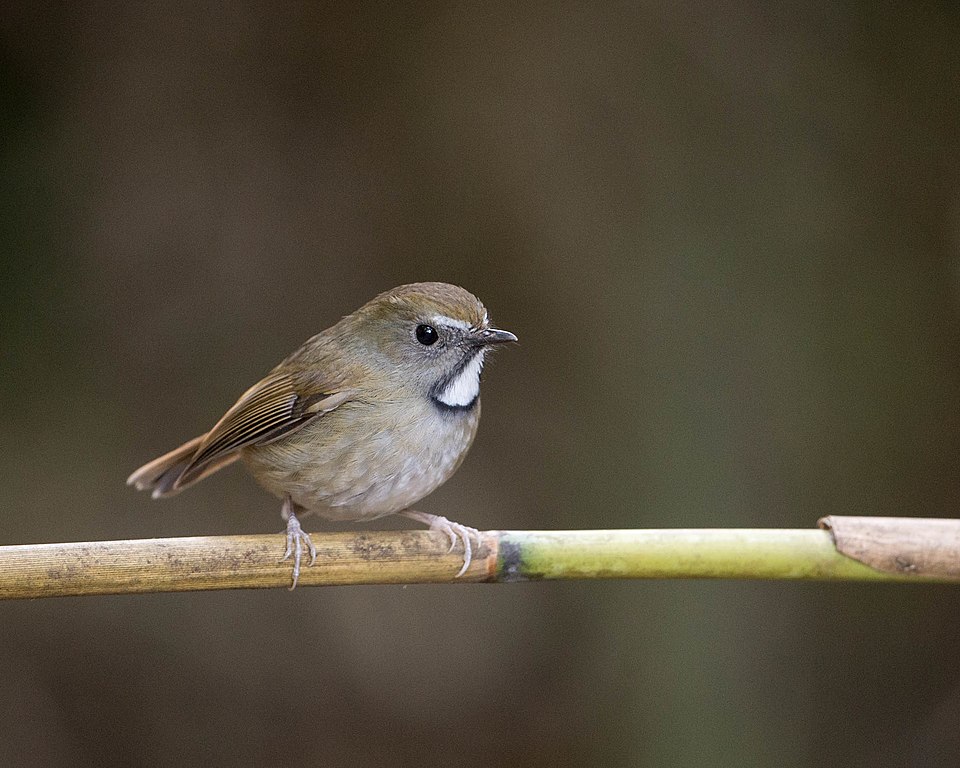
Rufous-breasted Bush-Robin
Tarsiger hyperythrus
Order: Passeriformes / Family: Muscicapidae

Wikimedia Commons
About the Rufous-breasted Bush-Robin
The Rufous-breasted Bush-Robin (Tarsiger hyperythrus) stands out as a captivating songbird, primarily residing in the temperate forests across the Himalayan regions. This small yet vibrant bird belongs to the family Muscicapidae, a group known for their diverse and often melodious vocalizations. Found at elevations ranging from 1,500 to 4,000 meters, the Rufous-breasted Bush-Robin thrives in dense undergrowth and forest edges, where its bright plumage provides a stark contrast to the lush greenery. This species is especially prevalent in countries like Nepal, Bhutan, and parts of northern India, where the forested slopes provide both abundant food sources and ideal nesting sites.
The ecological significance of the Rufous-breasted Bush-Robin lies in its role as both a predator of insects and a prey species for larger avian predators. By controlling insect populations, the bird contributes to maintaining ecological balance within its habitat. Additionally, the Rufous-breasted Bush-Robin serves as an indicator species for the health of its forest environment. Changes in its population density can reflect broader ecological shifts, often triggered by deforestation or climate change.
Seasonal behaviors of the Rufous-breasted Bush-Robin include altitudinal migration, where individuals may descend to lower elevations during harsh winter months in search of milder climates and more accessible food sources. During the breeding season, which spans from April to June, these birds are more conspicuous as males engage in elaborate courtship displays to attract mates. The presence of the Rufous-breasted Bush-Robin in a particular region can signify a well-preserved habitat, as they are less likely to thrive in areas experiencing significant human disturbance.
Conservation efforts for the Rufous-breasted Bush-Robin focus on habitat preservation, given that deforestation poses the greatest threat to their population. By safeguarding the integrity of their forest habitats, we not only ensure the survival of this striking species but also protect a myriad of other flora and fauna that depend on the same ecological niche.
The Rufous-breasted Bush-Robin belongs to the family Muscicapidae, within the order Passeriformes. These birds typically live average lifespan is around 6 years, with some individuals living up to 9 years..
How to Identify a Rufous-breasted Bush-Robin
The Rufous-breasted Bush-Robin is easily identified by its striking orange breast, which contrasts with its olive-brown upperparts and bluish-gray head. This distinct coloration makes it a favorite among birdwatchers. Males are more vividly colored than females, with more pronounced orange underparts and a deeper blue on the head. Females, while similar in pattern, exhibit a more subdued coloration, allowing them to blend into the forest undergrowth more effectively.
Juvenile Rufous-breasted Bush-Robins resemble the adult females but have more mottled brown plumage, which provides added camouflage during their vulnerable early life stages. In flight, the Rufous-breasted Bush-Robin displays a relatively short, rounded silhouette with rapid wingbeats, typical of a songbird adapted to maneuvering through dense forest environments. When perched, they often adopt an upright posture, frequently flicking their tail, a behavior that can help differentiate them from similar species.
Confusion may arise with the similar-looking Himalayan Bluetail, another member of the same family. However, the Bluetail lacks the Rufous-breasted Bush-Robin's characteristic orange breast. Observers can distinguish the two by focusing on the underparts and the specific shade of blue on the head and upperparts. While observing the Rufous-breasted Bush-Robin, note its tendency to remain low in the vegetation, often hopping along the forest floor or perching on low branches.
Having trouble telling birds apart? Upload a photo to our bird identification tool for an instant species match.
Rufous-breasted Bush-Robin Habitat and Range
Preferred Habitat
The Rufous-breasted Bush-Robin predominantly inhabits montane forests, favoring areas with dense undergrowth and rich biodiversity. These birds are commonly found at elevations between 1,500 and 4,000 meters, where they occupy both primary and secondary forests. They are most prevalent in mixed coniferous and broadleaf forests, which provide a varied diet and ample cover.
In terms of geographic distribution, their habitat spans the rugged terrain of the Himalayas, including regions across Nepal, Bhutan, northeast India, and southern Tibet. During the breeding season, they prefer higher elevations, but as winter approaches, they may move to lower altitudes to escape the harshest weather conditions. This altitudinal migration helps them cope with seasonal temperature extremes and food scarcity.
While primarily associated with natural forest environments, the Rufous-breasted Bush-Robin can occasionally be found in semi-rural settings, particularly in areas where forest edges meet human habitation. However, they are not typically found in highly urbanized environments, relying instead on the complex structure of forest habitats to meet their ecological needs.
Geographic Range
The breeding range of the Rufous-breasted Bush-Robin is primarily confined to the Himalayan region, encompassing parts of Nepal, Bhutan, northern India, and southern Tibet. This species thrives in the montane forests within these areas, where the combination of elevation and forest cover provides suitable nesting and foraging conditions.
During the winter months, the Rufous-breasted Bush-Robin exhibits altitudinal migration, moving to lower elevations within the same geographic region. This seasonal movement helps the bird avoid the harsh conditions of high-altitude winters, ensuring access to food resources and more temperate climates.
While their presence is well-documented across the central and eastern Himalayas, population density is generally higher in areas with minimal human disturbance and abundant forest cover. Conservation practices that focus on habitat protection are crucial in maintaining these population strongholds. Observers are most likely to encounter the Rufous-breasted Bush-Robin in protected areas and national parks, where conservation efforts help preserve their natural habitat.
Want to know which birds visit your area? Browse our backyard birds by location guides for region-specific species lists.
What Does the Rufous-breasted Bush-Robin Eat?
The Rufous-breasted Bush-Robin primarily feeds on a diet of insects and other small invertebrates, reflecting its role as an active insectivore. The bird forages by gleaning insects from leaves and branches, often working methodically through dense undergrowth to locate its prey. This feeding strategy not only helps control insect populations but also reduces competition with other insectivorous birds that prefer more open foraging techniques.
Seasonal variations in diet occur, with the bird consuming more arachnids and larvae during the breeding season, when protein demands are higher. The Rufous-breasted Bush-Robin may supplement its diet with small fruits and berries, particularly during the winter months, when insect availability decreases. This dietary flexibility aids in its survival across varying seasonal environments.
The bird's foraging activity predominantly takes place during daylight hours, with peak feeding times occurring in the early morning and late afternoon. By focusing its efforts during these times, the Rufous-breasted Bush-Robin maximizes its efficiency, taking advantage of cooler temperatures and increased insect activity.
Rufous-breasted Bush-Robin Behavior and Social Structure
The Rufous-breasted Bush-Robin exhibits solitary to mildly territorial behavior, especially during the breeding season. Males often sing from prominent perches to establish their territory and attract a mate. These territories, while vigorously defended during breeding, are generally small, reflecting the bird's preference for dense cover and localized resources.
Courtship displays include wing flicking and tail spreading, accompanied by soft, melodious songs. These displays not only serve to attract females but also reinforce pair bonds. Outside the breeding season, the Rufous-breasted Bush-Robin can form loose associations with other small birds, particularly during foraging.
Flocking behavior is uncommon, as individuals tend to forage independently or in pairs. When faced with potential predators, the Rufous-breasted Bush-Robin employs a tactic of rapid retreat into dense vegetation, relying on its cryptic plumage and elusive nature for protection. Its daily activity patterns involve active foraging interspersed with periods of rest in secluded, shaded areas.
Rufous-breasted Bush-Robin Nesting and Reproduction
The nesting habits of the Rufous-breasted Bush-Robin are closely tied to its forest habitat. Nests are typically constructed in low shrubs or small trees, often concealed by dense foliage to protect against predators. The nest itself is a cup-shaped structure, meticulously built with moss, leaves, and fine roots, providing both comfort and camouflage.
Clutch size generally ranges from three to five eggs, with incubation duties primarily undertaken by the female. The incubation period lasts approximately 12 to 14 days, during which the male may assist by providing food to the incubating female. Once hatched, the nestlings are altricial, requiring constant care and feeding from both parents.
The fledging period spans about 14 to 16 days after hatching, during which the young remain dependent on their parents for food and protection. Typically, the Rufous-breasted Bush-Robin raises one brood per year, although favorable conditions may occasionally lead to a second brood. Parental roles are well-delineated, ensuring that the young receive adequate care and resources for development.
Rufous-breasted Bush-Robin Sounds and Vocalizations
The primary song of the Rufous-breasted Bush-Robin is a sweet, melodious series of whistles and trills, often delivered from a concealed perch within the forest. The rhythm is steady, with a moderate pitch that carries well through the dense undergrowth, facilitating communication over short distances.
In addition to its primary song, the bird emits a variety of call notes, including soft 'tuk-tuk' sounds used in communication between mates or family groups. Alarm calls are sharp and more intense, designed to alert conspecifics to the presence of predators.
Dawn chorus participation is significant for the Rufous-breasted Bush-Robin, as males often begin singing at first light, a behavior that serves both territorial and mate-attraction purposes. Comparisons to the song of the Common Nightingale underscore the Rufous-breasted Bush-Robin's reputation as a skilled songster.
Interesting Facts About the Rufous-breasted Bush-Robin
- 1The Rufous-breasted Bush-Robin can be found at elevations as high as 4,000 meters, showcasing its adaptability to high-altitude environments.
- 2Despite its vibrant appearance, the Rufous-breasted Bush-Robin can be surprisingly elusive, often retreating into dense vegetation when disturbed.
- 3The bird's song is not only beautiful but also serves as a key mechanism for maintaining territory and attracting mates during the breeding season.
- 4Rufous-breasted Bush-Robins are known to migrate altitudinally, moving to lower elevations in winter to escape harsh conditions.
- 5This species plays a crucial role in controlling insect populations, highlighting its importance in forest ecosystem health.
- 6The Rufous-breasted Bush-Robin's preference for dense forest undergrowth makes it a reliable indicator of habitat quality in its range.
- 7Research shows that the Rufous-breasted Bush-Robin's population remains stable despite localized threats from habitat loss.
Rufous-breasted Bush-Robin Conservation Status
The Rufous-breasted Bush-Robin currently holds a status of Least Concern according to the IUCN Red List, though it faces localized threats due to habitat loss. Deforestation, driven by logging and agricultural expansion, poses the most significant risk to its population stability. While the overall population trend is considered stable, continued habitat destruction could lead to future declines. Conservation efforts focus on habitat preservation and the establishment of protected areas, which help maintain viable populations. Historical records suggest that the Rufous-breasted Bush-Robin's range has remained relatively stable, though habitat fragmentation in some areas has led to isolated populations. Ongoing conservation initiatives aim to monitor population dynamics closely, ensuring that this vibrant species remains a common sight within its natural range. By promoting sustainable land-use practices, conservationists work to mitigate the adverse effects of human encroachment, safeguarding the Rufous-breasted Bush-Robin and its habitat for future generations.