
Rufous-crested Coquette
Lophornis delattrei
Order: Apodiformes / Family: Trochilidae
Wikimedia Commons
About the Rufous-crested Coquette
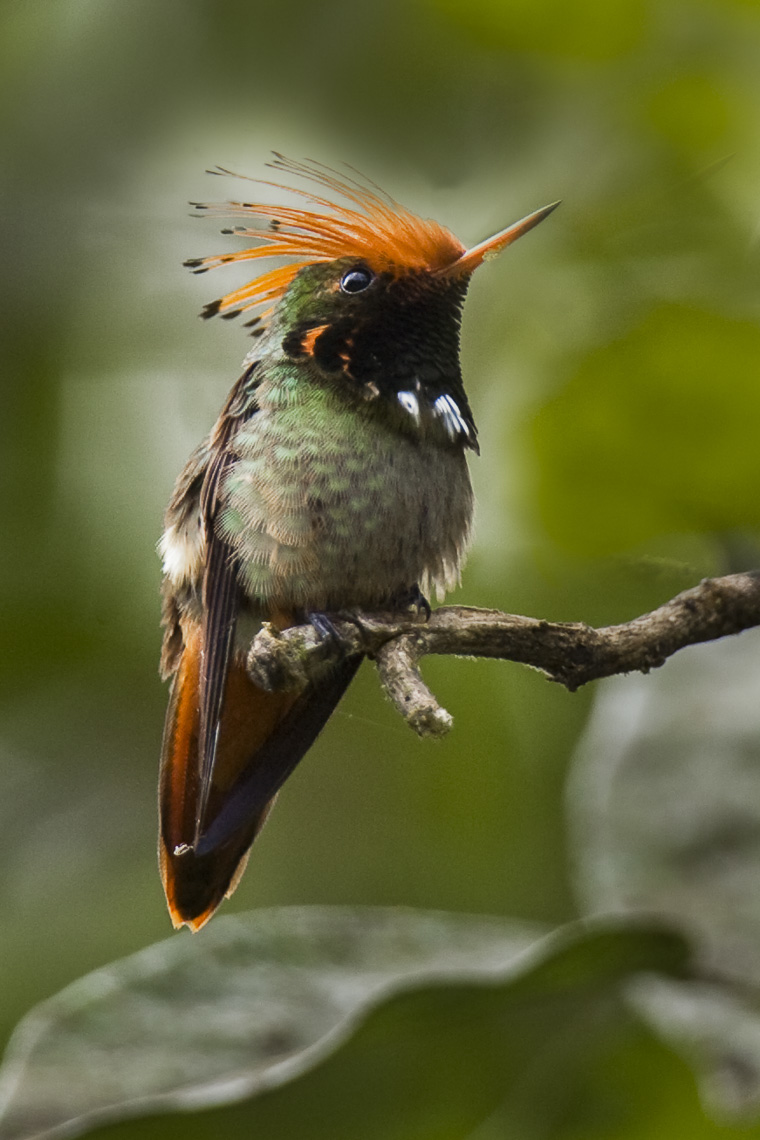
The Rufous-crested Coquette (Lophornis delattrei) is a small and striking member of the hummingbird family, Trochilidae, found primarily in Central and South America. This species is renowned for its vibrant rufous crest, which is more pronounced in males, making it an object of fascination and study among ornithologists and bird enthusiasts alike. The Rufous-crested Coquette plays a crucial role in its ecosystem as a pollinator, visiting a variety of flowering plants to feed on nectar. In addition to nectar, it consumes small insects, contributing to insect population control. The bird's range extends across countries such as Panama, Costa Rica, Colombia, Ecuador, and Peru, where it typically inhabits subtropical or tropical moist lowland forests, edges, and clearings. These regions provide the ideal backdrop for its feeding and breeding activities, with the bird favoring locations abundant in flowering plants. Flowering seasons in these areas influence its behavior, leading to increased visibility during peak blooming periods. The Rufous-crested Coquette has adapted well to its niche, displaying a high tolerance for habitat disturbance as long as its food sources remain plentiful. This adaptability is particularly evident during seasonal shifts when the bird might explore new areas in response to changes in flower availability. Despite its resilience, habitat loss due to deforestation poses an ongoing threat to its population. Conservation efforts focus on protecting critical habitats and ensuring sustainable land-use practices in the regions it inhabits.
The Rufous-crested Coquette belongs to the family Trochilidae, within the order Apodiformes. These birds typically live average 3-5 years; max recorded 8 years.
How to Identify a Rufous-crested Coquette
Identifying the Rufous-crested Coquette involves noting several distinctive field marks. Adult males are particularly striking, with a bright rufous crest that extends from the top of the head to the nape. This crest is complemented by iridescent green plumage covering the rest of the body. Females, while lacking the bold crest, have similar green plumage but are generally duller. Both sexes have a short, pointed bill, which aids in nectar feeding. Juveniles resemble females but are often duller with more muted plumage. The Rufous-crested Coquette's small size, typically ranging from 6 to 7 cm in length, further distinguishes it from larger hummingbirds. When in flight, the bird's silhouette is compact, with rapid wingbeats creating a blur that is characteristic of hummingbirds. Perched, it maintains an upright posture, often on thin branches or stems near flowering plants. While similar species such as the Tufted Coquette (Lophornis ornatus) might cause confusion, the Rufous-crested Coquette's unique crest and specific range help in accurate identification.
Having trouble telling birds apart? Upload a photo to our bird identification tool for an instant species match.
Rufous-crested Coquette Habitat and Range
Preferred Habitat
The Rufous-crested Coquette primarily inhabits subtropical or tropical moist lowland forests, forest edges, and clearings. It thrives in regions rich in flowering plants, which provide essential nectar sources. Typically found at elevations ranging from sea level to 1,200 meters, the bird occasionally ventures to higher altitudes when searching for food. Seasonal shifts in flower availability may prompt slight habitat changes, with the coquette exploring new areas within its range. In urbanized regions, the Rufous-crested Coquette can adapt to gardens and parks that feature abundant flowering plants, although it is more commonly associated with rural and forested landscapes. Its presence in urban settings depends heavily on the availability of suitable nectar sources and minimal disturbance.
Geographic Range
The Rufous-crested Coquette's range spans several countries in Central and South America. Breeding populations are prevalent in Panama and Costa Rica, while non-breeding individuals may be found as far south as Colombia, Ecuador, and Peru. Migration patterns within this range are minimal, as the bird is generally considered a resident species. However, some altitudinal movements occur in response to seasonal changes in flower availability. Population densities are highest in areas where forests intersect with clearings or agricultural lands, providing a mix of natural and semi-natural environments. Despite its relatively broad range, the Rufous-crested Coquette's presence is patchy, with localized population hotspots driven by food availability.
Want to know which birds visit your area? Browse our backyard birds by location guides for region-specific species lists.
What Does the Rufous-crested Coquette Eat?
The Rufous-crested Coquette primarily feeds on nectar, visiting a variety of flowering plants to obtain this energy-rich food source. It favors flowers with tubular shapes, such as those of the Heliconia and Inga species, which are adapted to hummingbird pollination. In addition to nectar, the coquette supplements its diet with small insects and spiders, which provide essential proteins and nutrients. Foraging typically occurs during daylight hours, with activity peaking in the early morning and late afternoon when flowers are most abundant. The bird employs a hovering technique to access nectar, using its specialized bill and tongue to extract it efficiently. Seasonal changes in flower availability can lead to shifts in diet composition, with insects becoming more prominent when nectar sources are scarce.
Want to attract Rufous-crested Coquettes to your yard? See our recommended feeders and seed types for the best results.
Rufous-crested Coquette Behavior and Social Structure
The Rufous-crested Coquette exhibits a range of intriguing behaviors, particularly in its social and territorial interactions. Males are known for their aggressive territoriality, especially during the breeding season when they defend prime feeding territories from rivals. Courtship displays are elaborate, with males showcasing their rufous crests and engaging in aerial displays to attract females. Despite their small size, Rufous-crested Coquettes are solitary, often seen alone or in pairs rather than in flocks. Their response to predators involves rapid, erratic flight and seeking cover in dense foliage. Daily activity patterns revolve around feeding, with periods of rest occurring during the hottest parts of the day. These birds are generally more active during the early morning and late afternoon, coinciding with peak flower availability.
Rufous-crested Coquette Nesting and Reproduction
Nesting for the Rufous-crested Coquette involves constructing small, cup-shaped nests on thin branches or twigs, often near a reliable food source. The nest is constructed using plant fibers, spider silk, and lichen, providing both strength and camouflage. Clutch size typically consists of two eggs, which are incubated primarily by the female for about 14-16 days. Once hatched, the chicks remain in the nest for approximately 20-22 days before fledging. The female assumes primary responsibility for feeding and caring for the young, with no assistance from the male. The Rufous-crested Coquette generally raises one to two broods per year, depending on food availability and environmental conditions.
Rufous-crested Coquette Sounds and Vocalizations
The Rufous-crested Coquette produces a series of soft, high-pitched calls that are often described as thin and insect-like. These calls serve various functions, including communication between mates and signaling alarm when potential threats are nearby. During the breeding season, males may also emit a rapid series of clicks and whistles as part of their courtship display. The bird's vocalizations are typically subdued compared to other hummingbird species, making them challenging to detect in dense forest habitats. Unlike many songbirds, the Rufous-crested Coquette does not participate in a dawn chorus, instead relying on visual displays to communicate and establish territory.
Interesting Facts About the Rufous-crested Coquette
- 1The Rufous-crested Coquette is one of the smallest hummingbirds, measuring just 6-7 cm in length.
- 2Despite its size, the coquette can flap its wings up to 80 times per second while hovering.
- 3Males display their rufous crests prominently during courtship, creating a dazzling visual spectacle.
- 4The bird's diet consists of up to 90% nectar, with the remainder made up of small insects and spiders.
- 5Rufous-crested Coquettes have been observed visiting over 30 different plant species for nectar.
- 6The species' name, Lophornis delattrei, honors French ornithologist Adolphe de Lattre.
- 7This hummingbird can be found at elevations ranging from sea level to 1,200 meters, adapting to various forest habitats.
Rufous-crested Coquette Conservation Status
The Rufous-crested Coquette is currently classified as Least Concern by the IUCN, reflecting a stable overall population trend. However, habitat loss due to deforestation and land-use change poses ongoing threats, particularly in regions where agricultural expansion is prevalent. Conservation efforts focus on protecting key habitat areas and promoting sustainable land management practices to ensure the availability of critical food and nesting resources. Historical population changes are not well-documented, but the species' adaptability to various forest habitats suggests resilience to moderate environmental changes. Continued monitoring and habitat protection are essential to prevent future declines.
Attracting Rufous-crested Coquettes to Your Feeder
The Rufous-crested Coquette is a regular visitor to backyard bird feeders across its range. At the Eye On The Fly feeding station, we observe Rufous-crested Coquettes regularly and capture footage with our feeder cameras.


