
Rufous-headed Woodpecker
Celeus spectabilis
Order: Piciformes / Family: Picidae
Wikimedia Commons
About the Rufous-headed Woodpecker
The Rufous-headed Woodpecker, known scientifically as Celeus spectabilis, is a captivating member of the Picidae family. This species thrives in the dense tropical rainforests of South America, particularly within the Amazon Basin, which spans across countries such as Brazil, Peru, and Colombia. Its unique ecological role includes controlling insect populations, as these woodpeckers feed primarily on wood-boring insects, thus maintaining the health of their forest habitats.
The significance of the Rufous-headed Woodpecker extends beyond its ecological contributions. As a bioindicator species, its presence can signal the health of its environment, making it a crucial subject of study for conservationists. This woodpecker also plays a role in seed dispersal and forest regeneration. By excavating nesting sites, it creates cavities that are later used by secondary cavity-nesters, including other bird species and small mammals.
Seasonally, the Rufous-headed Woodpecker exhibits subtle behavioral changes. During the breeding season, which coincides with the wet season in its habitat, males engage in more vocal displays and drumming to establish territories and attract mates. Outside of this period, these woodpeckers become more solitary, focusing on foraging and maintaining their territories. Their adaptability to shifts in food availability due to seasonal changes underscores their resilience as a species. Despite potential challenges from habitat loss, the Rufous-headed Woodpecker remains an integral component of its ecosystem.
The Rufous-headed Woodpecker belongs to the family Picidae, within the order Piciformes. These birds typically live average 6-10 years with max recorded 13 years.
How to Identify a Rufous-headed Woodpecker
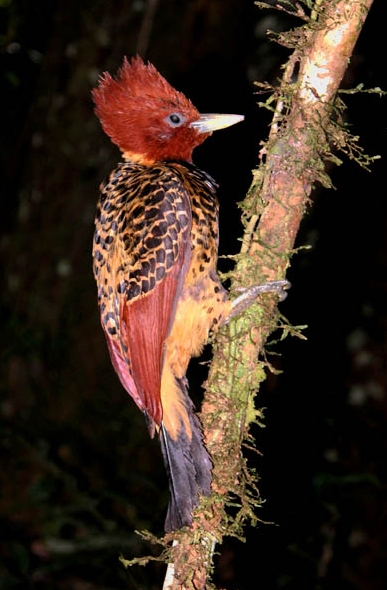
The Rufous-headed Woodpecker stands out with its vivid rufous crown, which contrasts strikingly with its otherwise dark plumage. Adult woodpeckers of this species exhibit a predominantly black and brown body, with a pale, barred belly that provides camouflage against the forest canopy. Males and females can be distinguished by the red malar stripe present on males, absent in females. Juveniles resemble adults but possess a duller crown and less distinct barring.
In flight, the Rufous-headed Woodpecker showcases a distinctive undulating pattern typical of woodpeckers, with rapid wing beats followed by short glides. When perched, it maintains a vertical posture, often clinging to tree trunks as it forages for insects. Its zygodactyl feet, with two toes facing forward and two backward, facilitate its arboreal lifestyle.
Confusion with similar species, such as the Chestnut-colored Woodpecker, can occur. However, the Rufous-headed Woodpecker's more vibrant crown and less pronounced tail banding aid in its identification. Observers should note its unique drumming pattern, shorter and slower compared to other woodpeckers in its range.
Having trouble telling birds apart? Upload a photo to our bird identification tool for an instant species match.
Rufous-headed Woodpecker Habitat and Range
Preferred Habitat
The Rufous-headed Woodpecker is a denizen of pristine tropical rainforests. It favors lowland forests, typically found at elevations from sea level up to 1,200 meters. This species thrives in areas with abundant deadwood, which provides both foraging opportunities and nesting sites. Unlike some woodpeckers, it does not frequently venture into urban areas, preferring the seclusion and resources of dense forest environments.
Seasonal habitat shifts are minimal, as the Rufous-headed Woodpecker remains a year-round resident within its preferred forest habitats. However, during periods of reduced food availability, it might explore adjacent secondary forests or forest edges.
The species' reliance on mature forests makes it vulnerable to habitat destruction, particularly deforestation for agriculture and logging. Conservation efforts focus on preserving these critical habitats to ensure the survival of the Rufous-headed Woodpecker.
Geographic Range
The Rufous-headed Woodpecker's range is primarily confined to the Amazon Basin within South America. It breeds and resides in countries such as Brazil, Peru, Colombia, and Ecuador. The bird's distribution follows the vast expanse of tropical rainforests in these regions, where it finds abundant resources and suitable nesting sites.
This species is non-migratory, maintaining a year-round presence within its range. Its population density is highest in well-preserved forest areas, where human disturbance is minimal. The Rufous-headed Woodpecker's range largely overlaps with protected areas, which offer some degree of conservation.
While not considered a widespread species, it is locally common in areas where suitable habitat remains intact. The woodpecker's presence often indicates a healthy forest ecosystem, contributing to its importance as a species of interest for ornithologists and conservationists alike.
Want to know which birds visit your area? Browse our backyard birds by location guides for region-specific species lists.
What Does the Rufous-headed Woodpecker Eat?
The Rufous-headed Woodpecker primarily feeds on insects, with a strong preference for wood-boring beetles and their larvae. This diet plays a crucial role in controlling potential pest populations within its habitat. It employs a technique known as 'gleaning', where it uses its strong bill to excavate insects from bark and wood crevices.
Seasonal variations in diet occur, with the woodpecker occasionally supplementing its insectivorous diet with fruits and seeds, particularly during periods when insect abundance declines. It is known to forage both alone and in mixed-species flocks, where it benefits from the increased foraging efficiency provided by the presence of other insectivorous birds.
The woodpecker's feeding schedule is diurnal, with peak activity occurring during the early morning and late afternoon. Its ability to adjust its diet according to seasonal availability underscores its adaptability and resilience in the face of environmental changes.
Rufous-headed Woodpecker Behavior and Social Structure
The Rufous-headed Woodpecker exhibits fascinating behavioral traits, reflective of its tropical environment. It typically maintains a solitary or paired existence, particularly during the breeding season, when pairs become highly territorial. Males engage in drumming and vocal displays to establish and defend territories, using these signals to communicate their presence to rivals and potential mates.
Courtship displays involve intricate dancing and mutual preening, strengthening pair bonds. Once paired, males and females work cooperatively in all aspects of nesting and raising young. Outside the breeding season, the Rufous-headed Woodpecker may join mixed-species flocks, enhancing its foraging opportunities and protection against predators.
Its response to predators is cautious, often resorting to stealth and the use of dense foliage for concealment. The woodpecker's daily activity peaks during cooler morning and late afternoon hours, with periods of rest during the midday heat. This routine ensures efficient energy use and maximizes feeding opportunities.
Rufous-headed Woodpecker Nesting and Reproduction
Rufous-headed Woodpeckers excavate nest cavities in dead or decaying trees, preferring sites that offer both concealment and structural integrity. The nesting process involves both partners, with males typically taking the lead in cavity excavation.
A typical clutch consists of 2-4 eggs, which both parents incubate for about 14-16 days. The altricial young require intensive care, with both parents sharing feeding and brooding duties. Fledging occurs approximately 24-28 days after hatching, but juvenile birds remain reliant on parental care for several more weeks as they learn essential survival skills.
This species typically raises one brood per year, although favorable conditions may occasionally permit a second. The reliance on deadwood for nesting highlights the importance of preserving natural forest habitats to support the Rufous-headed Woodpecker's reproductive success.
Rufous-headed Woodpecker Sounds and Vocalizations
The Rufous-headed Woodpecker's primary call is a sharp, resonant 'kik-kik-kik', repeated rapidly. This call serves multiple functions, including territory establishment and mate attraction. Its drumming, slower and more deliberate than other woodpeckers, consists of a series of rhythmic taps followed by a pause, resembling the sound of a distant drumbeat.
Alarm calls are more urgent and staccato, alerting nearby birds to potential threats. During the dawn chorus, these woodpeckers contribute with both vocalizations and drumming, adding a distinctive rhythm to the forest soundscape. The sound is reminiscent of the tapping of a small metal object on wood, easily distinguishable in the dense forest environment.
Interesting Facts About the Rufous-headed Woodpecker
- 1The Rufous-headed Woodpecker's drumming is unique among its genus, often used to communicate and attract mates.
- 2Despite its vibrant head, the Rufous-headed Woodpecker blends seamlessly into its environment, thanks to its barred belly.
- 3This species is a skilled excavator, with powerful neck muscles allowing it to chisel into the toughest woods.
- 4The Rufous-headed Woodpecker's role as a bioindicator helps scientists assess the health of tropical rainforest ecosystems.
- 5Its diet of wood-boring insects makes it a natural pest control agent, benefiting the forest's overall health.
- 6Rufous-headed Woodpeckers often reuse their nesting cavities, saving energy and time in subsequent breeding seasons.
- 7The woodpecker's zygodactyl feet provide exceptional grip, enabling it to navigate the vertical surfaces of tree trunks with ease.
Rufous-headed Woodpecker Conservation Status
Currently, the Rufous-headed Woodpecker is listed as Least Concern by the IUCN. However, its population trend is declining, primarily due to habitat loss from deforestation and human encroachment. The primary threats include logging, agricultural expansion, and infrastructure development, which reduce and fragment its natural habitat. Conservation efforts focus on habitat preservation, particularly in the Amazon Basin, where protected areas offer some respite from the pressures of deforestation. Monitoring population trends and promoting sustainable land-use practices are essential to ensure the long-term survival of this species. Historical population data indicate stability in regions with effective conservation measures, highlighting the importance of continued protection efforts.


