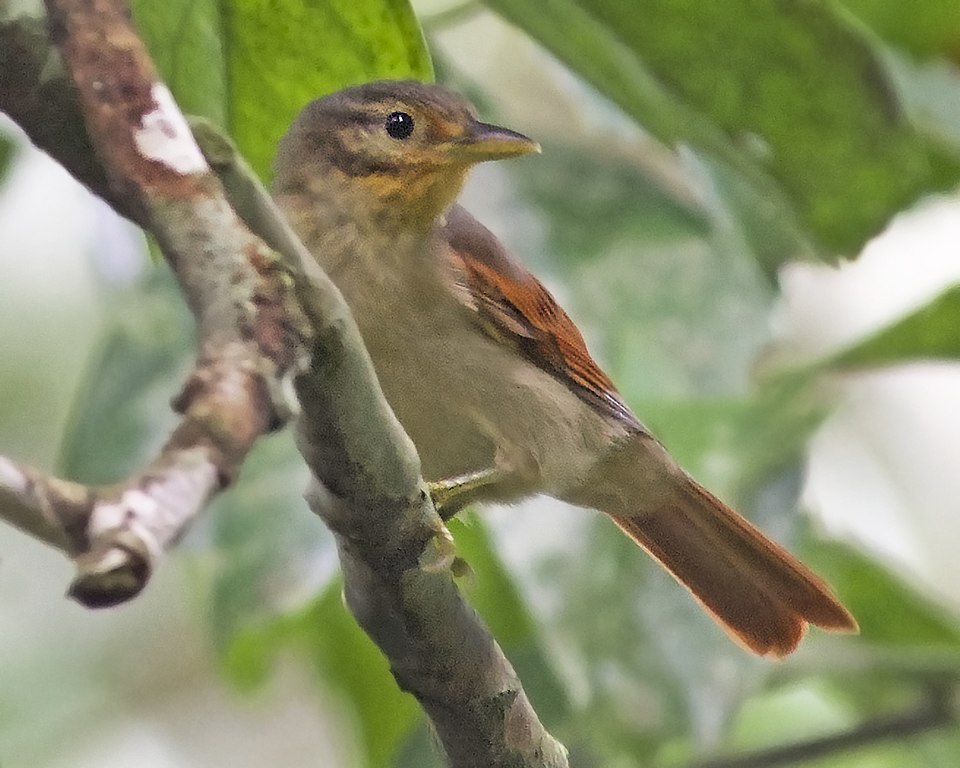
Rufous-rumped Foliage-gleaner
Philydor erythrocercum
Order: Passeriformes / Family: Furnariidae

Wikimedia Commons
About the Rufous-rumped Foliage-gleaner
The Rufous-rumped Foliage-gleaner (Philydor erythrocercum) is a member of the Furnariidae family, a diverse group known for their adaptability to various forest environments. This small passerine is primarily found in the Amazon Basin, stretching across countries like Brazil, Peru, and Bolivia. It inhabits subtropical and tropical moist lowland forests, thriving in the dense undergrowth where it forages for insects and other small invertebrates. The species plays a critical role in the ecosystem as a primary consumer of insects, thus helping to control insect populations and contributing to the ecological balance of its habitat. As a foliage-gleaner, this bird is adept at foraging in the leaf litter and on the forest floor, employing its strong claws and robust bill to search through the debris. Unlike many other birds, the Rufous-rumped Foliage-gleaner does not migrate seasonally, instead, it remains in its home territory year-round. This sedentary behavior makes it a reliable indicator of forest health and biodiversity. The bird's ability to adapt to different forest structures, including secondary forests, highlights its ecological significance in tropical ecosystems. Its presence indicates a well-functioning forest ecosystem, as it often shares its habitat with a variety of other avian species, as well as mammals and reptiles. Though not currently under significant threat, the Rufous-rumped Foliage-gleaner faces challenges from deforestation and habitat fragmentation. Conservation efforts in areas like the Amazon are vital to preserving the diverse habitats that support species like Philydor erythrocercum. Understanding the ecological role and habits of the Rufous-rumped Foliage-gleaner aids in formulating effective conservation strategies and highlights the importance of preserving tropical forest ecosystems.
The Rufous-rumped Foliage-gleaner belongs to the family Furnariidae, within the order Passeriformes. These birds typically live typically 5-7 years, with a maximum recorded of 10 years..
How to Identify a Rufous-rumped Foliage-gleaner
The Rufous-rumped Foliage-gleaner is a medium-sized bird, measuring approximately 16 to 18 centimeters in length. Its most distinguishing feature is its rufous rump and tail, which contrast with its olive-brown upperparts and buffy underparts. This coloration assists in camouflage among the forest foliage. The bird's eyes are a striking yellow, adding to its distinct appearance. Juveniles resemble adults but may have slightly duller plumage. Male and female Rufous-rumped Foliage-gleaners are similar in appearance, making sex differentiation in the field challenging. In terms of flight silhouette, this species has a rounded wing shape and a slightly upturned tail, typical of many foliage-gleaners. When perched, its posture is upright, often seen clinging to tree trunks and branches as it forages. While it can be confused with other foliage-gleaners, its rufous rump is a key identifying trait that sets it apart from similar species like the Buff-fronted Foliage-gleaner, which lacks the rufous coloring. Observers should note the Rufous-rumped Foliage-gleaner's methodical foraging style, which often involves meticulous examination of leaves and bark.
Having trouble telling birds apart? Upload a photo to our bird identification tool for an instant species match.
Rufous-rumped Foliage-gleaner Habitat and Range
Preferred Habitat
The Rufous-rumped Foliage-gleaner primarily inhabits tropical moist lowland forests, favoring the dense undergrowth and thickets of the Amazon Basin. It can be found at elevations ranging from sea level up to about 1000 meters. This bird shows a strong preference for undisturbed forest environments, although it can also be found in secondary forests and forest edges. It is uncommon in urban areas, as it relies heavily on the complex forest structure for foraging and nesting. During the wet season, the bird might adjust its range slightly to areas with optimal food availability, but generally remains within the same broad region year-round.
Geographic Range
The breeding and resident range of the Rufous-rumped Foliage-gleaner spans across the vast expanse of the Amazon Basin. It is predominantly found in countries such as Brazil, Peru, Ecuador, Bolivia, and Colombia. The species does not undertake long-distance migrations, maintaining a relatively stable presence in these regions throughout the year. Population density is highest in areas of pristine or well-preserved forest, where insect prey is abundant. Although not migratory, the bird may undertake small-scale, local movements in response to food availability and seasonal changes in habitat conditions.
Want to know which birds visit your area? Browse our backyard birds by location guides for region-specific species lists.
What Does the Rufous-rumped Foliage-gleaner Eat?
The diet of the Rufous-rumped Foliage-gleaner consists primarily of insects and other small arthropods. It forages through the forest undergrowth, using its bill to search through leaf litter and on branches for prey. The bird employs a methodical and deliberate foraging technique, often hanging upside down to reach insects hidden beneath leaves. Its diet can vary seasonally based on prey availability, with a tendency to consume more larvae and pupae during the breeding season when nutritional needs increase. The Rufous-rumped Foliage-gleaner typically feeds throughout the day, with peak foraging activity occurring in the early morning and late afternoon.
Rufous-rumped Foliage-gleaner Behavior and Social Structure
The Rufous-rumped Foliage-gleaner is generally a solitary bird, although it may be seen in pairs during the breeding season. It is territorial, often defending its foraging area from other individuals or intruding species. During courtship, males may perform subtle displays, involving wing-flicking and soft vocalizations to attract a mate. The bird's response to predators is typically evasive, using its cryptic coloration to blend into the forest background. Daily activity patterns involve alternating between active foraging and periods of rest, often in the dense vegetation that provides cover from predators.
Rufous-rumped Foliage-gleaner Nesting and Reproduction
The Rufous-rumped Foliage-gleaner constructs its nest in natural cavities, often in trees or dead wood. The nest is composed of a loose collection of leaves, twigs, and plant fibers, providing camouflage within the forest habitat. Clutch size typically ranges from 2 to 3 eggs, which are incubated by both parents. Incubation lasts approximately 17 to 19 days, followed by a fledging period of around 21 days. Both parents participate in feeding and caring for the young, ensuring a high survival rate for the fledglings. Generally, the species is capable of raising one brood per year, though in optimal conditions, a second brood might be attempted.
Rufous-rumped Foliage-gleaner Sounds and Vocalizations
The primary song of the Rufous-rumped Foliage-gleaner is a series of rapid, high-pitched notes that rise and fall in pitch, resembling the sound of a clattering typewriter. These vocalizations are often used to establish territory and communicate with mates. Call notes are sharp and metallic, serving as contact calls between individuals. Alarm calls are more urgent, a rapid succession of notes that alert others to potential danger. During the dawn chorus, the Rufous-rumped Foliage-gleaner contributes to the symphony with its distinctive song, adding to the rich acoustic tapestry of the Amazonian forest.
Interesting Facts About the Rufous-rumped Foliage-gleaner
- 1The Rufous-rumped Foliage-gleaner can flick its wings over 15 times per second during courtship displays, a mesmerizing sight.
- 2Despite its name, this bird's diet includes more than just foliage-related prey, delving into ground-level leaf litter for hidden insects.
- 3The Rufous-rumped Foliage-gleaner, while primarily insectivorous, occasionally consumes small fruits, especially during food scarcity.
- 4This species is a master of camouflage, with its rufous rump blending seamlessly into the forest floor's autumnal tones.
- 5Researchers have identified over 20 distinct vocalizations used by the Rufous-rumped Foliage-gleaner, each serving a different purpose.
- 6The bird's strong legs and claws allow it to cling to vertical surfaces, aiding in its thorough foraging strategy.
- 7Even in dense forest, the Rufous-rumped Foliage-gleaner's sharp calls can travel over 100 meters, alerting others to its presence.
Rufous-rumped Foliage-gleaner Conservation Status
The Rufous-rumped Foliage-gleaner is currently listed as Least Concern by the IUCN. While the species is not immediately threatened, ongoing deforestation in the Amazon poses a significant risk to its habitat. The conversion of forests to agricultural land and infrastructure development are primary threats that could impact future populations. Conservation efforts focus on protecting large tracts of forest, promoting sustainable land use, and conducting research to monitor population trends. Historically, the species has maintained a stable population, but continuous habitat protection is essential to ensure its long-term survival.
Other Furnariidae Species


Birds Similar to the Rufous-rumped Foliage-gleaner
These species are often confused with the Rufous-rumped Foliage-gleaner due to similar appearance or overlapping range.