
Rufous-tailed Attila
Attila phoenicurus
Order: Passeriformes / Family: Tyrannidae
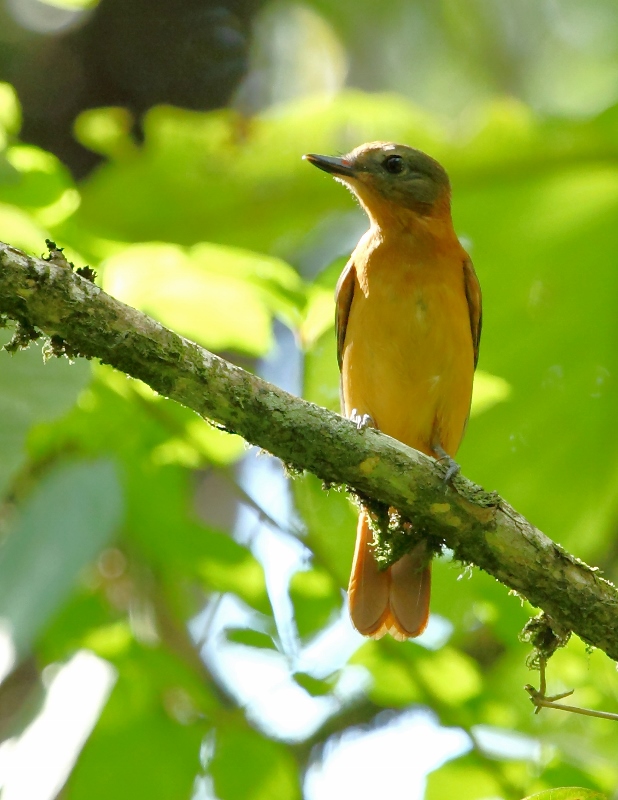
Wikimedia Commons
About the Rufous-tailed Attila
The Rufous-tailed Attila (Attila phoenicurus) is a striking bird belonging to the family Tyrannidae, known for its vibrant rufous tail and melodious calls. This species primarily inhabits the tropical and subtropical forests of South America, ranging from the lowland rainforests of the Amazon Basin to the montane forests in the Andean foothills. It is a key component of the ecosystem, acting as both predator and prey within its habitats.
The Rufous-tailed Attila plays a crucial role in insect population control, feeding on a variety of arthropods and small vertebrates. Its presence indicates a healthy forest ecosystem, as it requires a rich diversity of insects to sustain its diet. The bird's adaptability enables it to thrive in secondary forests and forest edges, making it a resilient species in the face of deforestation.
Seasonal behaviors of the Rufous-tailed Attila include subtle shifts in foraging and nesting activities. During the breeding season, typically from November to March, males engage in vocal displays to attract mates and establish territories. These vocal displays are a defining characteristic, with loud and clear whistles that resonate through the forest. As an insectivorous bird, the Rufous-tailed Attila contributes significantly to the balancing of forest insect populations, underscoring its ecological importance.
The Rufous-tailed Attila belongs to the family Tyrannidae, within the order Passeriformes. These birds typically live average 5 years, with a maximum recorded of 9 years..
How to Identify a Rufous-tailed Attila
The Rufous-tailed Attila is a medium-sized bird, measuring approximately 17-19 cm in length. Its most striking feature is the rufous tail, which contrasts vividly with its olive-green upperparts and pale underparts. The head is robust, with a slightly hooked bill typical of the Tyrannidae family. The bird's eyes are large and dark, providing a keen sense of sight necessary for spotting prey among dense foliage.
Adult plumage is characterized by a rich olive-green back and wings, with a lighter yellowish underside. The rufous tail, its namesake feature, is often flared during displays or when perched. Juveniles resemble adults but tend to show slightly duller colors and more streaking on the underparts. There is little sexual dimorphism, making male and female differentiation in the field quite challenging without observing behavior.
In flight, the Rufous-tailed Attila's silhouette is defined by broad wings and a short, square tail. Its posture when perching is upright, often on exposed branches, which aids in territorial calls and song displays. Though it might be confused with other Attila species, the rufous tail and specific vocalizations are distinguishing features.
Having trouble telling birds apart? Upload a photo to our bird identification tool for an instant species match.
Rufous-tailed Attila Habitat and Range
Preferred Habitat
The Rufous-tailed Attila inhabits a variety of forested environments, primarily favoring lowland tropical rainforests and subtropical forests. It thrives in dense canopy cover as well as forest edges and secondary growth areas, making it adaptable to different forest stages. The bird can be found at elevations ranging from sea level up to 1,500 meters, particularly in the Andean foothills.
While the Rufous-tailed Attila is predominantly a forest species, it occasionally ventures into less dense areas such as plantations and gardens, especially during non-breeding seasons. It is not typically found in urban settings, preferring the rich insect populations offered by forested regions. Seasonal habitat shifts are minimal, as the bird tends to remain within its established territories year-round, taking advantage of the consistent resources available in tropical climates.
Geographic Range
The breeding range of the Rufous-tailed Attila spans much of northern and central South America. It is most commonly found in countries like Brazil, Colombia, Venezuela, and Ecuador, extending into parts of Bolivia and the Guianas. The bird's range covers the expansive Amazon Basin, where it is a regular resident in the lowland rainforests.
While the Rufous-tailed Attila is not considered a migratory species, it does exhibit some local movements within its range, particularly in response to the availability of food resources. Population density is highest in regions with extensive forest cover and diverse arthropod populations. The bird is less frequently observed in fragmented habitats, where it faces competition from other forest birds better adapted to human-altered environments.
Want to know which birds visit your area? Browse our backyard birds by location guides for region-specific species lists.
What Does the Rufous-tailed Attila Eat?
The Rufous-tailed Attila primarily feeds on insects and other arthropods, making it a crucial insectivore in its ecosystem. Its diet includes beetles, caterpillars, and spiders, which it skillfully captures by gleaning from foliage or making short sallies from a perch. The bird's robust bill is well-suited for handling a variety of prey sizes, from minute insects to larger, soft-bodied creatures.
During the rainy season, when insect abundance peaks, the Rufous-tailed Attila may incorporate more diverse prey items, including small vertebrates such as lizards and frogs. This opportunistic feeding strategy ensures a steady food supply even during fluctuations in insect populations. The bird typically forages alone or in pairs, maintaining a feeding schedule that spans dawn to dusk with peak activity in the early morning and late afternoon.
Rufous-tailed Attila Behavior and Social Structure
The Rufous-tailed Attila exhibits a solitary or pair-based social structure, with individuals fiercely defending their territories, especially during the breeding season. Males establish and maintain territories through vocalizations, using their loud and penetrating calls to assert dominance and deter rivals.
Courtship displays involve vocal duets performed by mated pairs, strengthening pair bonds and coordinating breeding activities. The Rufous-tailed Attila's response to predators includes vocal alarms and evasive flight, often retreating to dense foliage when threatened.
Daily activity patterns reveal a bird that is most active during the cooler parts of the day. It engages in foraging, territorial singing, and nesting activities in the early morning and late afternoon, resting during the heat of midday. The bird's adaptability to various forest habitats and its role as a predator contribute to its resilience and ecological significance.
Rufous-tailed Attila Nesting and Reproduction
The Rufous-tailed Attila constructs its nest in a sheltered location, often high in the forest canopy. The nest is a cup-shaped structure made from twigs, leaves, and other plant materials, lined with softer fibers for insulation. It is typically built on a horizontal branch or in a tree fork, well-concealed by surrounding foliage.
A typical clutch consists of 2-3 eggs, which both parents incubate over a period of approximately 14-16 days. Once hatched, the chicks remain in the nest for about two weeks before fledging. During this time, both male and female Rufous-tailed Attilas participate in feeding and caring for the young.
The species may raise one to two broods per year, depending on environmental conditions and food availability. The Rufous-tailed Attila's nesting habits reflect a high degree of parental investment, ensuring the survival of offspring in the competitive forest environment.
Rufous-tailed Attila Sounds and Vocalizations
The primary song of the Rufous-tailed Attila is a series of loud, clear whistles that travel long distances through the forest. Each phrase is typically a rapid sequence of 3-5 notes, with a rising and falling pitch that creates a melodious yet distinct sound.
Call notes are shorter and more abrupt, serving as communication between mates or to signal alarm. The bird's alarm calls are sharp and piercing, alerting nearby birds to the presence of potential predators. During the dawn chorus, the Rufous-tailed Attila's song is particularly prominent, contributing to the rich acoustic landscape of tropical forests.
The quality of its calls can be compared to a flute, offering a contrast to the harsher calls of sympatric birds. This vocal repertoire plays a critical role in territory establishment and mate attraction.
Interesting Facts About the Rufous-tailed Attila
- 1The Rufous-tailed Attila's song is so penetrating that it can be heard up to 1 kilometer away in dense forest, rivaling calls of larger birds.
- 2This bird often perches motionless for extended periods, waiting patiently for prey, demonstrating its effective sit-and-wait hunting strategy.
- 3The Rufous-tailed Attila is known to engage in mixed-species flocks, benefiting from increased foraging efficiency and predator vigilance.
- 4Despite its vibrant tail, the Rufous-tailed Attila's olive-green plumage provides excellent camouflage among the forest canopy.
- 5The species' adaptability to secondary forests makes it a valuable indicator of ecosystem recovery in deforested areas.
- 6A pair of Rufous-tailed Attilas may occupy the same territory for several years, showcasing strong site fidelity.
- 7The bird's distinctive whistling calls play a crucial role in maintaining territory boundaries and mate communication.
Rufous-tailed Attila Conservation Status
The Rufous-tailed Attila is currently classified as Least Concern by the IUCN, with a stable population trend across its range. Despite facing threats such as habitat loss due to deforestation and fragmentation, the species' adaptability to secondary growth and forest edges has helped mitigate significant population declines. Conservation efforts focus on preserving large tracts of tropical forest and promoting sustainable land-use practices. Historical population changes have been minimal, thanks in part to the bird's ability to thrive in diverse forest environments. Continued monitoring and habitat protection remain crucial to ensuring the long-term survival of the Rufous-tailed Attila in its native range.
Other Tyrannidae Species


Birds Similar to the Rufous-tailed Attila
These species are often confused with the Rufous-tailed Attila due to similar appearance or overlapping range.
