
Russet-backed Oropendola
Psarocolius angustifrons
Order: Passeriformes / Family: Icteridae
Wikimedia Commons
About the Russet-backed Oropendola
The Russet-backed Oropendola (Psarocolius angustifrons) is a prominent bird within the family Icteridae, characterized by its distinctive russet-colored back and bright yellow tail feathers. This species exhibits a remarkable geographic distribution across the tropical regions of South America, predominantly found in the Amazon Basin and the foothills of the Andes. The Oropendola's wide range underscores its adaptability, thriving in a variety of habitats including lowland rainforests, montane forests, and even secondary growth areas. Typically inhabiting elevations ranging from sea level up to 1,800 meters, the Russet-backed Oropendola demonstrates a strong preference for humid and semi-humid forested environments.
The ecological role of the Russet-backed Oropendola is significant, particularly in seed dispersal and pest control. By feeding on a diet rich in fruits and insects, this bird contributes to the maintenance of forest health and diversity. The Oropendola's presence is a reliable indicator of the health of its environment, as it typically avoids severely disturbed areas, preferring intact or minimally disturbed forests. The species is also a key player in the complex web of avian social structure within its habitat, often participating in mixed-species flocks that help reduce predation risks.
Seasonally, the Russet-backed Oropendola exhibits subtle behavioral shifts, particularly during the breeding season when males engage in elaborate displays to attract mates. This period also sees increased vocal activity, with males producing a variety of calls and songs to establish territories and court females. Outside the breeding season, these birds may form loose flocks, moving through the forest in search of food. Such seasonal behaviors not only ensure the survival and reproduction of the species but also maintain the ecological balance within their habitats.
The Russet-backed Oropendola belongs to the family Icteridae, within the order Passeriformes. These birds typically live average 8-10 years, with a maximum recorded of 15 years..
How to Identify a Russet-backed Oropendola
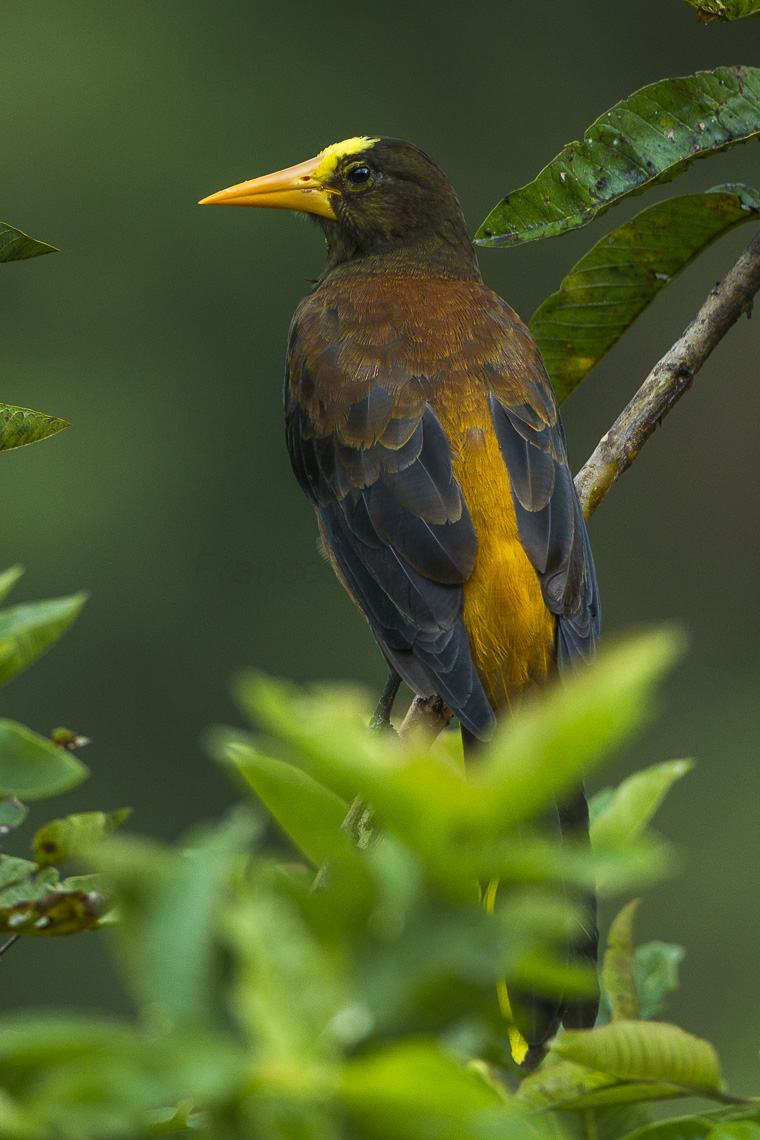
Adult Russet-backed Oropendolas are medium-sized, measuring approximately 30-40 cm in length, with a wingspan between 45-50 cm. Their striking appearance includes a rich russet-colored back and upper wings, contrasted by a bright yellow tail and dark, glossy head. The beak is long and conical, pale in color, providing an excellent tool for foraging.
Juveniles display similar plumage patterns to adults but tend to have duller coloration, lacking the pronounced glossiness seen in mature birds. Males are generally larger and more robust than females, with slightly longer tails and wingspans, though both genders share the same distinctive coloring.
In flight, the Russet-backed Oropendola exhibits a graceful silhouette, with its long tail creating a noticeable 'V' shape. When perched, this bird demonstrates a relaxed posture, often seen hanging upside down while constructing its intricate nests. While similar in appearance to other oropendola species, the russet back and yellow tail are key identifiers that help distinguish it from its relatives.
Having trouble telling birds apart? Upload a photo to our bird identification tool for an instant species match.
Russet-backed Oropendola Habitat and Range
Preferred Habitat
The Russet-backed Oropendola inhabits a variety of tropical and subtropical forest types across its range. It predominantly occupies lowland rainforests, such as those found in the Amazon Basin, but is also common in montane forests along the Andean foothills. These birds are often found up to elevations of 1,800 meters, where they thrive in humid conditions.
During certain times of the year, particularly outside the breeding season, the Oropendola may venture into secondary growth forests and forest edges. They are less frequently sighted in heavily urbanized areas, though they occasionally appear in rural landscapes where forests remain intact. Seasonal shifts in habitat preference are typically minor, with the species maintaining a strong association with forested environments year-round.
Geographic Range
The Russet-backed Oropendola's range spans much of South America, primarily within the countries of Colombia, Ecuador, Peru, Bolivia, and Brazil. The bird's distribution is largely concentrated in the Amazon Basin, an area known for its vast expanses of continuous forest cover. Its range extends into the Andean foothills, reaching as far as the eastern slopes of the Andes.
Population density is highest in regions with abundant forest cover, such as the Amazonian regions of Peru and Ecuador, where the species is commonly observed. While the Russet-backed Oropendola is considered a resident species, with no long-distance migrations, it may undertake short seasonal movements to exploit available resources. Such movements are typically localized within its established range.
Want to know which birds visit your area? Browse our backyard birds by location guides for region-specific species lists.
What Does the Russet-backed Oropendola Eat?
The diet of the Russet-backed Oropendola is primarily frugivorous, consisting largely of a variety of fruits and berries found within its forested habitat. Seasonal variations in fruit availability lead to shifts in diet composition, with insects and small invertebrates supplementing its diet, particularly during the breeding season when protein demands increase.
Foraging techniques include skillful manipulation of fruit with their strong, conical beaks, as well as gleaning insects from foliage and bark. The Oropendola is known to feed both in the canopy and at mid-levels of the forest, demonstrating adaptability in food acquisition. They typically forage in the early morning and late afternoon, taking advantage of cooler temperatures and higher insect activity during these times.
Russet-backed Oropendola Behavior and Social Structure
The Russet-backed Oropendola is a highly social bird, often found in flocks that provide enhanced protection from predators. Their social structure is complex, with a clear hierarchy often evident during feeding and nesting activities. During the breeding season, males engage in elaborate courtship displays, involving intricate songs and physical displays designed to attract potential mates.
Territorial behavior is pronounced during nesting, with males actively defending their territories through vocalizations and physical confrontations. Outside the breeding season, flocking behavior becomes more pronounced, with groups of Oropendolas often joining mixed-species flocks. Such associations provide increased foraging efficiency and reduced predation risks.
Daily activity patterns typically involve periods of active foraging interspersed with rest and social interaction. Predators include larger birds of prey, and the Oropendolas' response involves group mobbing and tight-knit flock formations to deter attacks.
Russet-backed Oropendola Nesting and Reproduction
The nesting behavior of the Russet-backed Oropendola is a fascinating aspect of its life history. These birds construct large, pendulous nests that can reach up to 1 meter in length, often suspended from the tips of branches overhanging water or open areas. The nests are woven from plant fibers, vines, and grasses, providing a secure and hidden environment for eggs and chicks.
Nesting sites are typically located high in the canopy, ensuring protection from ground-based predators. Clutch size ranges from 2 to 3 eggs, with an incubation period lasting approximately 15 to 18 days. Both parents participate in feeding the chicks, though the female undertakes the majority of brooding and incubation duties. Fledging occurs about 24 to 28 days after hatching, and the species generally raises one brood per year.
Russet-backed Oropendola Sounds and Vocalizations
The primary song of the Russet-backed Oropendola is a complex series of gurgling and bubbling notes interspersed with harsh calls. This song, often delivered from a high perch, serves as both a territorial and courtship display. Call notes include a distinctive 'chuck' sound, used to communicate with other flock members.
Alarm calls are sharp and piercing, designed to alert the flock to potential threats. During the dawn chorus, males are particularly vocal, engaging in prolonged singing bouts that showcase their vocal prowess. The sound of the Russet-backed Oropendola is a defining feature of its forested habitat, contributing to the auditory landscape of the regions it inhabits.
Interesting Facts About the Russet-backed Oropendola
- 1The Russet-backed Oropendola constructs its nests up to 1 meter long, one of the longest among passerines.
- 2These birds are known to join mixed-species flocks, benefiting from increased foraging success and reduced predation.
- 3Males perform complex displays with vocalizations and physical movements to attract females during the breeding season.
- 4The species is primarily frugivorous but adapts its diet to include insects during certain times of the year.
- 5Russet-backed Oropendolas can be found at elevations from sea level up to 1,800 meters in the Andes.
Russet-backed Oropendola Conservation Status
The Russet-backed Oropendola is currently listed as Least Concern by the IUCN, with stable population trends across its range. However, habitat loss due to deforestation poses a significant threat to local populations. Conservation efforts focus on preserving large tracts of continuous forest and promoting sustainable land use practices. Historical population changes are not well documented, but the species' adaptability to secondary growth areas suggests resilience to certain degrees of environmental change. Continued monitoring and habitat protection are essential to ensure the long-term survival of this species in the face of ongoing deforestation.
Other Icteridae Species


Birds Similar to the Russet-backed Oropendola
These species are often confused with the Russet-backed Oropendola due to similar appearance or overlapping range.

