
Saffron-crowned Tanager
Tangara xanthocephala
Order: Passeriformes / Family: Thraupidae
Wikimedia Commons
About the Saffron-crowned Tanager
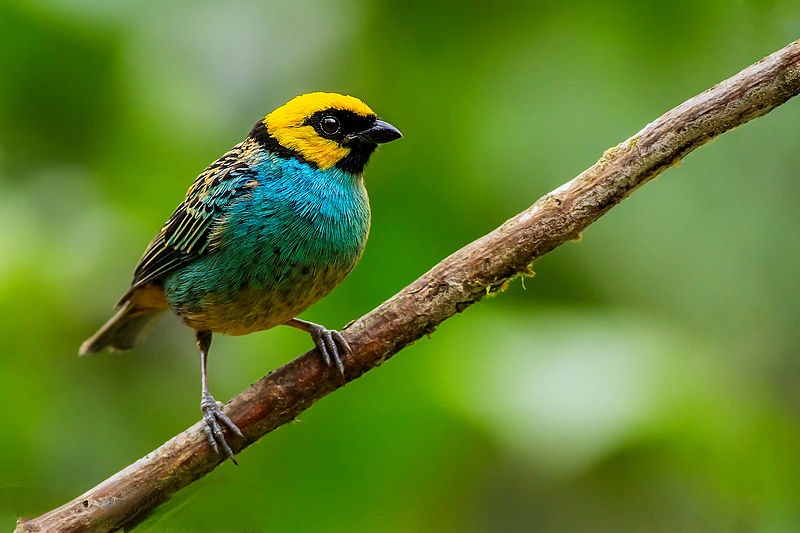
The Saffron-crowned Tanager, scientifically known as Tangara xanthocephala, is a visually captivating bird that inhabits the neotropical regions of South America. Its most distinctive feature, the brilliant saffron-yellow crown, provides an immediate visual cue for identification. This species belongs to the Thraupidae family, a group known for their colorful plumage and diverse habitats. The Saffron-crowned Tanager plays a significant ecological role as both a seed disperser and an insect controller, contributing to the health of its forest ecosystem.
Primarily found in the Andean foothills, this tanager thrives in montane forests. It is particularly common in countries such as Colombia, Ecuador, Peru, and Venezuela. These regions, characterized by high biodiversity, offer an array of fruits and insects that form the core diet of the Saffron-crowned Tanager. The bird's presence in these forests underscores its importance in maintaining the ecological balance, as it aids in both the propagation of plant species through seed dispersal and the natural control of insect populations.
Seasonally, the Saffron-crowned Tanager may exhibit slight altitudinal movements, depending on food availability. During the breeding season, these birds often become more territorial, but outside of this period, they may be observed in mixed-species flocks. Such flocking behavior provides the advantage of increased vigilance against predators and the opportunity to exploit food resources more efficiently. The Saffron-crowned Tanager, with its vibrant coloration and ecological contributions, is a species of both aesthetic and environmental significance, enhancing the rich tapestry of life in its native habitats.
The Saffron-crowned Tanager belongs to the family Thraupidae, within the order Passeriformes. These birds typically live average 4-5 years with a maximum recorded of 9 years..
How to Identify a Saffron-crowned Tanager
The adult Saffron-crowned Tanager is unmistakable with its bright saffron-yellow head, contrasting sharply with a predominantly green body. The back and wings exhibit a striking blue-green hue, adding to its vibrant appearance. Its underparts are lighter, typically a pale green, which helps in blending with the dense forest foliage. Males and females share similar plumage, although males may appear slightly more vibrant. Juveniles, however, display a duller version of the adult plumage, with a less pronounced yellow crown and more muted greens.
In terms of size, the Saffron-crowned Tanager measures approximately 13 cm in length and weighs around 19 grams, placing it in the small songbird category. When perched, the Saffron-crowned Tanager maintains an upright posture, often turning its head side to side as it surveys its surroundings for food or potential threats. During flight, its silhouette can be identified by the rapid wingbeats typical of many tanagers and a slightly rounded tail.
While the Saffron-crowned Tanager is quite distinctive, it may occasionally be confused with other tanagers that share its habitat, such as the Blue-capped Tanager. However, the latter lacks the yellow crown that is the hallmark of the Saffron-crowned Tanager. Accurate identification often relies on observing the bird's unique color pattern and listening for its specific vocalizations.
Having trouble telling birds apart? Upload a photo to our bird identification tool for an instant species match.
Saffron-crowned Tanager Habitat and Range
Preferred Habitat
The Saffron-crowned Tanager inhabits humid montane forests, a habitat characterized by high rainfall and dense, evergreen vegetation. These forests, often found at elevations ranging from 1200 to 2500 meters, provide the ideal environment for this species. The tanager frequently occupies the forest canopy and edges, where it can forage for fruits and insects.
In terms of geographic distribution, it is native to the Andes, with populations recorded in Colombia, Ecuador, Peru, and Venezuela. These regions offer the mix of elevation and vegetation that the Saffron-crowned Tanager requires. While primarily a forest dweller, it can occasionally be observed in secondary growth areas, particularly where forest has been partially disturbed but retains sufficient tree cover.
The Saffron-crowned Tanager does not typically inhabit urban areas, preferring the relative seclusion and biodiversity of rural forest environments. During the non-breeding season, these birds may be more likely to venture into lower elevation areas, depending on food resources, but they generally remain within mountainous regions year-round.
Geographic Range
The Saffron-crowned Tanager has a range that encompasses several countries along the Andean mountain range. This bird is primarily found in Colombia, Ecuador, Peru, and Venezuela. It occupies a range of elevations, typically from 1200 to 2500 meters, which allows it to exploit the unique ecological niches presented by montane forests.
Within these countries, the Saffron-crowned Tanager is generally more common in the western slopes of the Andes, where optimal forest habitats are more prevalent. There are no significant migratory movements for this species, as they tend to be resident in their montane habitats year-round. However, some altitudinal shifts might occur in response to seasonal changes in food availability.
Population density tends to be higher in regions where forest edges and clearings offer abundant fruiting plants and insect prey. These areas provide the necessary resources for breeding and sustenance throughout the year, making them hotspots for observing this vibrant tanager.
Want to know which birds visit your area? Browse our backyard birds by location guides for region-specific species lists.
What Does the Saffron-crowned Tanager Eat?
The Saffron-crowned Tanager primarily feeds on a varied diet of fruits and insects, reflecting its role as both a seed disperser and an insectivore. Fruits such as berries and small drupes constitute a significant portion of its diet, especially during the wet season when these are more abundant. Its strong, conical bill is well-suited for plucking and swallowing fruits whole.
In addition to fruits, the Saffron-crowned Tanager actively hunts for insects and other small invertebrates. It often employs a foraging technique known as 'gleaning,' where it picks prey from foliage or bark surfaces. Insects such as beetles, caterpillars, and ants provide essential proteins, particularly during the breeding season when nutritional demands increase.
Seasonal diet changes are primarily driven by the availability of these food resources. In the dry season, when fruit is less plentiful, the tanager may rely more heavily on insects. The Saffron-crowned Tanager typically forages during daylight hours, with peak feeding activity occurring in the early morning and late afternoon, coinciding with times when insects are most active and visible.
Saffron-crowned Tanager Behavior and Social Structure
The Saffron-crowned Tanager exhibits a range of intriguing behaviors, reflective of its ecological adaptations and social tendencies. This species often participates in mixed-species flocks, a behavior that enhances its ability to locate food and offers protection from predators. Within these flocks, the Saffron-crowned Tanager is a lively participant, often engaging in brief chases and displays.
During the breeding season, which generally occurs from October to March, the Saffron-crowned Tanager becomes more territorial. Males engage in vocal displays and aerial chases to establish and defend their territories. Courtship displays mainly involve the male showcasing his vibrant plumage, accompanied by specific calls to attract a mate.
In terms of daily activity patterns, the Saffron-crowned Tanager is diurnal, with most of its activities confined to daylight hours. It begins its day with a burst of activity at dawn, often foraging energetically before retreating to less active periods during midday heat. In response to predators, such as raptors, the Saffron-crowned Tanager relies on its agile flight and the safety of dense foliage to evade capture. This bird's behavior, marked by its social interactions and territorial displays, highlights its adaptability and survival strategies in the montane forest environment.
Saffron-crowned Tanager Nesting and Reproduction
The nesting habits of the Saffron-crowned Tanager are characteristic of many montane forest birds. They typically build their nests in the dense foliage of trees or shrubs, often choosing locations that provide concealment from predators and the elements. The nest itself is a cup-shaped structure, constructed from materials such as fine twigs, moss, and plant fibers, which offer both stability and camouflage.
Saffron-crowned Tanagers usually lay a clutch of two to three eggs. The female assumes the primary role in incubation, with the period lasting approximately 14 to 16 days. During this time, the male may assist by bringing food to the nesting female. After hatching, both parents partake in feeding the chicks, bringing a diet rich in insects and fruits to ensure rapid growth.
Fledging occurs roughly 14 to 16 days after hatching, at which point the young birds begin to explore their surroundings under the watchful eyes of their parents. The Saffron-crowned Tanager typically raises one brood per year, although favorable conditions may allow for a second. The careful selection of nesting sites and shared parental duties underscore the species' adaptive strategies for successful reproduction.
Saffron-crowned Tanager Sounds and Vocalizations
The vocalizations of the Saffron-crowned Tanager are as distinctive as its plumage. Its primary song consists of a series of short, melodious notes, delivered with a rapid, tinkling quality. This song serves both to establish territory and to communicate with potential mates during the breeding season.
Call notes are typically softer, used for communication between individuals within the same species. These calls often feature a high-pitched 'tsip' or 'seet,' which can be heard throughout the day as the birds forage or interact with others in mixed-species flocks.
In response to threats or disturbances, the Saffron-crowned Tanager emits sharp alarm calls, which alert nearby conspecifics and members of other species. The dawn chorus, a common phenomenon in their montane habitats, often features the vocal contributions of the Saffron-crowned Tanager, adding to the vibrant soundscape of the forest.
The vocal repertoire of the Saffron-crowned Tanager, marked by its melodious song and varied calls, is a key aspect of its communication and survival in the complex sound environment of the Andean forests.
Interesting Facts About the Saffron-crowned Tanager
- 1Despite its vivid plumage, the Saffron-crowned Tanager can be surprisingly hard to spot in dense forest foliage.
- 2The Saffron-crowned Tanager's diet includes over 20 different fruit species, making it a key seed disperser.
- 3It forages primarily in the forest canopy, often hanging upside down to reach difficult spots.
- 4In mixed-species flocks, the Saffron-crowned Tanager benefits from increased predator vigilance.
- 5Its bright yellow crown is not only for show; it plays a role in mate selection during breeding.
- 6Saffron-crowned Tanagers are known to engage in 'anting,' a behavior where they rub ants on their feathers.
- 7The species' range overlaps with several biodiversity hotspots, underscoring its ecological importance.
Saffron-crowned Tanager Conservation Status
The Saffron-crowned Tanager is currently listed as Least Concern by the IUCN, indicating a stable population trend. However, like many species reliant on forest habitats, it faces potential threats from habitat loss due to deforestation and land conversion for agriculture. Such changes can reduce the availability of food and nesting sites, impacting population numbers over time. Conservation efforts aimed at preserving montane forest ecosystems indirectly benefit the Saffron-crowned Tanager. Protected areas and national parks within its range, such as those in Colombia and Ecuador, provide crucial refuges where this species can thrive. Additionally, community-based conservation projects that promote sustainable land use help mitigate the impact of human activities on these vital habitats. Historically, the Saffron-crowned Tanager has maintained stable populations, but continuous monitoring is essential to ensure that conservation measures remain effective. Collaboration between governments, conservation organizations, and local communities is vital for preserving the ecological integrity of the regions where this colorful bird resides.


