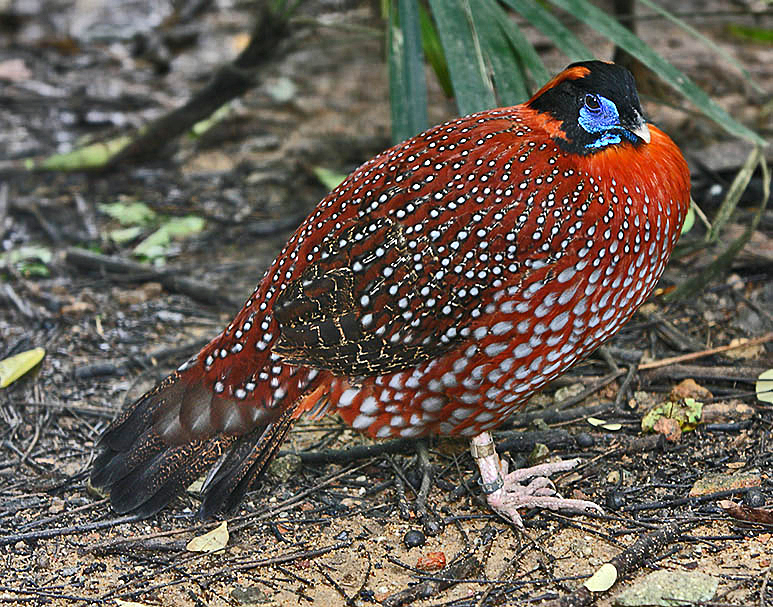
Satyr Tragopan
Tragopan satyra
Order: Galliformes / Family: Phasianidae

Wikimedia Commons
About the Satyr Tragopan
The Satyr Tragopan, Tragopan satyra, is a striking and colorful bird that belongs to the Phasianidae family. This pheasant species is renowned for its vibrant appearance and engaging behaviors, particularly during the breeding season. Found primarily in the dense, subtropical, and temperate forests of the Himalayas, the Satyr Tragopan resides within the altitudinal range of 2400 to 4200 meters. Its habitat spans across several countries including Bhutan, India, Nepal, and Tibet. These birds are an integral part of the ecosystem, playing a crucial role in seed dispersal and contributing to the biodiversity of their native forests.
The importance of the Satyr Tragopan extends beyond its ecological role. It holds cultural significance in many regions, often featuring in local folklore and traditions. The bird's elaborate displays and vivid coloration make it a symbol of natural beauty and a subject of interest for birdwatchers and researchers alike. With a diet primarily composed of seeds, shoots, and insects, the Satyr Tragopan helps maintain the balance of its forest habitat by controlling insect populations and aiding in plant propagation.
Seasonally, the Satyr Tragopan exhibits fascinating behavioral changes, particularly during the breeding season. Males engage in dramatic courtship rituals, showcasing their vibrant plumage and inflating brightly colored lappets and horns to attract mates. These displays not only serve as a mating strategy but also reinforce social hierarchies within their populations. Outside of the breeding season, these birds are more elusive, often remaining solitary or in small groups as they forage and navigate their mountainous environments. Their presence is a testament to the richness of the Himalayan forests, underscoring the need for conservation efforts to protect these vital ecosystems and the species that inhabit them.
The Satyr Tragopan belongs to the family Phasianidae, within the order Galliformes. These birds typically live 8-12 years in the wild, with some individuals reaching up to 15 years..
How to Identify a Satyr Tragopan
The Satyr Tragopan is easily identified by its stunning red plumage, with males showcasing a brilliant mix of scarlet, orange, and black markings. The male's head is adorned with a pair of fleshy blue horns and a blue lappet that can be inflated during courtship. In contrast, females are more subdued in appearance, with a mottled brown plumage that provides excellent camouflage against the forest floor. Juveniles resemble females but can be distinguished by their slightly duller colors and less defined markings.
When comparing the Satyr Tragopan with similar species, such as the Temminck's Tragopan, one can note that the Satyr Tragopan lacks the distinctive white spots on the body and the male's facial skin is a more intense blue. In flight, the bird reveals broad, rounded wings that facilitate short bursts of flight through dense vegetation. On the ground, the Satyr Tragopan maintains a proud posture, often with its head held high and tail slightly fanned, a testament to its confident and territorial nature.
Despite its vibrant coloration, the Satyr Tragopan can be surprisingly elusive when stationary, blending in with the forest undergrowth. This camouflage, coupled with their cautious movements, makes them a challenge to spot outside of the breeding season. Birders should look for the subtle movement of their bold plumage amidst the foliage or listen for their distinct calls to locate these magnificent birds.
Having trouble telling birds apart? Upload a photo to our bird identification tool for an instant species match.
Satyr Tragopan Habitat and Range
Preferred Habitat
The Satyr Tragopan thrives in the dense, montane forests of the Himalayas, preferring environments that offer a rich understory for foraging and cover. Typical habitats include rhododendron and oak forests, where the bird can find ample food and protection from predators. These forests are often found between elevations of 2400 and 4200 meters, providing the cool, temperate climate that the Satyr Tragopan favors.
During different times of the year, this bird may shift its habitat slightly, moving to higher elevations during the summer months to take advantage of cooler temperatures and abundant food. In winter, it descends to lower altitudes where snow cover is less extensive, allowing easier access to food sources. While the Satyr Tragopan is predominantly found in rural and wild forested areas, occasional sightings have been reported near human settlements where these forests remain intact.
The species' reliance on dense forest habitats makes it vulnerable to habitat loss due to deforestation and land conversion for agriculture. Conservation of these montane forests is critical to the survival of the Satyr Tragopan, ensuring that these birds continue to thrive in their natural environment.
Geographic Range
The Satyr Tragopan's range is primarily concentrated in the Himalayas, spanning several countries including Bhutan, India, Nepal, and parts of Tibet. In India, it is predominantly found in the northeastern states such as Sikkim and Arunachal Pradesh, where the forested landscapes provide ideal habitats.
The bird's breeding range coincides with its overall distribution, as it does not undertake long migrations. Instead, the Satyr Tragopan may exhibit altitudinal movements, descending to lower elevations during the winter months to avoid heavy snowfall and ascend to higher areas during the summer for better foraging opportunities. These movements are primarily driven by climatic conditions and food availability rather than breeding requirements.
Population density hotspots are often found in protected areas such as national parks and wildlife sanctuaries where conservation efforts have helped preserve suitable habitats. These include the Neora Valley National Park in India and the Jigme Dorji National Park in Bhutan, both of which offer a refuge for this species amidst increasing habitat pressures. While the Satyr Tragopan remains relatively common within its range, ongoing habitat degradation poses a significant threat, emphasizing the need for continued conservation initiatives.
Want to know which birds visit your area? Browse our backyard birds by location guides for region-specific species lists.
What Does the Satyr Tragopan Eat?
The Satyr Tragopan's diet is diverse and primarily consists of seeds, fruits, and various plant materials, supplemented by insects and other invertebrates. This omnivorous diet allows the bird to utilize a wide range of food sources available within its forest habitat. During the spring and summer months, when vegetation is abundant, the Satyr Tragopan primarily feeds on tender shoots, leaves, and berries, which provide essential nutrients for maintaining its vibrant plumage and overall health.
In the winter, when plant material is scarce, the bird's diet shifts to include more seeds and insects, which it diligently forages from the forest floor. The Satyr Tragopan employs a methodical foraging technique, using its strong legs and feet to scratch through leaf litter and uncover hidden food items. This behavior not only aids in locating food but also plays a role in seed dispersal and soil aeration within its habitat.
The size of the prey consumed by the Satyr Tragopan varies, but it typically prefers smaller to medium-sized insects such as beetles and ants, which are abundant in its environment. Its feeding schedule is primarily diurnal, with peak activity occurring in the early morning and late afternoon when temperatures are moderate, and foraging conditions are optimal.
Satyr Tragopan Behavior and Social Structure
The Satyr Tragopan exhibits a variety of fascinating behaviors, particularly during the breeding season. Males are known for their elaborate courtship displays, which involve inflating their blue facial lappets and horns, fanning their tail feathers, and engaging in a series of rhythmic movements to attract females. These displays are not only a visual spectacle but also serve to establish dominance and secure mating opportunities.
Territorial behavior is pronounced in this species, with males defending their chosen areas vigorously against rivals. This territoriality ensures access to optimal resources such as food and nesting sites, which are crucial for successful reproduction. Outside of the breeding season, the Satyr Tragopan tends to be more solitary or found in small family groups, displaying less aggressive behavior.
The bird's daily activity patterns are largely dictated by environmental conditions. It is most active during the cooler parts of the day, engaging in foraging and social interactions. When faced with predators, the Satyr Tragopan relies on its excellent camouflage, remaining motionless and blending seamlessly with the forest floor. If threatened further, it may take to flight in short bursts, using its strong wings to navigate through dense vegetation and escape danger.
Satyr Tragopan Nesting and Reproduction
The Satyr Tragopan typically nests on the ground, often choosing secluded sites that offer protection from predators and harsh weather. The nest is a simple structure, primarily composed of leaves, twigs, and other plant materials collected from the surrounding area. These materials provide insulation and camouflage, crucial for the survival of both eggs and chicks.
A typical clutch consists of 2 to 4 eggs, which the female incubates alone for approximately 28 days. During this period, the male remains nearby, sometimes offering food and protection to the nesting female. Once hatched, the chicks are precocial, meaning they are relatively mature and mobile, able to leave the nest shortly after birth. Both parents play an active role in caring for the young, leading them to food sources and teaching them to forage effectively.
The fledging period lasts about 2 months, during which the chicks grow rapidly and develop the necessary skills for survival. The Satyr Tragopan generally has one brood per year, though in ideal conditions, a second brood may be possible. The reproductive success of this species is closely linked to the availability of suitable habitats, highlighting the importance of conserving their forest environments.
Satyr Tragopan Sounds and Vocalizations
The vocalizations of the Satyr Tragopan are distinctive and varied, playing a crucial role in communication and territory defense. The primary song of the male is a series of low, resonant calls, often described as a 'woo-woo-woo' sound that can be heard over long distances. This call serves to establish territory boundaries and attract females during the breeding season.
Aside from its song, the Satyr Tragopan also produces a range of call notes, including clucks and whistles used in social interactions and to maintain contact between individuals. Alarm calls are sharp and abrupt, serving as a warning to other birds about potential threats or predators in the vicinity.
During the dawn chorus, the Satyr Tragopan's calls contribute to the symphony of sounds that fill its forest habitat, marking the start of a new day. These vocalizations, while not as melodious as those of songbirds, are an integral aspect of the bird's behavior and provide valuable insight into its social dynamics and environmental interactions.
Interesting Facts About the Satyr Tragopan
- 1The Satyr Tragopan is named after the satyrs of Greek mythology, reflecting its flamboyant and colorful appearance.
- 2During courtship, the male Satyr Tragopan inflates its blue horns and lappets as part of its display to attract females.
- 3Despite their bright colors, Satyr Tragopans are adept at camouflage, blending in with the forest understory when threatened.
- 4The Satyr Tragopan is one of five tragopan species, each known for their unique and vibrant plumage.
- 5These birds play a critical role in their ecosystem by dispersing seeds of the plants they consume, aiding forest regeneration.
- 6Satyr Tragopans are primarily monogamous, forming lasting pair bonds during the breeding season.
- 7Their calls are often the first indication of their presence in a dense forest, as visual sightings can be challenging.
Satyr Tragopan Conservation Status
The Satyr Tragopan is currently classified as Near Threatened by the IUCN, with its population trend showing signs of decline. The primary threats to this species include habitat destruction due to deforestation and agricultural expansion, as well as hunting and trapping for the wildlife trade. Conservation efforts are underway in several countries within its range, focusing on protecting and restoring forest habitats and implementing legal protections to curb hunting. Establishing and maintaining protected areas such as national parks and wildlife reserves have proven effective in safeguarding populations of the Satyr Tragopan. Historically, the population of the Satyr Tragopan has experienced fluctuations in response to changes in land use and conservation policies. Continued efforts to address habitat loss and promote sustainable land management practices are essential to ensure the long-term survival of this beautiful and ecologically significant species.
Other Phasianidae Species


Birds Similar to the Satyr Tragopan
These species are often confused with the Satyr Tragopan due to similar appearance or overlapping range.