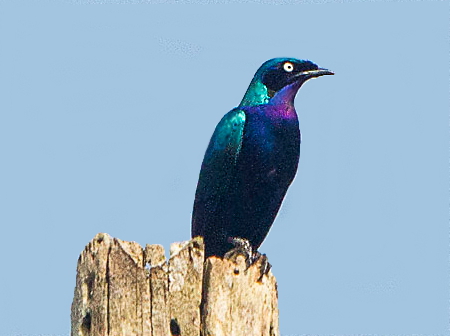
Shelley's Starling
Lamprotornis shelleyi
Order: Passeriformes / Family: Sturnidae

Wikimedia Commons
About the Shelley's Starling
Shelley's Starling (Lamprotornis shelleyi) is a captivating member of the starling family, Sturnidae, renowned for its striking iridescent plumage. This bird is primarily found in the savannas and open woodlands of Eastern Africa, where it plays a crucial ecological role. Its vivid coloration serves not only as a visual delight for birdwatchers but also as a crucial element in its social interactions and mating displays. Shelley's Starling inhabits regions stretching from Ethiopia to Tanzania, where it contributes to the biodiversity of these ecosystems by controlling insect populations. The bird's diet consists mainly of insects and fruits, making it an essential player in both pest control and seed dispersal. Shelley's Starling exhibits seasonal behaviors that align closely with the African climate. During the rainy seasons, when food is abundant, it participates in breeding activities, building nests and rearing young in the relatively lush landscape. As the dry season approaches and food becomes scarcer, the starling may travel in search of more hospitable areas, though it typically remains within its established range. The starling's adaptability to various habitats, including human-modified landscapes, underscores its resilience and resourcefulness. Despite its adaptability, Shelley's Starling faces several ecological challenges. Habitat loss due to agricultural expansion and deforestation threatens its traditional nesting sites and food sources. Conservation efforts aimed at preserving the bird's natural habitat are essential to ensuring its continued presence in the wild. In cultural contexts, Shelley's Starling holds significance for local communities, often being the subject of folklore and traditional stories. Its vibrant appearance and social nature make it a favorite among bird enthusiasts and researchers alike. Through its interactions with the environment and other species, Shelley's Starling plays a vital role in maintaining the ecological balance of its habitats, highlighting the interconnectedness of species within these rich ecosystems.
The Shelley's Starling belongs to the family Sturnidae, within the order Passeriformes. These birds typically live average 5-7 years with a maximum recorded of 10 years..
How to Identify a Shelley's Starling
Shelley's Starling is a medium-sized bird, measuring approximately 23 centimeters in length. Its most distinguishing feature is its shimmering iridescent plumage, which can appear blue, purple, or green depending on the angle of the light. The adults display a metallic blue-green sheen across their bodies, with a purplish gloss on the head and upperparts. The underparts are typically a darker shade, providing a striking contrast. Juveniles, in contrast, exhibit duller plumage with less iridescence, making them less conspicuous. There is little sexual dimorphism in Shelley's Starling, with both males and females sharing similar coloration and size. However, during the breeding season, males may exhibit slightly more vibrant hues as a display to attract mates. In flight, Shelley's Starling presents a distinctive silhouette with pointed wings and a slightly forked tail. When perched, it maintains an upright posture, often seen in small groups or pairs. Confusion with similar species, such as the Superb Starling or the Splendid Starling, may occur. However, Shelley's Starling can be distinguished by its more extensive blue-purple iridescence and the lack of white underparts, which are prominent in the Superb Starling.
Having trouble telling birds apart? Upload a photo to our bird identification tool for an instant species match.
Shelley's Starling Habitat and Range
Preferred Habitat
Shelley's Starling predominantly inhabits open woodlands and savannas in Eastern Africa. It thrives in areas where trees and shrubs provide ample foraging opportunities and nesting sites. Typical habitats include Acacia-dominated landscapes, which offer an abundance of insects and fruits. The bird is commonly found at elevations ranging from lowland areas to around 1,500 meters. While primarily associated with rural and semi-arid environments, Shelley's Starling has demonstrated a capacity to adapt to urban and suburban settings, where it may forage in gardens and parks. Seasonal habitat shifts align with the availability of food and nesting materials, prompting temporary movements without long-distance migrations.
Geographic Range
Shelley's Starling is native to Eastern Africa, with its range extending from southern Ethiopia through Kenya, Uganda, and into northern Tanzania. It occupies regions that offer suitable savanna and woodland habitats, with population density often higher in areas that provide abundant food sources. During the breeding season, the starling becomes more localized within its range, focusing on regions with optimal nesting conditions. Although not strictly migratory, Shelley's Starling may undertake local movements in response to environmental changes, such as the onset of the dry season, when it seeks areas with continued access to food and water.
Want to know which birds visit your area? Browse our backyard birds by location guides for region-specific species lists.
What Does the Shelley's Starling Eat?
The diet of Shelley's Starling primarily consists of insects, including beetles, grasshoppers, and caterpillars, which it actively forages for among trees and shrubs. During the breeding season, the starling's consumption of insects increases, supporting the nutritional needs of growing chicks. Fruits, such as figs and berries, also play a significant role in its diet, particularly during periods when insect availability decreases. Shelley's Starling employs a versatile foraging technique, utilizing both ground feeding and aerial hawking to capture prey. Its feeding schedule aligns with the dawn and dusk hours, taking advantage of the cooler temperatures and peak insect activity during these times.
Shelley's Starling Behavior and Social Structure
Social and gregarious, Shelley's Starling often forms loose flocks, especially outside of the breeding season. These flocks can number from a few individuals to several dozen, facilitating communal foraging and vigilance against predators. The starling exhibits complex social interactions, including cooperative breeding behaviors where non-breeding individuals assist in raising young. During courtship, males perform elaborate displays, showcasing their iridescent plumage and vocal abilities to attract mates. Territorial behavior is more pronounced during the breeding season, with pairs defending their nesting sites from intruders. Shelley's Starling demonstrates a keen awareness of predators, such as raptors and snakes, responding with alarm calls and coordinated evasive maneuvers. Daily activity patterns include a mix of foraging, socializing, and resting, with peak activity occurring in the cooler morning and late afternoon hours.
Shelley's Starling Nesting and Reproduction
Shelley's Starling typically nests in tree cavities, often utilizing abandoned woodpecker holes or natural crevices. It may also nest in man-made structures when natural cavities are scarce. The nest consists of a loose assembly of grass, leaves, and feathers, providing a soft lining for the eggs. A typical clutch contains 2-4 eggs, which the female incubates for approximately 14-16 days. Both parents participate in feeding the chicks, which fledge about 20-24 days after hatching. Shelley's Starling may produce one or two broods per year, depending on environmental conditions and food availability. Nesting success is influenced by factors such as predation and competition for suitable nesting sites.
Shelley's Starling Sounds and Vocalizations
Shelley's Starling produces a melodious song characterized by a series of rich, whistling notes interspersed with chattering phrases. The song serves as a key element in territorial and courtship displays. Its call notes are sharp and piercing, often used in social communication and alarm situations. During the dawn chorus, Shelley's Starling contributes a distinctive voice, adding to the symphony of early morning bird songs. Comparatively, its vocalizations are more musical than those of other starlings, with a fluid quality that captivates listeners.
Interesting Facts About the Shelley's Starling
- 1Shelley's Starling was named after George Ernest Shelley, a 19th-century English ornithologist.
- 2The iridescent plumage of Shelley's Starling is not due to pigmentation but microscopic feather structures.
- 3Shelley's Starling can consume up to 50% of its body weight in insects daily during peak feeding periods.
- 4These starlings are known to mimic the calls of other bird species, adding complexity to their vocalizations.
- 5Shelley's Starling's ability to adapt to urban environments showcases its remarkable resilience and versatility.
- 6The species plays a crucial role in controlling pest populations, benefiting agricultural landscapes.
- 7Shelley's Starling participates in cooperative breeding, with helpers assisting in chick rearing duties.
Shelley's Starling Conservation Status
According to the IUCN, Shelley's Starling is currently classified as a species of Least Concern, though its population trend remains uncertain. Primary threats include habitat loss from deforestation and agricultural expansion, which reduce available nesting sites and food resources. Conservation efforts focus on habitat preservation and restoration, particularly in regions where agricultural encroachment is most severe. Historical population changes have not been extensively documented, but localized studies suggest that the bird's adaptability has so far mitigated some of the pressures it faces.
Other Sturnidae Species


Birds Similar to the Shelley's Starling
These species are often confused with the Shelley's Starling due to similar appearance or overlapping range.