
Sierran Elaenia
Elaenia pallatangae
Order: Passeriformes / Family: Tyrannidae
Wikimedia Commons
About the Sierran Elaenia
The Sierran Elaenia (Elaenia pallatangae) stands out as a member of the Tyrannidae family, known for its unassuming plumage and distinctive vocalizations. Found predominantly in the montane cloud forests of the Andes, this bird extends its range across countries such as Colombia, Ecuador, Peru, and Bolivia. It thrives at elevations ranging from 1,500 to 3,500 meters, often inhabiting areas characterized by dense, moist foliage. The Sierran Elaenia plays a crucial ecological role as both a seed disperser and an insect predator, maintaining the delicate balance of its habitat. During the breeding season, typically between November and February, the Sierran Elaenia becomes more vocal and active, asserting its presence with its characteristic two-note call. As a resident bird, it does not partake in long migratory journeys but may shift altitudinally in response to seasonal changes in food availability. The Sierran Elaenia’s reliance on specific habitats underscores its vulnerability to deforestation and habitat fragmentation. Its ability to adapt to small patches of secondary growth and disturbed habitats highlights its resilience, yet continued environmental pressures can pose substantial threats. Conservation efforts focused on preserving cloud forests are vital for ensuring the survival of this and many other species reliant on such ecosystems.
The Sierran Elaenia belongs to the family Tyrannidae, within the order Passeriformes. These birds typically live generally lives 4-6 years, with up to 8 years recorded.
How to Identify a Sierran Elaenia
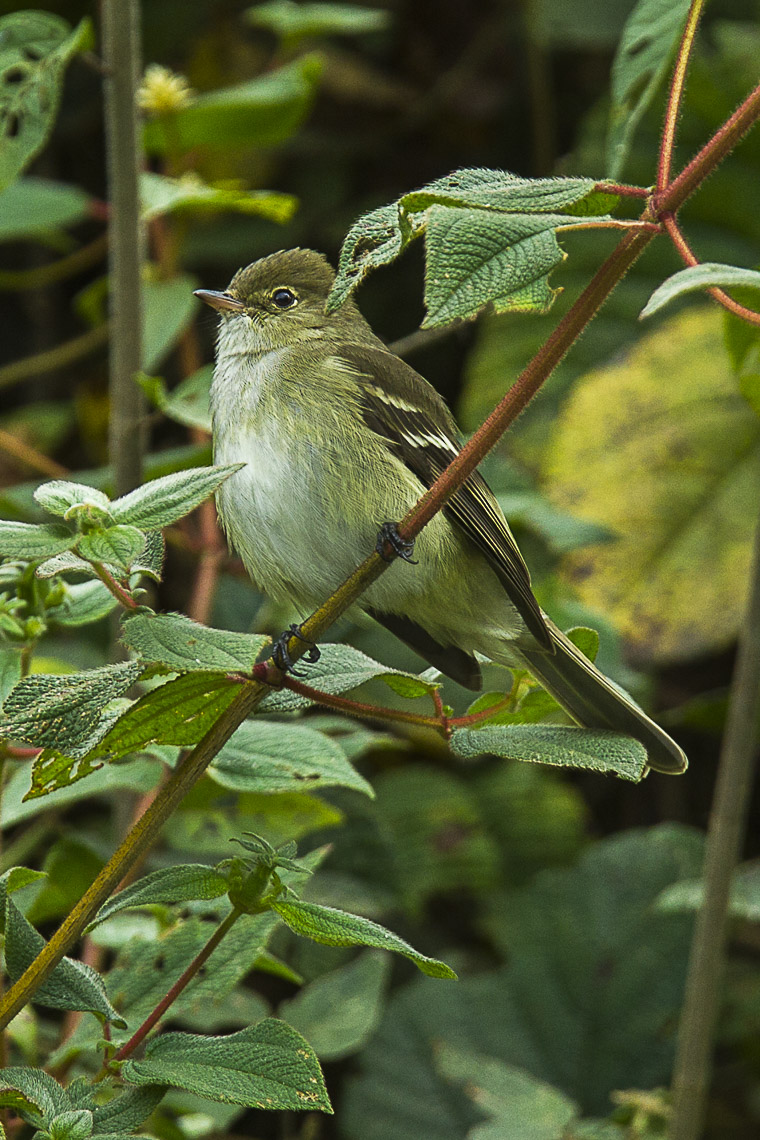
The Sierran Elaenia is a medium-sized flycatcher, typically measuring around 15-16 cm in length. Adult plumage is a subtle mix of olive-green on the upperparts, with a paler grayish-green underside, making it well camouflaged amidst the foliage. Its head features a short crest, often raised when the bird feels alert or curious, and two white wing bars that are noticeable during flight. Juveniles tend to have a duller overall appearance, with less pronounced wing bars and crest. There is little sexual dimorphism in coloration, making it challenging to differentiate males from females in the field. However, during the breeding season, males might exhibit slightly more vibrant plumage. The Sierran Elaenia can often be confused with other Elaenia species, such as the White-crested Elaenia, but can be distinguished by its less conspicuous crest and unique vocalizations. In flight, it presents a streamlined silhouette with a slightly forked tail, often seen sallying from a perch to catch insects mid-air or hover briefly while foraging.
Having trouble telling birds apart? Upload a photo to our bird identification tool for an instant species match.
Sierran Elaenia Habitat and Range
Preferred Habitat
The Sierran Elaenia primarily inhabits montane cloud forests, thriving in areas with thick undergrowth and abundant moisture. It prefers elevations between 1,500 and 3,500 meters, where it finds ample food and suitable nesting sites. This species shows some adaptability by occupying forest edges and secondary growth, although it remains closely tied to forested environments. During wetter seasons, the Sierran Elaenia may venture into lower cloud forests, while in drier periods, it might be found at slightly higher altitudes. It is less commonly observed in urban environments, as it favors the relative seclusion and complexity of forest habitats.
Geographic Range
The Sierran Elaenia's range spans the northern Andes, covering regions in Colombia, Ecuador, Peru, and Bolivia. It resides year-round within these countries, primarily in montane cloud forests. Populations are densest in Ecuador's eastern and western Andean slopes. Unlike many migratory species, the Sierran Elaenia does not engage in extensive migratory movements but may exhibit altitudinal migration within its range, descending to lower elevations during harsher weather conditions or when food becomes scarce at higher altitudes. Its presence is less common in lowland forests and coastal regions.
Want to know which birds visit your area? Browse our backyard birds by location guides for region-specific species lists.
What Does the Sierran Elaenia Eat?
The diet of the Sierran Elaenia primarily consists of insects and other small invertebrates, which it captures in mid-air or gleans from foliage. During the breeding season, when energy demands are high, its insectivorous habits intensify. In addition to insects, the Sierran Elaenia occasionally consumes small fruits and berries, playing a part in seed dispersal. Its foraging technique involves sallying from a perch to catch prey in flight or hovering momentarily to pick insects from leaves. This diverse diet allows some adaptability in response to seasonal food availability, although its core reliance on arthropods remains unchanged.
Sierran Elaenia Behavior and Social Structure
The Sierran Elaenia exhibits a solitary lifestyle outside the breeding season, often seen alone or in pairs. Territorial behavior becomes pronounced during the breeding months, with males actively defending their chosen areas through vocalizations and displays. Courtship involves aerial displays and mutual preening, reinforcing pair bonds. While not highly social, the Sierran Elaenia may join mixed-species foraging flocks, benefiting from safety in numbers and increased foraging efficiency. In response to predators, it relies on cryptic plumage and quick, agile flight to evade capture. Daily activity peaks in the early morning and late afternoon, aligning with insect activity.
Sierran Elaenia Nesting and Reproduction
Sierran Elaenias construct cup-shaped nests, often in the forks of small trees or shrubs, utilizing a variety of materials such as grass, moss, and spider silk to create a secure structure. These nests are typically well-concealed within dense foliage. Clutch size ranges from two to three eggs, with incubation lasting approximately 14 days. Both parents share incubation duties, although the female invests more time in this role. After hatching, fledglings leave the nest around 14-16 days later. The species typically raises one brood per year, although favorable conditions may permit a second.
Sierran Elaenia Sounds and Vocalizations
The primary song of the Sierran Elaenia is a clear, melodic two-note whistle, often described as 'pee-wee.' This song serves both as a territorial call and a means of attracting a mate. Call notes are softer, consisting of a series of quick, sharp whistles used in close-range communication between pairs. Alarm calls are harsher and more abrupt, serving to alert others to potential threats. During dawn, the Sierran Elaenia participates in a chorus, its calls mingling with those of other forest residents.
Interesting Facts About the Sierran Elaenia
- 1The Sierran Elaenia can be found at elevations as high as 3,500 meters, making it one of the higher-dwelling members of the Tyrannidae family.
- 2This species is known for its distinctive 'pee-wee' call, which is easily recognizable even in the dense forests it inhabits.
- 3Despite its subtle coloration, the Sierran Elaenia plays a vital role in seed dispersal, contributing to the health of its forest ecosystem.
- 4The Sierran Elaenia often joins mixed-species flocks, which can include up to a dozen different bird species, enhancing its foraging success.
- 5Studies suggest that the Sierran Elaenia may adjust its feeding strategy based on seasonal availability, showing a flexible approach to foraging.
- 6This bird's foraging behavior includes sallying and hovering, techniques that allow it to exploit a range of prey items efficiently.
- 7While not migratory over long distances, the Sierran Elaenia may shift altitudinally, moving to lower elevations during harsh weather conditions.
Sierran Elaenia Conservation Status
Currently, the Sierran Elaenia holds a status of Least Concern according to the IUCN, with a population trend considered stable. Primary threats include deforestation and habitat degradation due to agriculture and logging. Conservation efforts focus on protecting montane cloud forests and establishing ecological corridors. While historical population changes remain poorly documented, ongoing preservation of its habitat is crucial to prevent future declines.


