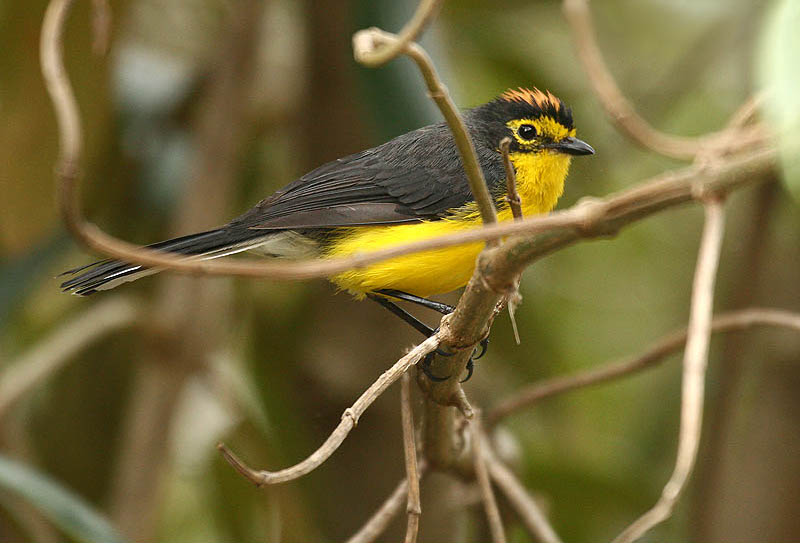
Slate-throated Redstart
Myioborus miniatus
Order: Passeriformes / Family: Parulidae

Wikimedia Commons
About the Slate-throated Redstart
The Slate-throated Redstart (Myioborus miniatus) is a small, striking songbird belonging to the family Parulidae. This species is renowned for its vibrant appearance and lively behavior, making it a favorite among ornithologists and birdwatchers alike. It primarily inhabits montane forests throughout Central and South America, ranging from Mexico down to Bolivia. The redstart's presence in these regions highlights its adaptability to a variety of elevational zones, from 600 meters to over 3,000 meters above sea level. This adaptability allows it to thrive in various forest types, including subtropical and tropical moist forests. Ecologically, the Slate-throated Redstart plays an important role in controlling insect populations. By foraging actively for insects, it aids in maintaining a balanced ecosystem. This species is also a notable indicator of forest health, with its presence often signaling a rich and diverse environment. The redstart demonstrates distinct seasonal behaviors. During the breeding season, which varies by location but typically spans from March to July, the bird exhibits increased territoriality and vocal activity. As the season changes, its focus shifts to finding food, often joining mixed-species flocks to forage more efficiently. This versatile bird's adaptability to different habitats and elevations underscores its ecological significance in the regions it inhabits.
The Slate-throated Redstart belongs to the family Parulidae, within the order Passeriformes. These birds typically live average 4-5 years with a max recorded of 7 years.
How to Identify a Slate-throated Redstart
The Slate-throated Redstart is unmistakable with its bright red belly contrasting sharply with its slate-colored throat and upperparts. Adult males and females share similar plumage, which features a striking combination of slate gray, black, and red. However, slight sexual dimorphism may occur, with males showing slightly brighter red underparts. Juveniles are less vividly colored, often displaying a more subdued gray and brown plumage that gradually brightens with age. In flight, the redstart's tail, with its white outer feathers, becomes a key identification feature, flaring open to reveal a distinctive pattern that aids in startling insects during foraging. The bird's perching posture is often upright and alert, allowing it to quickly spot potential prey. Among similar species, the Slate-throated Redstart can be confused with the Painted Redstart, but the latter lacks the slate throat and has a more extensive white wing patch.
Having trouble telling birds apart? Upload a photo to our bird identification tool for an instant species match.
Slate-throated Redstart Habitat and Range
Preferred Habitat
The Slate-throated Redstart thrives in montane and cloud forests, typically at elevations ranging from 600 to 3,000 meters. It favors habitats with dense understory vegetation, which provides ample foraging opportunities and nesting sites. These forests are often characterized by a high level of humidity and a complex structure, offering the redstart a rich array of insect prey. While primarily a forest dweller, this species can occasionally be found in adjacent shrubby or semi-open areas, particularly during non-breeding seasons. The bird's preference for high-altitude forests makes it less common in urban areas, though it may venture into rural gardens if suitable cover and food sources are available.
Geographic Range
The Slate-throated Redstart's range extends from the mountainous regions of southern Mexico through Central America, reaching as far south as Bolivia in South America. It is a resident species throughout much of its range, with populations in countries such as Guatemala, Costa Rica, and Colombia being particularly dense. While not migratory in the traditional sense, the redstart may exhibit altitudinal movements, shifting to lower elevations during colder months or when food becomes scarce. These movements are more pronounced in the northern parts of its range, where seasonal temperature variations are more significant.
Want to know which birds visit your area? Browse our backyard birds by location guides for region-specific species lists.
What Does the Slate-throated Redstart Eat?
Primarily insectivorous, the Slate-throated Redstart feeds on a wide variety of insects and spiders. It employs a distinctive foraging technique known as 'flush-pursuit,' where it flits its tail to startle insects into motion before capturing them mid-air. This method is highly effective in the dense understory where visibility is limited. The bird's diet can vary seasonally, with a higher intake of caterpillars and other insects during the breeding season to meet the nutritional demands of feeding young. During leaner months, the redstart may supplement its diet with small fruits and seeds, showcasing its dietary adaptability.
Slate-throated Redstart Behavior and Social Structure
The Slate-throated Redstart is a highly active and social bird, often seen flitting energetically through the forest understory. It tends to forage in pairs or small family groups, displaying a notable level of cooperation during the breeding season. This species is also known to join mixed-species flocks, which enhances its foraging success and provides additional protection against predators. Territorial behavior becomes pronounced during the breeding season, with males singing vigorously to defend their chosen area. Courtship involves complex displays, including tail fanning and aerial chases, aimed at securing a mate. The redstart maintains a daily routine of active foraging interspersed with periods of rest and preening.
Slate-throated Redstart Nesting and Reproduction
Slate-throated Redstarts typically nest on the ground or in low shrubs, often concealed well within dense vegetation. The nest is a cup-shaped structure fashioned from grasses, leaves, and moss, providing excellent camouflage. A typical clutch consists of 2 to 4 eggs, which are incubated primarily by the female for about 12 to 14 days. Both parents participate in feeding the fledglings, ensuring a high level of care. The fledgling period lasts approximately 10 to 12 days, after which the young birds continue to rely on the parents for food and protection until they can fend for themselves. The species typically raises one to two broods per year, depending on environmental conditions.
Slate-throated Redstart Sounds and Vocalizations
The song of the Slate-throated Redstart is a melodious series of high-pitched notes that can be described as cheerful and lively. This song serves both to attract mates and to establish territory. In addition to its primary song, the redstart produces a variety of call notes, including sharp chips and trills used for communication between mates and during flocking. Alarm calls are more abrupt and harsh, serving to warn of potential predators. During the dawn chorus, the redstart's song is particularly prominent, contributing to the rich acoustic environment of its forest home.
Interesting Facts About the Slate-throated Redstart
- 1Despite its name, the Slate-throated Redstart's red coloration is actually a vibrant orange-red, making it one of the most colorful members of its genus.
- 2This bird's 'flush-pursuit' foraging technique is so effective that it has inspired studies on its potential applications in understanding prey-predator dynamics.
- 3In some regions, the Slate-throated Redstart is known as the 'whitestart,' a nod to the conspicuous white tail markings that are key to its foraging strategy.
- 4The Slate-throated Redstart is a prime example of Bergmann's rule, with larger individuals typically found in the cooler, higher altitudes of its range.
- 5Research has shown that the Slate-throated Redstart has a varied song repertoire, with regional dialects that differ across its expansive geographic range.
- 6Ornithologists have observed that Slate-throated Redstarts are highly responsive to pishing, a technique used by birdwatchers to attract birds by mimicking their alarm calls.
- 7The Slate-throated Redstart's tail fanning behavior is not just for foraging; it also plays a crucial role in courtship displays and territorial disputes.
Slate-throated Redstart Conservation Status
The Slate-throated Redstart is currently listed as Least Concern by the IUCN, with stable population trends across its range. However, habitat loss due to deforestation and land conversion poses a significant threat. Conservation efforts focus on preserving montane and cloud forest habitats, which are essential to the species' survival. Protected areas and reserves play a crucial role in maintaining viable populations, while reforestation projects offer hope for degraded areas. Historically, the bird has shown resilience, but ongoing habitat preservation is vital for its continued well-being.
Other Parulidae Species


Birds Similar to the Slate-throated Redstart
These species are often confused with the Slate-throated Redstart due to similar appearance or overlapping range.