
Small-billed Tinamou
Crypturellus parvirostris
Order: Tinamiformes / Family: Tinamidae
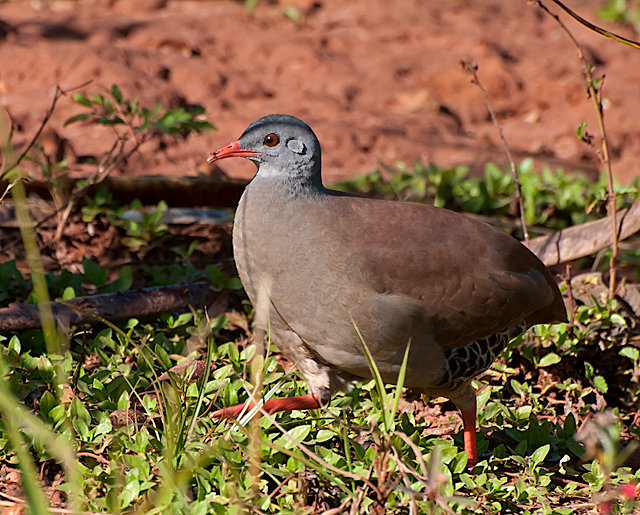
Wikimedia Commons
About the Small-billed Tinamou
The Small-billed Tinamou, Crypturellus parvirostris, is a fascinating bird species found primarily in the forests and scrublands of South America. This bird is part of the Tinamidae family, which is notable for its close evolutionary ties with the ratites, including ostriches and emus. Despite its relatively small size, the Small-billed Tinamou plays an important ecological role as both a seed disperser and a prey species for larger predators.
This species inhabits a range of environments across its distribution, from subtropical forests to semi-arid regions. It is particularly prevalent in countries like Brazil, Paraguay, and Argentina, where it contributes to the biodiversity of these ecosystems. The Small-billed Tinamou is a ground-dwelling bird that relies on its cryptic plumage to blend seamlessly into the forest floor, making it a master of stealth.
Ecologically, the Small-billed Tinamou plays a crucial role in its habitat. By foraging on the ground, it aids in seed dispersal, thereby assisting in maintaining plant diversity. The bird’s diet consists mainly of fruits, seeds, and small invertebrates, which align with its role as a seed disperser and a crucial link in the food chain. During the breeding season, typically between September and March, the Small-billed Tinamou exhibits interesting behavioral adaptations. Males are known for their role in incubating eggs and caring for the young, a trait that is relatively rare among birds.
As seasons change, so do the behaviors and roles of the Small-billed Tinamou. During the wet season, they are more vocal and active, taking advantage of the abundance of food. In contrast, the dry season poses challenges with food scarcity, during which the bird's adaptability and foraging skills are put to the test. Despite these challenges, the Small-billed Tinamou remains a resilient species, capable of thriving across a range of habitats and climatic conditions.
The Small-billed Tinamou belongs to the family Tinamidae, within the order Tinamiformes. These birds typically live average 5-10 years, with a maximum recorded of 12 years..
How to Identify a Small-billed Tinamou
Identifying the Small-billed Tinamou involves noting several key characteristics. Adults showcase a generally brown and gray plumage, which provides excellent camouflage among the leaf litter of their forest habitat. The bird's small, curved bill is a distinctive trait, setting it apart from other tinamous with larger bills. Males and females are similar in appearance, though females may be slightly larger and more robust.
Juveniles resemble adults but tend to have slightly duller plumage, allowing them to blend into their surroundings as they mature. The Small-billed Tinamou's rounded body, short tail, and relatively long legs are typical of ground-dwelling birds, aiding in its swift movement through underbrush.
The bird's flight silhouette is characterized by rounded wings that are not well-suited for long distances. Instead, the Small-billed Tinamou relies on quick, short bursts of flight to escape predators. When disturbed, it is more likely to run than fly, using its coloration and speed to evade detection. Its posture is usually crouched and low to the ground, which helps it remain inconspicuous.
Having trouble telling birds apart? Upload a photo to our bird identification tool for an instant species match.
Small-billed Tinamou Habitat and Range
Preferred Habitat
The Small-billed Tinamou inhabits a variety of habitats in South America, each offering unique conditions for survival. Primarily, it thrives in subtropical and tropical forests, where dense vegetation provides ample cover. These forests are often found at elevations ranging from sea level to about 1,500 meters, allowing the bird to exploit a wide range of ecological niches.
Aside from forests, the Small-billed Tinamou is also found in shrublands and savannas, particularly in regions with scattered trees and dense undergrowth. These habitats offer the bird both food resources and protection from predators. In more arid areas, it shows a preference for locations that provide some moisture, such as riparian zones.
Seasonal changes influence the habitat preferences of this bird. During wetter months, it is more likely to be found in denser forested areas, while in drier periods, it may move to more open habitats where food is more accessible. Although primarily a rural species, the Small-billed Tinamou occasionally ventures into the outskirts of urban areas, particularly where green spaces or gardens provide suitable cover.
Geographic Range
The Small-billed Tinamou has a broad distribution range across South America, with its presence recorded in countries such as Brazil, Paraguay, Argentina, and Bolivia. This bird is largely non-migratory, residing in its range year-round, though it may exhibit local movements in response to seasonal food availability.
In Brazil, it is found across much of the eastern and central parts of the country, with significant populations in the Atlantic Forest and Cerrado biomes. In Argentina, it is more common in the northern and northeastern regions, where forested landscapes offer ideal habitats. Paraguay serves as a central hub of its range, with extensive forests that support a stable population.
Population density of the Small-billed Tinamou varies according to habitat quality, with larger numbers recorded in undisturbed forest areas. In regions where deforestation has occurred, the bird's population may be more fragmented, confined to isolated patches of suitable habitat. Despite these challenges, its adaptability to a range of habitats has enabled it to maintain a widespread presence across its range.
Want to know which birds visit your area? Browse our backyard birds by location guides for region-specific species lists.
What Does the Small-billed Tinamou Eat?
The diet of the Small-billed Tinamou primarily consists of fruits, seeds, and small invertebrates, reflecting its role as both a herbivore and insectivore. This varied diet allows it to adapt to different seasonal food availabilities. During the wet season, when fruits and insects are abundant, the Small-billed Tinamou forages actively on the forest floor.
Fruits are a significant part of its diet, with the bird often consuming berries and fallen fruits from a variety of native trees and shrubs. Seeds are also crucial, providing a reliable food source during drier periods when other resources might be scarce. The bird's small bill is well-suited for picking up seeds and small pieces of food from the ground.
Insects and other invertebrates supplement the Small-billed Tinamou's diet, especially when it is rearing young. These protein-rich foods are essential for the growth and development of chicks. The bird typically forages alone or in pairs, using its keen eyesight to spot potential food items among the leaf litter.
Small-billed Tinamou Behavior and Social Structure
The Small-billed Tinamou exhibits a range of interesting behaviors, particularly in its social structure and interactions. Typically solitary or found in pairs, these birds are known for their elusive nature, often remaining hidden in dense vegetation. The Small-billed Tinamou is generally non-territorial, though it may exhibit some degree of territoriality during the breeding season.
Courtship displays are a notable aspect of their behavior. Males engage in vocalizations to attract females, producing a series of soft, whistling calls that serve both to announce their presence and to establish a bond with potential mates. Once paired, the male takes on the primary role in incubating eggs and caring for the young, a behavior that is less common among birds. This role reversal is a distinctive feature of the Small-billed Tinamou's breeding strategy.
In response to predators, the Small-billed Tinamou relies on its camouflage and speed. When threatened, it prefers to run rather than fly, using the dense underbrush as cover. Its daily activities are primarily crepuscular, with peaks in activity during dawn and dusk when it forages for food.
Small-billed Tinamou Nesting and Reproduction
Nesting for the Small-billed Tinamou involves ground nests, which are simple scrapes lined with leaves and other vegetation. These nests are typically situated in well-concealed locations, such as under dense shrubs or among tall grasses, to protect against predators. Clutch sizes vary but generally consist of 2 to 5 eggs, which are smooth and glossy, providing some camouflage against the forest floor.
The incubation period lasts about 16 to 20 days and is primarily the responsibility of the male. This role reversal is noteworthy, as it is the male who incubates the eggs and cares for the hatchlings. After hatching, the young are precocial, meaning they are relatively mature and mobile, able to follow the parent almost immediately.
Fledging occurs quickly, with the young leaving the nest within a few days to a week. The male continues to care for and protect the chicks until they are fully independent. The Small-billed Tinamou typically raises one brood per year, though favorable conditions may allow for a second brood.
Small-billed Tinamou Sounds and Vocalizations
The vocalizations of the Small-billed Tinamou are characterized by soft, whistling calls, often heard at dawn and dusk. The primary song consists of a series of mellow, descending notes, which can be described as soothing and somewhat melancholic. These calls serve both to establish territory and to facilitate communication between mates.
Call notes are typically brief and low-pitched, functioning as contact calls to keep pairs together while foraging in dense vegetation. Alarm calls, on the other hand, are sharper and more urgent, alerting mates and nearby birds to potential danger. During the breeding season, males are more vocal, using their calls to attract females and to fend off potential rivals.
Listeners might compare the Small-billed Tinamou's song to the sound of a distant flute, its quality and rhythm providing a distinctive audio signature in its natural habitat.
Interesting Facts About the Small-billed Tinamou
- 1The Small-billed Tinamou is one of approximately 47 species in the Tinamidae family, demonstrating remarkable diversity.
- 2Despite being capable of flight, the Small-billed Tinamou prefers to run from predators, showcasing its adept terrestrial skills.
- 3The bird's soft, whistling song can travel through dense forest, making it easier to hear than to see.
- 4Small-billed Tinamous are important seed dispersers, contributing to the maintenance of plant diversity in their habitats.
- 5The male's role in incubation and chick-rearing is uncommon among birds, highlighting unique behavioral adaptations.
- 6The Small-billed Tinamou's compact size and ground-dwelling nature make it one of the more elusive birds in its range.
- 7This species is often found in sympatry with other tinamou species, sharing the same habitats without direct competition.
Small-billed Tinamou Conservation Status
The IUCN currently lists the Small-billed Tinamou as a species of Least Concern, indicating that its populations are relatively stable. However, habitat destruction due to deforestation and agricultural expansion poses a significant threat to its long-term survival. In some areas, populations have become fragmented as a result of these activities. Conservation efforts focus on preserving large tracts of forested areas and promoting sustainable land use practices. Protected areas in key regions like the Atlantic Forest and Cerrado help safeguard vital habitats for the Small-billed Tinamou and other species. Monitoring population trends is essential to ensure that this species remains common and widespread across its range. Historically, the Small-billed Tinamou has shown resilience to human encroachment, though continued habitat loss could impact its numbers. Maintaining healthy populations requires ongoing conservation measures and public awareness to address the challenges posed by habitat degradation.


