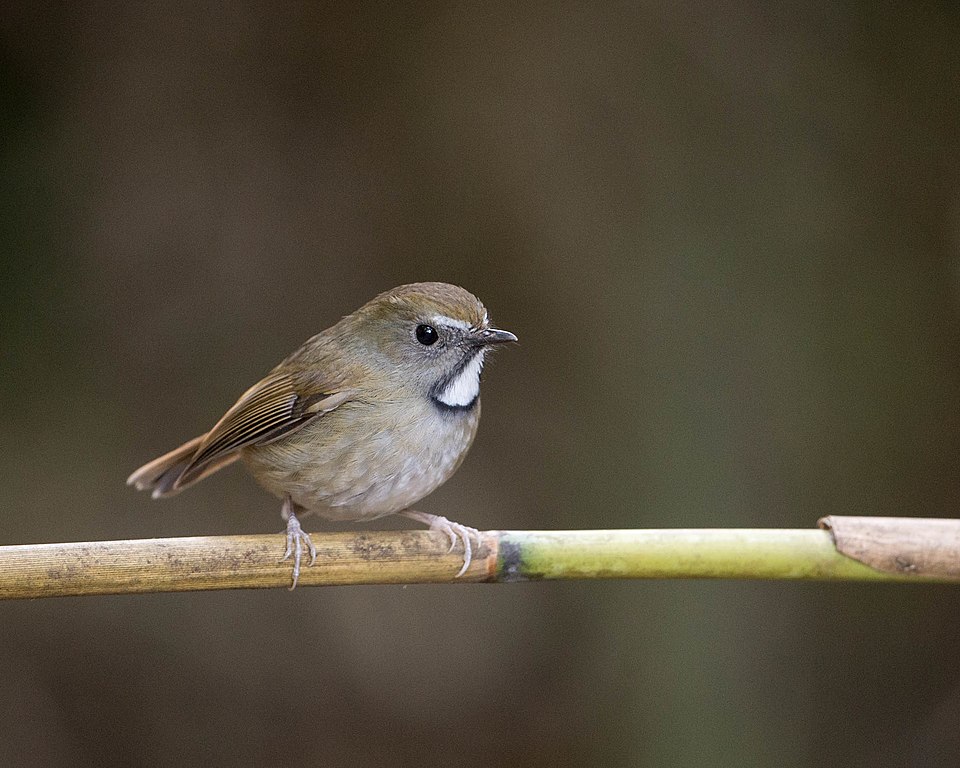
Snowy-crowned Robin-Chat
Cossypha niveicapilla
Order: Passeriformes / Family: Muscicapidae

Wikimedia Commons
About the Snowy-crowned Robin-Chat
The Snowy-crowned Robin-Chat (Cossypha niveicapilla) is a striking songbird found predominantly across the tropical and subtropical regions of sub-Saharan Africa. This species, a member of the Muscicapidae family, plays a crucial role in the ecosystems of its native habitats by aiding in pest control and seed dispersion. Its range extends from Senegal and Gambia in the west, across to Uganda and Kenya in the east, and down to Zambia in the south. The Snowy-crowned Robin-Chat is particularly associated with dense, moist woodlands and riverine forests, thriving in areas with ample undergrowth and foliage. These environments provide the cover and resources necessary for their foraging and nesting habits. Typically, this bird is not migratory, though it may undertake local movements to exploit seasonal food abundance or to find optimal nesting sites during the breeding season. In its role as an insectivore, the Snowy-crowned Robin-Chat contributes significantly to controlling insect populations. Additionally, by consuming fruits and berries, it assists in the spread of seeds, facilitating forest regeneration and maintaining biodiversity. The Snowy-crowned Robin-Chat is not just a passive resident of its environment but an active participant in the ecological balance, influencing both the flora and fauna of its habitat. During the breeding season, which varies slightly with geography, these birds are known for their melodious singing, a behavior that plays a key role in courtship and territorial defense. Their song, a rich and varied mix of whistles and chatters, can often be heard at dawn and dusk, echoing through the forest. The Snowy-crowned Robin-Chat's adaptability to different forest types, including secondary growth and modified habitats near human settlements, exemplifies its resilience. However, ongoing deforestation and habitat fragmentation present significant challenges, emphasizing the need for continued conservation efforts to ensure its survival. Despite these threats, current population trends remain stable, largely owing to the bird's wide distribution and adaptability.
The Snowy-crowned Robin-Chat belongs to the family Muscicapidae, within the order Passeriformes. These birds typically live 6-8 years in the wild..
How to Identify a Snowy-crowned Robin-Chat
The Snowy-crowned Robin-Chat is easily identifiable by its distinctive white crown, which contrasts sharply with its otherwise dark plumage. Adults exhibit a predominantly gray to black upper body, with the white crown being the most conspicuous feature. The underparts are a vibrant orange, extending from the throat to the undertail. Males and females look similar, although males may have slightly brighter plumage during the breeding season. Juveniles differ from adults by having a more subdued coloration, lacking the pronounced white crown, and displaying a mottled brown pattern on their upperparts. In flight, the Snowy-crowned Robin-Chat shows a rounded wing silhouette and a relatively short tail, which can make it less conspicuous except for its white crown. When perched, it often adopts an upright posture, frequently flicking its tail up and down. This behavior, along with its distinctive coloration, helps differentiate it from similar species such as the White-crowned Robin-Chat (Cossypha albicapilla), which has a larger size and different geographical range. Confusion may also arise with the African Stonechat (Saxicola torquatus), but the latter lacks the vibrant orange underparts and white-crowned head.
Having trouble telling birds apart? Upload a photo to our bird identification tool for an instant species match.
Snowy-crowned Robin-Chat Habitat and Range
Preferred Habitat
The Snowy-crowned Robin-Chat inhabits a variety of forested environments, including dense riverine forests, moist lowland forests, and wooded savannas. It prefers areas with thick undergrowth, where it can forage and nest in relative safety. Although primarily found at low elevations, it can also be seen in montane forests up to 2000 meters. During the dry season, these birds may shift to areas with remaining water sources and abundant food, though they generally avoid open or heavily deforested landscapes. In some regions, they have adapted to living near human settlements, utilizing gardens and parks that mimic their natural forest habitats.
Geographic Range
The Snowy-crowned Robin-Chat's range extends widely across sub-Saharan Africa. It is resident in countries such as Nigeria, Ghana, and Cameroon, stretching eastward to Uganda, Kenya, and Tanzania. Southern populations reach Zambia and northern Angola. While the species is largely non-migratory, it may exhibit local movements in response to food availability and environmental conditions. Population density is highest in regions with extensive forest cover, such as the Congolese rainforest, where the bird benefits from high insect and fruit availability. In West Africa, its presence is notable in forested areas of Ivory Coast and Sierra Leone, where it contributes to the rich biodiversity of these regions.
Want to know which birds visit your area? Browse our backyard birds by location guides for region-specific species lists.
What Does the Snowy-crowned Robin-Chat Eat?
The Snowy-crowned Robin-Chat primarily feeds on insects, which it captures through a variety of foraging techniques. It often engages in 'gleaning,' picking insects off leaves and branches, and can also be observed foraging on the ground, turning over leaf litter in search of prey. Its diet includes beetles, ants, and caterpillars, with occasional consumption of spiders and small vertebrates. During the fruiting season, the bird supplements its diet with berries and small fruits, playing a role in seed dispersal. Feeding activity peaks during the early morning and late afternoon, aligning with periods of increased insect activity.
Snowy-crowned Robin-Chat Behavior and Social Structure
The Snowy-crowned Robin-Chat is predominantly solitary or found in pairs, especially during the breeding season. It exhibits strong territorial behavior, with males singing from prominent perches to defend their territory. Courtship involves vocal displays and acrobatic flights, with pairs often seen chasing each other through the forest canopy. Unlike some other robins, this species rarely forms large flocks, though loose foraging groups may occur in areas with abundant food. The bird's response to predators includes a range of alarm calls and evasive flight maneuvers. Daily activity revolves around foraging, with peak periods in the early morning and late afternoon. The Snowy-crowned Robin-Chat is predominantly diurnal, retreating to dense cover during the midday heat.
Snowy-crowned Robin-Chat Nesting and Reproduction
The Snowy-crowned Robin-Chat constructs its nest in dense vegetation, often close to the ground. It prefers secluded sites such as thickets or the base of trees. The nest is a cup-shaped structure made from twigs, leaves, and other plant materials, lined with softer fibers for insulation. A typical clutch contains two to three eggs, which the female incubates for about 14 days. Both parents participate in feeding the chicks, which fledge approximately 14 to 16 days after hatching. The species generally raises one brood per year, though in regions with extended breeding seasons, a second brood may occur. Parental care continues for several weeks post-fledging as the young learn to forage independently.
Snowy-crowned Robin-Chat Sounds and Vocalizations
The Snowy-crowned Robin-Chat's song is a series of melodious whistles and chatters, rich in variety and often delivered from a concealed perch. Its pitch ranges from high to medium, with a rhythmic quality that can be both soothing and vibrant. Calls are typically short and sharp, used for communication between pairs or to signal alarm. During the dawn chorus, its song blends with those of other forest birds, creating a symphonic tapestry. In alarm situations, the bird emits a rapid 'chack-chack' sound, reminiscent of the call of a distant squirrel.
Interesting Facts About the Snowy-crowned Robin-Chat
- 1The Snowy-crowned Robin-Chat can mimic the calls of other bird species, showcasing its vocal versatility.
- 2Despite its vivid appearance, this bird is adept at staying hidden within the dense undergrowth of forests.
- 3Its melodious song is often compared to that of the Nightingale, renowned for its beauty and complexity.
- 4The species exhibits a unique tail-flicking behavior, used in both communication and foraging.
- 5During the breeding season, males sing more frequently to establish and defend their territories.
- 6The Snowy-crowned Robin-Chat can adapt to modified habitats, including gardens and urban parks.
- 7It plays a vital ecological role by controlling insect populations and dispersing seeds within its habitat.
Snowy-crowned Robin-Chat Conservation Status
The Snowy-crowned Robin-Chat is classified as Least Concern by the IUCN, with a stable population trend. However, habitat loss due to deforestation and land conversion poses significant threats. Conservation efforts focus on habitat preservation and management, particularly in areas of high biodiversity like national parks and reserves. Historical population data indicates a stable presence across its range, although localized declines have been noted in heavily deforested regions. Efforts to mitigate habitat destruction will be crucial in maintaining its populations.