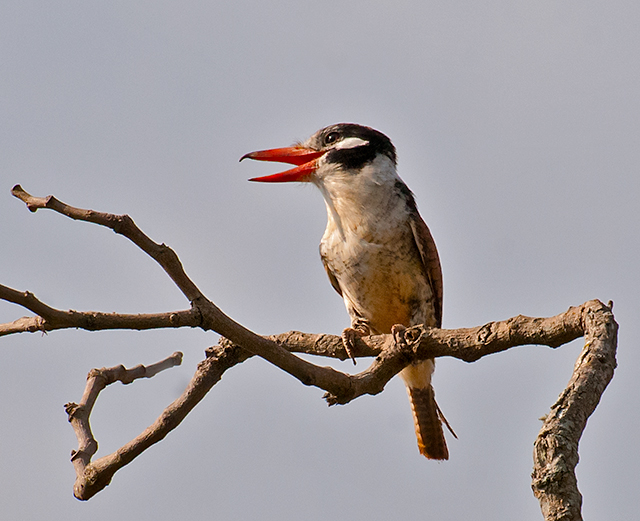
Sooty-capped Puffbird
Bucco noanamae
Order: Piciformes / Family: Bucconidae

Wikimedia Commons
About the Sooty-capped Puffbird
The Sooty-capped Puffbird (Bucco noanamae) occupies a unique niche within the avifaunal community of the Neotropics. Known for its striking appearance and elusive nature, this bird is primarily found in the humid lowland forests of western Colombia and adjacent areas in Panama. Unlike many of its relatives, the Sooty-capped Puffbird maintains a relatively small and fragmented distribution, which makes it an intriguing subject for ornithologists and conservationists alike. Its presence is often an indicator of healthy, undisturbed forest habitats, as the species prefers dense, mature forests where it can remain concealed from predators and human disturbance. Ecologically, the Sooty-capped Puffbird plays a crucial role as both a predator and prey within its ecosystem. By hunting insects and small vertebrates, it helps regulate these populations, contributing to the complex food web of the forest. Its predatory behavior is typical of the Bucconidae family, characterized by a sit-and-wait hunting strategy. During the breeding season, which generally coincides with the early rainy season, the puffbird becomes more vocal and assertive in defending its territory. This period also sees an increase in insect abundance, providing ample food for raising young. Outside the breeding season, the Sooty-capped Puffbird may roam more widely within its range, though it remains largely sedentary. The species' reliance on specific habitat types underscores its vulnerability to deforestation and habitat degradation, emphasizing the need for targeted conservation efforts to ensure its survival.
The Sooty-capped Puffbird belongs to the family Bucconidae, within the order Piciformes. These birds typically live estimated lifespan is around 5-7 years, though little data is available due to its elusive nature..
How to Identify a Sooty-capped Puffbird
The Sooty-capped Puffbird is a medium-sized bird with a robust body and a distinctive black crown, which gives it its name. Adults exhibit a striking contrast between the dark crown and the rest of the head, which is predominantly white. The back and wings are a rich brown, providing excellent camouflage against the bark and foliage of its forest habitat. Notably, the puffbird's bill is stout and slightly hooked, adapted for capturing and dispatching prey. Juveniles resemble adults but may have slightly duller plumage and less distinct markings. Males and females are similar in appearance, making gender differentiation in the field challenging without behavioral cues. The Sooty-capped Puffbird's flight silhouette is compact and direct, with short, rounded wings that allow for agile maneuvers through dense vegetation. When perched, it often adopts an upright posture, appearing alert and motionless, a behavior that aids in its camouflage. Despite its distinctive features, observers might confuse this species with other puffbirds or similarly sized tropical birds, but its unique combination of coloration and habitat preference helps in proper identification.
Having trouble telling birds apart? Upload a photo to our bird identification tool for an instant species match.
Sooty-capped Puffbird Habitat and Range
Preferred Habitat
The Sooty-capped Puffbird inhabits dense, humid lowland forests, favoring areas with heavy canopy cover and minimal human disturbance. These forests provide the ideal environment for its sit-and-wait predation strategy. The species can be found at elevations ranging from sea level to about 500 meters, though it is most commonly seen in the lowlands. Unlike some birds that adapt to fragmented habitats or edge environments, the Sooty-capped Puffbird shows a strong preference for contiguous forest tracts. Seasonal shifts in habitat are minimal, as the bird tends to remain in its preferred environment year-round. While urban presence is rare due to its reliance on undisturbed forests, small populations may occasionally occur in rural forest fragments, provided these areas are sufficiently dense and protected from agricultural encroachment.
Geographic Range
The Sooty-capped Puffbird's range is primarily confined to the lowland tropical forests of western Colombia and southwestern Panama. It inhabits the Chocó biogeographical region, which is known for its high biodiversity and endemism. The bird's distribution is quite limited, and it is considered rare throughout its range. There are no significant migration corridors for this species, as it is largely sedentary. Population density is higher in areas where forest cover is extensive and intact, particularly within protected reserves such as Colombia's Utría National Park and Panama's Darién National Park. These hotspots are crucial for the bird's conservation, providing critical habitat that supports its breeding and foraging activities.
Want to know which birds visit your area? Browse our backyard birds by location guides for region-specific species lists.
What Does the Sooty-capped Puffbird Eat?
The Sooty-capped Puffbird primarily feeds on insects and small vertebrates, including lizards and frogs, which it captures using a patient sit-and-wait approach. It remains motionless on a perch, scanning for movement on the forest floor or in the understory. Once prey is detected, the puffbird executes a swift plunge to capture it with its robust bill. The diet varies seasonally, with a higher proportion of insects consumed during the wet season when they are most abundant. Prey size typically ranges from small insects to larger arthropods and small amphibians. Foraging usually occurs during the early morning and late afternoon, with less activity during the heat of midday. This feeding schedule allows the puffbird to take advantage of increased prey activity at cooler times of day.
Sooty-capped Puffbird Behavior and Social Structure
The Sooty-capped Puffbird is largely solitary, though it may be seen in pairs during the breeding season. It maintains a territory that it defends vocally, using its loud, distinctive calls to deter intruders and attract mates. Courtship displays are subtle, often involving mutual preening and gentle bill-touching between pairs. Unlike many birds, the puffbird does not form large flocks; it prefers the company of just one or two birds at most. When confronted by potential predators, the puffbird relies on its cryptic plumage and motionless posture to avoid detection. Its daily activities follow a predictable pattern, with periods of intense foraging interspersed with long intervals of inactivity, during which it rests or preens. This behavior maximizes energy efficiency and reduces exposure to predators.
Sooty-capped Puffbird Nesting and Reproduction
The nesting habits of the Sooty-capped Puffbird are typical of the Bucconidae family, with a preference for nesting in cavities. These cavities are often excavated into earthen banks or termite mounds, providing a secure environment for eggs and chicks. The female typically lays a clutch of two to three eggs, which both parents incubate over a period of approximately 16 to 18 days. Once hatched, the chicks remain in the nest for about three weeks before fledging. During this time, both parents are actively involved in feeding and caring for the young, bringing a steady supply of insects and other prey to the nest. The species generally raises one brood per year, though in favorable conditions, a second brood is possible. Nesting sites are carefully chosen to minimize the risk of predation and disturbance.
Sooty-capped Puffbird Sounds and Vocalizations
The Sooty-capped Puffbird's primary song is a series of melodious whistles, each note rising and falling in pitch with a clear, flute-like quality. These vocalizations serve both territorial and courtship functions, often heard at dawn and dusk when the bird is most active. The call notes are sharp and piercing, used to communicate with mates or signal alarm. When disturbed, the puffbird may emit a rapid succession of short, harsh notes, alerting nearby individuals to potential threats. The dawn chorus, a cacophony of calls from various species, provides a backdrop against which the puffbird's distinct song can be identified by experienced birders.
Interesting Facts About the Sooty-capped Puffbird
- 1The Sooty-capped Puffbird's Latin name, Bucco noanamae, honors the Noanamá indigenous people of Colombia, reflecting its cultural significance.
- 2Unlike many birds that build nests in trees, the Sooty-capped Puffbird prefers to nest in cavities, often burrowed into termite mounds or riverbanks.
- 3The bird's distinct black crown is not just for show; it serves as effective camouflage in the dappled light of its forest habitat.
- 4Sooty-capped Puffbirds are part of the Bucconidae family, known as puffbirds due to their fluffy, puffed-up appearance when resting.
- 5They are a crucial part of their ecosystem, controlling insect populations and serving as prey for larger predators.
- 6The Sooty-capped Puffbird's song is a series of melodious whistles, often compared to the clear notes of a woodwind instrument.
- 7Their reliance on intact forest habitats makes Sooty-capped Puffbirds sensitive indicators of environmental health and biodiversity.
Sooty-capped Puffbird Conservation Status
The Sooty-capped Puffbird is currently listed as Near Threatened on the IUCN Red List, reflecting its limited distribution and the ongoing threat of habitat loss. The primary threat to its survival is deforestation, driven by agricultural expansion, logging, and infrastructure development in its native range. Despite these challenges, some populations exist within protected areas, offering hope for their preservation. Conservation efforts focus on habitat protection and restoration, as well as raising awareness of the species' ecological importance. Historical population trends are difficult to assess due to the bird's elusive nature, but ongoing research aims to provide a clearer picture of its status and inform future conservation strategies.
Other Bucconidae Species


Birds Similar to the Sooty-capped Puffbird
These species are often confused with the Sooty-capped Puffbird due to similar appearance or overlapping range.