
Southern Gray-headed Sparrow
Passer diffusus
Order: Passeriformes / Family: Passeridae
Wikimedia Commons
About the Southern Gray-headed Sparrow
The Southern Gray-headed Sparrow (Passer diffusus) is a small passerine bird widely distributed across the southern regions of Africa. It plays a crucial role in the ecosystems it inhabits, often serving as both a seed disperser and an insect control agent. This sparrow is a member of the family Passeridae and is commonly found in a variety of environments ranging from savannas and grasslands to urban areas. Its adaptability to diverse habitats makes it a resilient species. The Southern Gray-headed Sparrow is an essential part of the avian community in southern Africa, contributing to seed dispersal and the control of insect populations. During the breeding season, typically coinciding with the rainy season, these sparrows become especially active as they gather nesting materials and forage for food to feed their young. They are known for their sociable nature and often form loose colonies, particularly in urban settings where resources are abundant. Outside the breeding season, these sparrows form larger flocks, often mingling with other sparrow species. The Southern Gray-headed Sparrow is notable for its resilience in the face of habitat change. While many bird species are adversely affected by urbanization, this sparrow has adapted well to human-altered environments. It often exploits gardens, parks, and agricultural lands, where it finds ample food and nesting opportunities. Despite its adaptability, the sparrow faces challenges, such as competition with other bird species and predation by domestic cats. Nonetheless, its ability to thrive in both natural and urban settings highlights its ecological flexibility. The Southern Gray-headed Sparrow's presence in various habitats underscores its importance in maintaining ecological balance. By controlling insect populations and dispersing seeds, it contributes to the health and regeneration of its environment. Its adaptability also offers insights into how changing landscapes influence avian populations. As climate change and urbanization continue to alter habitats, the sparrow's ability to adjust may serve as a model for understanding the resilience of other species.
The Southern Gray-headed Sparrow belongs to the family Passeridae, within the order Passeriformes. These birds typically live typically 2-3 years with a maximum recorded of 6 years.
How to Identify a Southern Gray-headed Sparrow
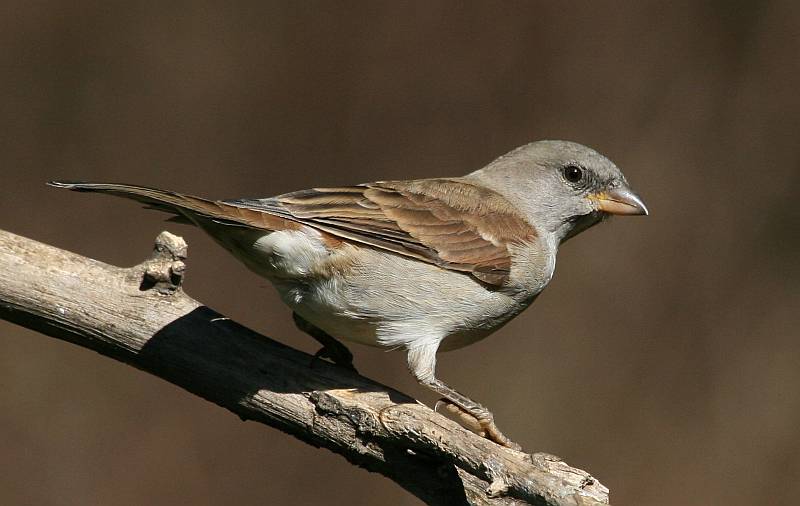
The Southern Gray-headed Sparrow can be easily identified by its distinctive gray head, which contrasts with its brown back and wings. Adult birds exhibit a clear demarcation between the gray of the head and the brown plumage of their body. The underparts are typically a lighter gray or whitish, providing further contrast. Juveniles tend to have a duller appearance, with more muted colors and less distinct head markings. Both males and females share similar plumage, making them difficult to distinguish visually. However, subtle differences exist, such as slightly brighter plumage in males, especially during the breeding season. This species can be confused with the Northern Gray-headed Sparrow (Passer griseus) but can be differentiated by its more restricted range and subtle plumage differences, such as a less pronounced gray on the head. In flight, the Southern Gray-headed Sparrow displays a typical sparrow silhouette, with short, rounded wings and a slightly notched tail. When perched, it often adopts an upright posture, making it easily recognizable even from a distance. Its compact size and shape, combined with its distinctive coloring, make it a bird that is relatively straightforward to identify for both novice and experienced birdwatchers.
Having trouble telling birds apart? Upload a photo to our bird identification tool for an instant species match.
Southern Gray-headed Sparrow Habitat and Range
Preferred Habitat
The Southern Gray-headed Sparrow thrives in a wide range of habitats, including savannas, open woodlands, and agricultural areas. It is also commonly found in urban environments, such as gardens, parks, and city centers, where it exploits the availability of food and nesting sites. The bird typically inhabits elevations ranging from sea level to around 2,000 meters, although it is most frequently observed in lowland regions. During different seasons, the sparrow may shift its habitat slightly, taking advantage of seasonal food resources and nesting opportunities. In rural areas, it often frequents farms and fields, where it can find both food and nesting sites. In urban settings, it makes use of man-made structures and gardens for nesting, often building nests in eaves and other sheltered locations.
Geographic Range
The Southern Gray-headed Sparrow is widely distributed across southern Africa, with its range extending from Angola and Zambia in the north to South Africa in the south. It is a resident bird, meaning it does not undertake significant migratory movements, although some local movements may occur in response to food availability. The bird is common throughout its range, with population densities highest in areas where human habitation provides abundant resources. Countries such as Botswana, Namibia, Zimbabwe, and Mozambique also host significant populations of this adaptable sparrow. Within these countries, the birds can be found in a variety of habitats, from rural farmlands to bustling urban centers.
Want to know which birds visit your area? Browse our backyard birds by location guides for region-specific species lists.
What Does the Southern Gray-headed Sparrow Eat?
The Southern Gray-headed Sparrow has a varied diet that includes seeds, grains, and insects. Seeds form the bulk of its diet, particularly during the dry season when other food sources are scarce. The sparrow forages primarily on the ground, using its strong bill to pick up seeds and small grains. Insects become a more significant part of its diet during the breeding season, providing essential protein for nestlings. The sparrow actively hunts for ants, beetles, and caterpillars, often catching them in the air or picking them off vegetation. Its foraging behavior is opportunistic, and it frequently visits bird feeders in urban areas, where it consumes bread crumbs, seeds, and other human-provided foods. The sparrow's feeding schedule is largely diurnal, with peak activity during the early morning and late afternoon when temperatures are cooler.
Want to attract Southern Gray-headed Sparrows to your yard? See our recommended feeders and seed types for the best results.
Southern Gray-headed Sparrow Behavior and Social Structure
The Southern Gray-headed Sparrow exhibits a range of social behaviors, often forming loose flocks, particularly outside the breeding season. During breeding, pairs establish territories, which they defend vigorously against intruders. Courtship displays include a series of calls and physical postures designed to attract a mate and reinforce pair bonds. The sparrow's social structure is flexible; while it often forms small groups, these can merge into larger flocks, especially in urban areas where food resources are abundant. When faced with predators, the sparrow exhibits alarm calls and seeks cover in dense vegetation or man-made structures. Its daily activities include foraging, preening, and social interactions, with the most active periods occurring in the early morning and late afternoon.
Southern Gray-headed Sparrow Nesting and Reproduction
Southern Gray-headed Sparrows build cup-shaped nests primarily using grass, feathers, and other fine materials. These nests are often constructed in sheltered locations, such as the eaves of buildings or dense foliage. Preferred nesting sites include urban environments where human structures provide ample opportunities for secure nests. The typical clutch size ranges from 2 to 5 eggs, which are incubated by the female for approximately 12 to 14 days. Both parents participate in feeding the chicks, which fledge about two weeks after hatching. The sparrows may produce two to three broods per year, depending on environmental conditions and food availability.
Southern Gray-headed Sparrow Sounds and Vocalizations
The primary song of the Southern Gray-headed Sparrow is a series of chirping notes, often delivered in a repetitive, rhythmic manner. The pitch is medium, and the quality is somewhat harsh compared to the melodious songs of some other passerines. Call notes are simple chirps used for communication within flocks, while alarm calls are sharper and more urgent, designed to warn of predators. At dawn, the sparrow's song is more frequent, contributing to the morning chorus that marks the start of the day in many African landscapes.
Interesting Facts About the Southern Gray-headed Sparrow
- 1The Southern Gray-headed Sparrow can live up to six years in the wild, making it one of the longer-lived sparrows.
- 2This sparrow species is highly adaptable, often nesting in urban areas, including in gutters and streetlights.
- 3The Southern Gray-headed Sparrow is known to hybridize with other sparrow species, such as the Northern Gray-headed Sparrow.
- 4During the breeding season, the sparrow's diet shifts significantly towards protein-rich insects to feed its young.
- 5The sparrow's song, a simple series of chirps, plays a vital role in establishing territory and attracting mates.
- 6Southern Gray-headed Sparrows are often seen in mixed-species flocks, which helps reduce predation risk.
- 7These sparrows are known to use discarded human materials, like strings and paper, in their nest construction.
Southern Gray-headed Sparrow Conservation Status
The Southern Gray-headed Sparrow is currently listed as Least Concern by the IUCN, with stable population trends across its range. Despite its adaptability, habitat loss and degradation remain potential threats, particularly in rapidly urbanizing areas. Conservation efforts focus on maintaining habitat quality and monitoring population changes. Historically, the sparrow's population has remained robust, thanks to its ability to exploit a variety of habitats, including those modified by humans. Continued monitoring is essential to ensure that it remains a common and integral part of Africa's avian biodiversity.
Attracting Southern Gray-headed Sparrows to Your Feeder
The Southern Gray-headed Sparrow is a regular visitor to backyard bird feeders across its range. At the Eye On The Fly feeding station, we observe Southern Gray-headed Sparrows regularly and capture footage with our feeder cameras.


