
Southern Tchagra
Tchagra tchagra
Order: Passeriformes / Family: Malaconotidae
Wikimedia Commons
About the Southern Tchagra
The Southern Tchagra (Tchagra tchagra) is an intriguing member of the family Malaconotidae, known for its rich vocalizations and distinctive plumage. This bird is primarily found in the southern parts of Africa, where it inhabits a variety of habitats from dense woodlands to dry savannas. The Southern Tchagra plays a significant ecological role as both a predator of insects and a seed disperser, contributing to the health of its ecosystem. Its presence is most notable in countries like South Africa, Botswana, and Namibia, where it thrives in thicket-like environments. The Southern Tchagra exhibits fascinating seasonal behaviors, including slight shifts in territory during the breeding season to optimize access to resources. This bird's adaptability to different environments allows it to persist across various landscapes, including rural and semi-urban areas, making it a common yet valued sight among bird enthusiasts. Its ecological role extends beyond mere presence, as it helps control insect populations and disperses seeds, facilitating plant growth and biodiversity. The Southern Tchagra's adaptability is evidenced by its ability to utilize both natural and altered environments, maintaining its population across a wide geographic range. Its behavior changes with the seasons, reflecting a dynamic relationship with its environment. During breeding, it becomes more territorial, often seen in pairs or small family groups. In contrast, outside the breeding season, it may join mixed-species flocks, showcasing its ability to adapt its social structure according to environmental conditions. With its distinctive appearance and vocal prowess, the Southern Tchagra is not just a bird of visual interest but also an acoustic marvel in its habitats. As part of the broader avian community, the Southern Tchagra contributes to the overall soundscape, adding a unique layer to the auditory environment. Its calls and songs serve both as communication tools within species and as a means of delineating territory. Observing the Southern Tchagra offers insights into the complexities of avian life in southern Africa, revealing the interconnectedness of species and habitats.
The Southern Tchagra belongs to the family Malaconotidae, within the order Passeriformes. These birds typically live average 8 years, with a maximum recorded of 13 years..
How to Identify a Southern Tchagra
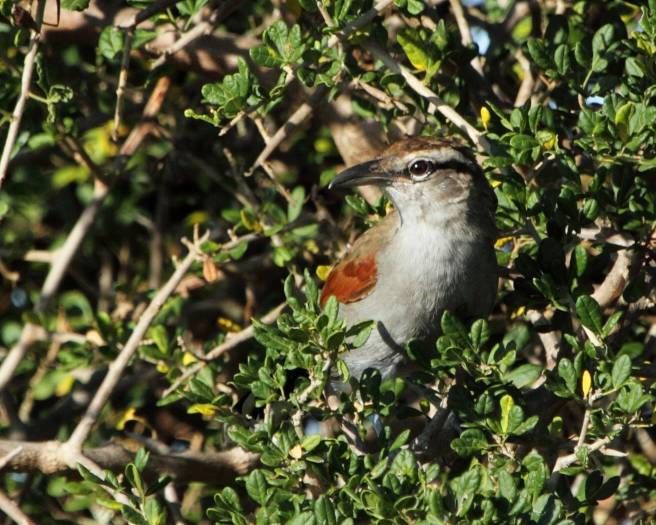
The Southern Tchagra is a medium-sized bird with a striking appearance, easily identifiable by its rich chestnut-brown back and wings, contrasted by a pale underbelly. One of its most distinguishing features is the prominent white supercilium, or 'eyebrow,' which runs above its eyes, providing a sharp contrast to its otherwise muted coloration. Males and females share similar plumage, making them difficult to distinguish at a glance. However, juveniles can be identified by their duller coloration and less distinct markings. In flight, the Southern Tchagra exhibits a rounded wing silhouette, with a relatively short tail compared to other members of the Malaconotidae family. This feature, combined with its distinctive coloration, assists in field identification. When perched, the Southern Tchagra often sits in an upright posture, with its tail slightly cocked, a habit that can aid birdwatchers in recognizing this species even at a distance. Although it shares some superficial similarities with other tchagras and shrikes, the combination of its rich brown plumage and white supercilium makes it stand out. Its vocalizations also play a crucial role in identification, offering a reliable cue for those familiar with its calls.
Having trouble telling birds apart? Upload a photo to our bird identification tool for an instant species match.
Southern Tchagra Habitat and Range
Preferred Habitat
The Southern Tchagra inhabits a range of habitats, predominantly favoring thornveld, scrubby areas, and dense thickets. It is frequently found in regions with acacia trees and other bush-like vegetation, where it can find ample cover and resources. Unlike some other birds, the Southern Tchagra does not restrict itself to pristine wild areas; it is often observed in agricultural lands and even near human settlements, provided there is sufficient cover. This adaptability in habitat choice allows the Southern Tchagra to occupy elevations from sea level up to approximately 2,000 meters. Seasonal shifts in habitat preference are minimal, though during the breeding season, it may choose denser areas to ensure nest protection. Its presence in both urban and rural settings highlights its adaptability and resilience in the face of changing landscapes.
Geographic Range
The Southern Tchagra's range predominantly covers southern Africa, with its core distribution in countries such as South Africa, Namibia, Botswana, Zimbabwe, and parts of Mozambique. Its breeding range is extensive within these regions, where it establishes territories in suitable habitats. Unlike many migratory birds, the Southern Tchagra is largely sedentary, with only minor local movements noted in response to environmental conditions or food availability. In terms of population density, it is more commonly observed in the eastern parts of South Africa, particularly in KwaZulu-Natal and the Eastern Cape, where its preferred habitats are abundant. While its range does not extend far beyond southern Africa, within this area, the Southern Tchagra is widespread and frequently encountered, making it a familiar sight to local birdwatchers.
Want to know which birds visit your area? Browse our backyard birds by location guides for region-specific species lists.
What Does the Southern Tchagra Eat?
The Southern Tchagra primarily feeds on insects, making it an important predator of pests in its ecosystem. Its diet consists of grasshoppers, beetles, caterpillars, and other arthropods, which it skillfully captures using a combination of ground foraging and foliage gleaning techniques. During the breeding season, it may increase its insect intake to meet the higher nutritional demands of chick-rearing. In addition to insects, the Southern Tchagra also consumes seeds and fruits, especially during the non-breeding season when insects are less abundant. Its diverse diet reflects its adaptability and ability to exploit different food sources according to availability. Foraging often occurs during the cooler parts of the day, such as early morning and late afternoon, when insect activity is higher.
Southern Tchagra Behavior and Social Structure
The Southern Tchagra is a socially versatile bird, displaying a range of behaviors depending on the season and environmental conditions. During the breeding season, it becomes distinctly territorial, with pairs actively defending their area from intruders. Courtship displays include a series of vocalizations and subtle physical gestures to strengthen pair bonds. Outside the breeding season, the Southern Tchagra may join mixed-species flocks, which can provide additional protection from predators through increased vigilance. Its daily activity patterns are rhythmic, with peaks of activity in the early morning and late afternoon, aligning with the availability of food resources and optimal environmental conditions. The Southern Tchagra's response to predators involves both vocal alarms and physical displays designed to deter threats, showcasing its strategic approach to survival in the wild.
Southern Tchagra Nesting and Reproduction
The Southern Tchagra builds its nest primarily in dense shrubbery or thorny bushes, utilizing a combination of twigs, grass, and leaves to create a compact cup-like structure. This strategic placement provides both camouflage and protection from predators. The typical clutch size ranges from two to four eggs, which are incubated for about 14 days. Both parents share the responsibility of incubation and feeding the chicks, exhibiting a strong pair bond throughout the breeding season. The fledging period lasts approximately 14 to 16 days, during which the young remain dependent on their parents for food and protection. The Southern Tchagra typically raises one to two broods per year, with breeding often timed to coincide with periods of peak food availability.
Southern Tchagra Sounds and Vocalizations
The Southern Tchagra's vocal repertoire includes a distinctive song characterized by a series of rich, melodious notes that rise and fall in pitch. This song, often heard during the breeding season, serves both as a territorial declaration and a means of attracting mates. Its call notes are sharp and clear, often used for communication between mates or to signal alarm. In the presence of threats, the Southern Tchagra emits a series of short, harsh notes designed to alert others and deter intruders. During the early morning hours, its song contributes to the dawn chorus, adding to the vibrant soundscape of its habitat.
Interesting Facts About the Southern Tchagra
- 1The Southern Tchagra's name 'tchagra' is derived from its distinctive call, which resembles the sound 'tchagra-tchagra.'
- 2Despite its rich song, the Southern Tchagra is not classified as a true songbird, falling instead in the bushshrike family.
- 3The Southern Tchagra is capable of mimicking the calls of other birds, adding complexity to its vocalizations.
- 4This bird is known for its 'anting' behavior, where it uses ants to clean its feathers, a trait shared with few other birds.
- 5Southern Tchagras often engage in mutual grooming, a behavior that strengthens pair bonds and aids in parasite control.
- 6The species' adaptability to both urban and rural environments makes it a successful inhabitant across diverse landscapes.
- 7Although not migratory, the Southern Tchagra may undertake short local movements in response to food availability.
Southern Tchagra Conservation Status
Currently, the Southern Tchagra is listed as a species of Least Concern by the IUCN, reflecting its relatively stable population across its range. However, habitat destruction due to agricultural expansion and urbanization poses ongoing threats. Conservation efforts focus on preserving its natural habitats and monitoring population trends to ensure long-term stability. Historically, the Southern Tchagra has shown resilience, maintaining healthy numbers despite environmental changes. Continued conservation measures are essential to mitigate potential future threats and protect this species' ecological role.


