
Souza's Shrike
Lanius souzae
Order: Passeriformes / Family: Laniidae
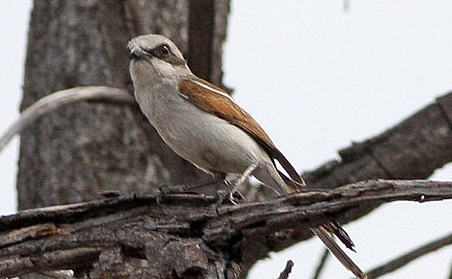
Wikimedia Commons
About the Souza's Shrike
The Souza's Shrike, scientifically known as Lanius souzae, is a captivating member of the shrike family, Laniidae, known for its predatory habits and striking appearance. Endemic to Africa, primarily found in Angola, Zambia, and parts of Botswana, this bird inhabits savanna ecosystems, open woodlands, and scrublands where it demonstrates its impressive hunting skills. Its ecological role is significant as it helps control insect populations and small vertebrates, contributing to the balance of its native habitats. Characterized by strong territoriality, the Souza's Shrike is often observed perched conspicuously atop bushes or small trees, scanning for prey with its keen eyesight. During the breeding season, this species becomes even more territorial, engaging in vocal displays and aggressive interactions to defend its area. The Souza's Shrike is particularly adapted to the semi-arid environments of southern Africa, thriving in regions where other avian predators may struggle due to varying food availability and harsh climatic conditions. Seasonal behaviors include a more solitary lifestyle during the breeding season, while outside of this period, these birds may be seen in small family groups. Their presence in these ecosystems indicates a healthy environment as they require a stable prey base to sustain their energy-intensive hunting methods. Although not migratory, some local movements occur in response to food availability, particularly during dry seasons when prey might become scarce. The adaptability of the Souza's Shrike to its environment, along with its role as both predator and prey, underscores its importance in the ecological dynamics of the regions it inhabits.
The Souza's Shrike belongs to the family Laniidae, within the order Passeriformes. These birds typically live 6-8 years with a maximum recorded of 10 years.
How to Identify a Souza's Shrike
The adult Souza's Shrike displays a striking appearance with a gray head and back, contrasting sharply with its bold black mask that extends from the beak through the eye to the nape. This mask is its most identifiable feature, aiding in recognition even from a distance. The underparts are predominantly off-white, providing a clear contrast with its darker upperparts. Its wings are primarily brown with hints of white, especially noticeable in flight. The long, graduated tail is black with white outer feathers. Juveniles resemble adults but exhibit a more muted brownish plumage, lacking the distinct sharpness of the black mask found in adults. Males and females are similar in appearance, making sex differentiation in the field challenging without behavioral context during the breeding season. Compared to similar species, such as the Common Fiscal, the Souza's Shrike is smaller and possesses a more pronounced mask. When perched, it often sits upright, a characteristic posture for shrikes, enabling easy field identification. In flight, its silhouette is compact, with rounded wings and a slightly forked tail, distinct from other larger, more raptor-like birds.
Having trouble telling birds apart? Upload a photo to our bird identification tool for an instant species match.
Souza's Shrike Habitat and Range
Preferred Habitat
Souza's Shrike favors open habitats, predominantly occupying dry savannas and open woodland areas. It thrives in regions with scattered shrubs and small trees, offering ample perching sites to survey for prey. The species is typically found at elevations ranging from lowlands to modest upland regions, though it avoids dense forests and overly arid deserts. Its preference for semi-arid to arid environments allows it to exploit niches less accessible to other predatory birds. While primarily rural, it can occasionally be found in less densely vegetated urban fringes where its habitat requirements are met, such as in parks or large gardens. Seasonal shifts in habitat use are minimal, although in times of drought, it may move to areas with more reliable water sources or higher prey density.
Geographic Range
The Souza's Shrike is predominantly distributed across central and southern Africa. Its core range includes Angola, Zambia, and Botswana, where it maintains a stable presence. Unlike many other shrike species, it does not undertake long migrations, remaining resident throughout its range. However, some local movements are observed, particularly in response to seasonal changes in prey availability or habitat conditions. The species is notably absent from coastal regions, favoring the more inland, semi-arid environments. Population densities are higher in areas where the landscape provides a mosaic of open ground and scattered trees, essential for its hunting strategy. While not considered widespread, it is not confined to isolated pockets, maintaining a relatively continuous distribution within its preferred ecological zone.
Want to know which birds visit your area? Browse our backyard birds by location guides for region-specific species lists.
What Does the Souza's Shrike Eat?
The diet of the Souza's Shrike consists primarily of insects and small vertebrates, showcasing its role as a proficient predator. It frequently captures beetles, grasshoppers, and crickets, employing its sharp bill to subdue prey. Larger insects, such as locusts, form an important part of its diet during periods of abundance. The bird also preys on small lizards and occasionally small mammals, especially in times of insect scarcity. Foraging techniques include sit-and-wait strategies from prominent perches, allowing it to detect and swoop down on unsuspecting prey. The Souza's Shrike may also engage in impaling, a behavior characteristic of shrikes, where it stores excess food on thorns or barbed wire for later consumption. This behavior is particularly useful during breeding seasons when increased energy demands require a reliable food source. Feeding occurs primarily during daylight hours, with peak activity in the early morning and late afternoon when prey is most active.
Souza's Shrike Behavior and Social Structure
The Souza's Shrike exhibits solitary and territorial behaviors, particularly during the breeding season. Males establish and defend territories through song and physical displays, often engaging in aerial chases with rivals. Courtship displays include offering food to potential mates, a behavior that strengthens pair bonds. Outside the breeding season, it may form small family groups, but it generally maintains a solitary or paired lifestyle. The bird is diurnal, with peak activity during cooler parts of the day, avoiding the intense midday heat typical in its range. Souza's Shrike is vigilant against predators, employing alarm calls to warn of threats such as raptors or snakes. Its response to danger is quick and involves retreating to dense cover. The species exhibits an aggressive demeanor towards intruders, often seen mobbing larger birds that encroach on its territory. This behavior highlights its assertive nature and the importance of territory in its survival strategy.
Souza's Shrike Nesting and Reproduction
Souza's Shrike constructs cup-shaped nests using twigs, grass, and lined with softer materials such as feathers or wool. These nests are typically located in small trees or shrubs, positioned to provide both concealment and a vantage point. The female primarily undertakes nest construction, while the male may assist by bringing materials. A typical clutch consists of 3-5 eggs, which are incubated for approximately 14-16 days by the female. During this period, the male provides food for the incubating female. Once hatched, both parents share in feeding the chicks, which fledge after about 18-21 days. The fledglings remain dependent on the parents for several weeks post-fledging, learning essential survival skills. The Souza's Shrike typically raises one brood per year, although optimal conditions can sometimes lead to a second brood.
Souza's Shrike Sounds and Vocalizations
The primary song of the Souza's Shrike is a complex series of harsh, rasping notes interspersed with melodic whistles, often delivered from a high perch. Its call notes include sharp, metallic 'kek-kek' sounds used to communicate with mates or to signal alarm. The alarm call is particularly harsh and rapid, serving as an effective warning. During the dawn chorus, this shrike is vocal, establishing its territory through repeated singing. Its vocalizations, while musical, have a distinct harshness compared to other songbirds, reflecting its predatory nature. These sounds are an integral part of its behavioral repertoire, playing key roles in territory defense and mate attraction.
Interesting Facts About the Souza's Shrike
- 1The Souza's Shrike is known for its unique hunting technique of impaling prey on thorns.
- 2Unlike many shrikes, the Souza's Shrike is not migratory, preferring to remain resident in its range.
- 3During non-breeding seasons, the Souza's Shrike may be seen in small family groups rather than solitary.
- 4The species is named after the Portuguese explorer Antonio de Souza, who first documented the bird.
- 5Souza's Shrike's black mask helps reduce glare from the sun, aiding in hunting accuracy.
- 6The species can sometimes be seen using man-made structures like barbed wire to impale prey.
- 7Their vocalizations are used not only for communication but also to assert dominance over territories.
Souza's Shrike Conservation Status
Currently, the Souza's Shrike is listed as Least Concern by the IUCN, with stable population trends. Its primary threats include habitat loss due to agricultural expansion and deforestation. Conservation efforts focus on habitat protection, emphasizing the maintenance of savanna and woodland ecosystems. While not immediately threatened, ongoing habitat changes necessitate monitoring to prevent future declines. Historical data indicate that populations have remained stable over the last few decades, though localized declines have occurred where habitat alteration is significant.


