
Square-tailed Kite
Lophoictinia isura
Order: Accipitriformes / Family: Accipitridae
Wikimedia Commons
About the Square-tailed Kite
The Square-tailed Kite (Lophoictinia isura) is a unique raptor belonging to the Accipitridae family, known for its distinctively square-shaped tail and slender wings. This medium-sized bird of prey primarily inhabits the woodlands and forests of Australia, with a range extending across the eastern, northern, and southwestern regions of the continent. The Square-tailed Kite is particularly adapted to hunting in open woodlands, where it glides gracefully beneath the canopy to flush out its prey.
Ecologically, the Square-tailed Kite plays a vital role in controlling the populations of small birds and insects, which constitute a significant portion of its diet. This raptor is known for its specialized feeding behavior, where it targets the nests of small birds to capture both the adults and their young. Its presence is often an indicator of the health of the ecosystem, as it requires a well-structured habitat with an abundant avian prey base.
The significance of the Square-tailed Kite extends beyond its ecological role, as it is a species of interest for conservationists. While its population is considered stable, the Square-tailed Kite faces threats from habitat destruction, particularly due to agriculture and urban development. Protecting its natural habitat is crucial for maintaining its population, given its relatively low density and specific habitat requirements. Seasonal behaviors of the Square-tailed Kite include a tendency to wander widely during the non-breeding season, though it is not considered migratory in the traditional sense.
The Square-tailed Kite belongs to the family Accipitridae, within the order Accipitriformes. These birds typically live average 10-12 years, with a maximum recorded of 18 years..
How to Identify a Square-tailed Kite
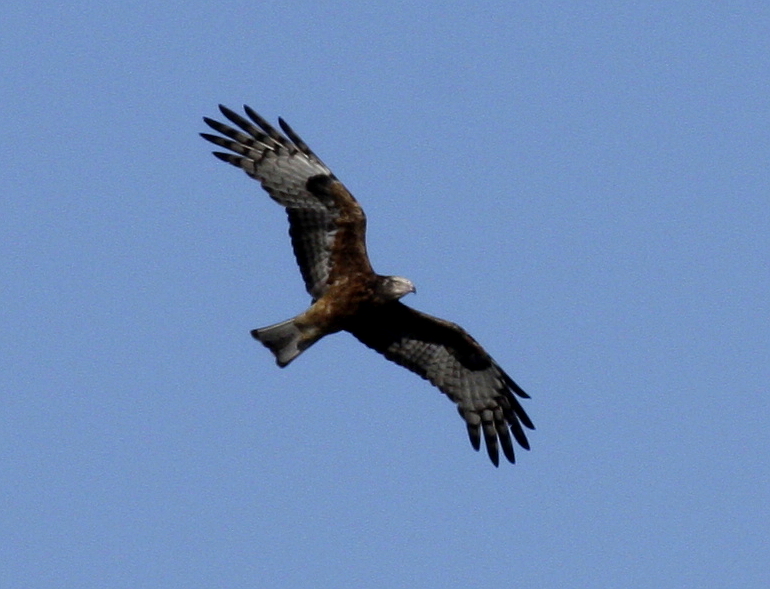
The Square-tailed Kite is easily recognizable by its distinctive square-tipped tail, a feature that sets it apart from most other raptors. Adults exhibit a striking plumage with rich rufous and chestnut tones on their underparts, while the upperparts are a contrasting dark brown. This color pattern provides excellent camouflage as the bird soars beneath the forest canopy. Juveniles resemble adults but have a paler, more streaked appearance, aiding in their identification.
In terms of sexual dimorphism, the Square-tailed Kite shows minimal differences between males and females, with both sexes exhibiting similar size and coloration. However, females are slightly larger than males, a common trait among birds of prey. In flight, the Square-tailed Kite's silhouette is characterized by long, narrow wings and a unique tail shape, which helps in differentiating it from similar species such as the related Black Kite (Milvus migrans), which has a more deeply forked tail.
When perched, the Square-tailed Kite appears somewhat hunched and maintains a vigilant posture, indicative of its predatory nature. Observers should note the bird's head shape and facial pattern, which includes a noticeable pale streak above the eye, providing an additional field mark for accurate identification.
Having trouble telling birds apart? Upload a photo to our bird identification tool for an instant species match.
Square-tailed Kite Habitat and Range
Preferred Habitat
The preferred habitat of the Square-tailed Kite includes open forests and woodlands, particularly those with a well-developed canopy and sparse understorey. This raptor thrives in areas where it can glide effortlessly through the trees, utilizing its agility to hunt small birds and insects. In Australia, it is often found in eucalypt forests, acacia woodlands, and along forest edges.
The Square-tailed Kite typically inhabits lowland areas but is also known to occur at elevations up to 1,200 meters in some regions. While it predominantly occupies rural and semi-rural landscapes, it occasionally ventures into urban areas, especially those near significant patches of native vegetation. Seasonal habitat shifts are not pronounced, as the Square-tailed Kite tends to remain within its chosen range throughout the year, although individuals may wander in search of food during the non-breeding season.
Geographic Range
The Square-tailed Kite is predominantly found across Australia, with its range extending from the eastern states, including Queensland, New South Wales, and Victoria, through the Northern Territory and into parts of Western Australia. It is most frequently observed in the subtropical and temperate regions where suitable habitat conditions prevail.
While not strictly migratory, the Square-tailed Kite exhibits a degree of seasonal movement, particularly during the austral summer when food resources become scarcer. During this period, individuals may disperse more widely within their range, though they do not undertake long-distance migrations like some other raptors. Population density is generally low, with the species being considered uncommon throughout much of its range.
Specific population hotspots include the coastal regions of eastern Australia, where the combination of diverse habitats supports a higher abundance of the Square-tailed Kite. In contrast, it is rarer in the arid interior and highly urbanized areas, where suitable foraging opportunities are limited.
Want to know which birds visit your area? Browse our backyard birds by location guides for region-specific species lists.
What Does the Square-tailed Kite Eat?
The diet of the Square-tailed Kite primarily consists of small birds, especially nestlings and fledglings, which it adeptly hunts by scanning the canopy and swooping down with precision. In addition to avian prey, the Square-tailed Kite also consumes insects, particularly large beetles and grasshoppers, which supplement its diet, especially during the breeding season when energy demands are high.
Seasonal changes can affect the availability of its preferred prey, leading the Square-tailed Kite to adjust its foraging habits accordingly. During the breeding season, it is more likely to focus on bird nests, while in the non-breeding season, it may rely more heavily on insects. The Square-tailed Kite employs a unique foraging technique, flying low over vegetation to surprise its prey, often catching them in mid-air or directly from the nest.
Prey size varies, but the Square-tailed Kite is capable of taking birds up to the size of a small pigeon. Its adaptability in diet and foraging techniques allows it to exploit a range of food sources, making it a versatile and efficient predator.
Square-tailed Kite Behavior and Social Structure
The Square-tailed Kite exhibits solitary behavior for most of the year, although it is occasionally observed in pairs, particularly during the breeding season. These pairs are often seen engaging in aerial displays, which include synchronized soaring and tumbling maneuvers, as part of their courtship ritual. Territorial behavior is evident during this period, with pairs actively defending their nesting area from intruding conspecifics.
Social structure outside of the breeding season is less defined, with individuals often seen alone or in loose associations with other raptors. Flocking is not common for this species, as it relies on stealth and surprise to capture its prey. The Square-tailed Kite is diurnal, with peak activity occurring during the early morning and late afternoon when it patrols its territory in search of food.
In response to predators, the Square-tailed Kite can be quite aggressive, often mobbing larger raptors that pose a threat to its nest or young. Its vocalizations are typically reserved for courtship and defense, as it otherwise remains relatively silent compared to other birds of prey.
Square-tailed Kite Nesting and Reproduction
Square-tailed Kites construct large stick nests, typically situated high in the canopy of tall trees within their woodland habitat. Preferred nest sites include mature eucalypts or acacias, where they build a platform lined with green leaves and other soft materials to cushion the eggs and young.
The typical clutch size for the Square-tailed Kite is two eggs, though occasionally three eggs may be laid. Both parents participate in incubating the eggs, which lasts approximately 35 days. After hatching, the chicks are altricial and require constant care and feeding, a responsibility shared by both parents.
The fledging period for Square-tailed Kite chicks is about 50 days, after which the young begin to explore the surrounding area, gradually becoming independent. Typically, only one brood is raised per year, owing to the intensive parental investment required to successfully rear the offspring in the demanding forest environment.
Square-tailed Kite Sounds and Vocalizations
The vocal repertoire of the Square-tailed Kite is relatively limited compared to other raptors. Its primary vocalization consists of a series of high-pitched, whistling calls used during courtship and when defending its territory. These whistles are often described as clear and plaintive, somewhat reminiscent of a distant gull.
Alarm calls are sharper and more insistent, employed when potential threats approach the nest or young. The Square-tailed Kite remains largely silent while hunting, relying on stealth rather than sound to capture its prey. Unlike songbirds, it does not participate in a dawn chorus, though its calls are occasionally heard at first light as it begins its daily activities.
Interesting Facts About the Square-tailed Kite
- 1The Square-tailed Kite is one of the few raptors that specializes in hunting small birds, especially targeting nests for prey.
- 2With a wingspan of up to 1.5 meters, the Square-tailed Kite is adept at gliding through the forest canopy to surprise its prey.
- 3Square-tailed Kites are known to use fire fronts to their advantage, catching prey flushed out by the advancing flames.
- 4Unlike many other raptors, the Square-tailed Kite does not have a highly migratory lifestyle, opting instead for local dispersal.
- 5The Square-tailed Kite's distinct square tail is an adaptation for maneuverability, allowing it to navigate through dense foliage with ease.
- 6Both male and female Square-tailed Kites participate equally in incubation and rearing of their young, showcasing strong parental cooperation.
- 7Despite its striking appearance, the Square-tailed Kite's population density is relatively low, making it a rare sighting for bird enthusiasts.
Square-tailed Kite Conservation Status
The Square-tailed Kite is currently listed as Least Concern by the IUCN, with a population trend that is considered stable. However, it remains sensitive to habitat loss and fragmentation, primarily due to land clearance for agriculture and urban expansion. These threats reduce the availability of suitable nesting and foraging sites, potentially impacting local populations. Conservation efforts focus on preserving large tracts of native forest and woodland, which are essential for the Square-tailed Kite's survival. Historical population changes are not well-documented, but ongoing habitat protection and restoration initiatives aim to safeguard its future. The species benefits from legal protection in Australia, where it is considered a species of conservation interest, highlighting the need for continued monitoring and habitat preservation.


