
Sri Lanka Bush Warbler
Elaphrornis palliseri
Order: Passeriformes / Family: Locustellidae
Wikimedia Commons
About the Sri Lanka Bush Warbler
The Sri Lanka Bush Warbler, Elaphrornis palliseri, is a small, reclusive bird endemic to the high-altitude forests of Sri Lanka. This warbler is an integral part of the montane ecosystem, playing a significant role in insect population control. Found predominantly in the central highlands, its presence is most notable in the Horton Plains National Park and the Sinharaja Forest Reserve. These areas provide the dense undergrowth and moist conditions the warbler favors, making them ideal for its survival. Being non-migratory, the Sri Lanka Bush Warbler has adapted well to its specific habitat, with its life cycle closely tied to the seasonal changes of the montane forests. During the monsoon months, when vegetation is lush and insect activity peaks, the warbler is most active, seen flitting through underbrush in search of prey. The bird is notoriously secretive, often more easily heard than seen, as it remains well-camouflaged in the dense foliage. This elusive nature has made it a species of interest among birders and researchers alike, contributing to its significance as a symbol of Sri Lanka's rich biodiversity. The Sri Lanka Bush Warbler's ecological role cannot be overstated. As an insectivore, it helps maintain a balanced ecosystem, controlling insect populations that, if left unchecked, could affect plant health and diversity. The bird's feeding habits are especially beneficial during post-monsoon periods, when insect populations surge. Additionally, as a prey species for larger birds and mammals, it forms part of the complex food web in the highland forests. Conservation of the Sri Lanka Bush Warbler and its habitat is crucial for preserving the ecological integrity of Sri Lanka's montane forests.
The Sri Lanka Bush Warbler belongs to the family Locustellidae, within the order Passeriformes. These birds typically live average 6 years.
How to Identify a Sri Lanka Bush Warbler
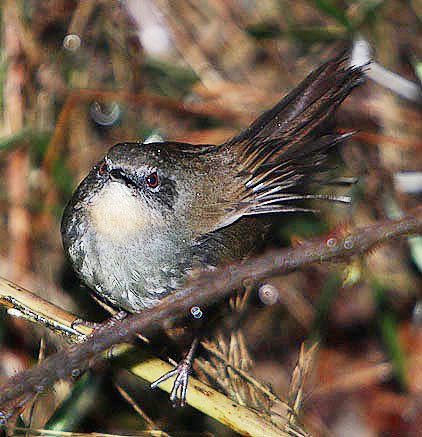
The Sri Lanka Bush Warbler is a small bird, measuring approximately 14 cm in length. It exhibits a predominantly olive-brown plumage, which provides excellent camouflage in its forest habitat. The bird's underparts are slightly paler, and it has a distinct short tail and a rounded wing structure. Adults possess a somewhat indistinct eyebrow stripe, adding to their subtle appearance. Males and females are similar in coloration, though males may appear marginally brighter during the breeding season. Juveniles resemble adults but have a more muted tone and lack the subtle eyebrow stripe. In flight, the Sri Lanka Bush Warbler presents a compact silhouette with rapid, fluttering wing beats. Its perching posture is typically upright, often seen clinging to vertical stems in dense vegetation. Confusion with other species is rare due to its unique habitat preferences and elusive behavior. Nonetheless, it could be mistaken for other small brown warblers, but its distinct call and habitat choice help differentiate it.
Having trouble telling birds apart? Upload a photo to our bird identification tool for an instant species match.
Sri Lanka Bush Warbler Habitat and Range
Preferred Habitat
The Sri Lanka Bush Warbler inhabits the montane forest regions of Sri Lanka, primarily above elevations of 1200 meters. These forests are characterized by dense undergrowth and a moist, cool climate, conditions that are ideal for this species. Notable locations include the Horton Plains and the Knuckles Mountain Range. The bird shows a preference for thickets and forest edges where it can easily forage for insects. Unlike many bird species, the Sri Lanka Bush Warbler does not show significant seasonal habitat shifts, remaining within its montane environment year-round. This warbler is not typically found in urban areas, as it relies heavily on undisturbed forest habitat. The preservation of these montane forests is crucial for the species' survival, as they provide all necessary resources for feeding, breeding, and sheltering.
Geographic Range
Endemic to Sri Lanka, the Sri Lanka Bush Warbler is restricted to the central highlands of the island. Its range is confined to montane forest regions, where it is considered a resident species. There are no known migration patterns for this bird, as it is non-migratory, remaining within its specific habitat throughout the year. Population densities are highest in protected areas such as Horton Plains National Park and the adjoining forest reserves. These regions provide the undisturbed habitat that the species requires for breeding and foraging. The restricted range and specific habitat needs make the Sri Lanka Bush Warbler vulnerable to habitat destruction and climate change effects.
Want to know which birds visit your area? Browse our backyard birds by location guides for region-specific species lists.
What Does the Sri Lanka Bush Warbler Eat?
Primarily an insectivore, the Sri Lanka Bush Warbler feeds on a variety of insects and arthropods found in the undergrowth and leaf litter of its forest habitat. Its diet includes beetles, ants, spiders, and caterpillars. During the monsoon season, when insect abundance peaks, the warbler increases its foraging activity to capitalize on the plentiful food resources. It employs a methodical foraging technique, gleaning insects from leaves and stems while remaining well-hidden. The bird occasionally supplements its diet with small fruits and seeds, especially in the post-monsoon period when insects are less abundant. The Sri Lanka Bush Warbler tends to forage alone or in pairs, with feeding activity most intense during the early morning and late afternoon.
Sri Lanka Bush Warbler Behavior and Social Structure
The Sri Lanka Bush Warbler exhibits a largely solitary lifestyle, often found alone or in pairs rather than in flocks. It maintains a well-defined territory, especially during the breeding season, vigorously defending its space with vocal displays and occasional physical confrontations. Courtship involves subtle displays, including tail-fanning and soft call notes exchanged between mates. This warbler is diurnal, with peak activity occurring at dawn and dusk, aligning with the periods when its insect prey is most active. When threatened by predators, the Sri Lanka Bush Warbler employs a strategy of remaining motionless or retreating into dense vegetation, relying on its camouflage for protection. While generally silent, it becomes more vocal if disturbed, emitting sharp alarm calls to warn other birds.
Sri Lanka Bush Warbler Nesting and Reproduction
The Sri Lanka Bush Warbler constructs its nest close to the ground within dense undergrowth, using materials such as twigs, grass, and leaves. The nest is cup-shaped, providing a secure environment for the eggs. The female typically lays a clutch of 2 to 3 eggs, which she incubates for approximately two weeks. During this period, the male may assist by bringing food to the nesting site. Once hatched, the chicks are altricial, requiring significant parental care. Both parents participate in feeding the young, which fledge about two weeks after hatching. The warbler generally produces one brood per year, timed to coincide with peak insect availability during the monsoon season.
Sri Lanka Bush Warbler Sounds and Vocalizations
The primary song of the Sri Lanka Bush Warbler is a series of high-pitched, melodious trills that carry well through its dense forest habitat. This song serves as both a territorial marker and a mating call, predominantly heard during the breeding season. In addition to its song, the warbler emits sharp, chipping call notes, particularly when alarmed or alerting others to potential threats. These call notes are less musical but serve important communication functions within its territory. The bird's dawn chorus is a distinctive feature of its acoustic presence, marking its territory and signaling the start of daily activities.
Interesting Facts About the Sri Lanka Bush Warbler
- 1The Sri Lanka Bush Warbler is one of only a few bird species endemic to the island, highlighting its unique evolutionary adaptation.
- 2Despite its small size, the Sri Lanka Bush Warbler has a surprisingly loud and far-reaching song that can be heard over 100 meters away.
- 3The bird's elusive nature makes it a sought-after species for birdwatchers visiting Sri Lanka's highland forests.
- 4Its close relative, the Ceylon Scaly Thrush, shares a similar habitat, but the warbler's song is a key distinguishing feature.
- 5The Sri Lanka Bush Warbler is well-adapted to its montane environment, with a plumage that blends seamlessly with the forest floor.
- 6Research suggests that this warbler's population remains stable due to its specialized niche within protected forest reserves.
- 7The bird contributes to the control of pest populations, showcasing the ecological value of insectivorous birds in forest ecosystems.
Sri Lanka Bush Warbler Conservation Status
Currently listed as Near Threatened on the IUCN Red List, the Sri Lanka Bush Warbler faces pressures from habitat loss due to deforestation and agricultural expansion. While its population is considered stable within protected areas, these threats could lead to declines if not addressed. Conservation efforts focus on habitat preservation and the establishment of protected areas such as national parks. Historically, the population has been relatively stable, but ongoing conservation measures are essential to ensure its long-term survival amid changing environmental conditions.


