
Sri Lanka Wood-Pigeon
Columba torringtoniae
Order: Columbiformes / Family: Columbidae
Wikimedia Commons
About the Sri Lanka Wood-Pigeon
The Sri Lanka Wood-Pigeon, Columba torringtoniae, is an endemic avian species found exclusively in the lush montane and sub-montane forests of Sri Lanka. As a member of the Columbidae family, this bird plays a crucial ecological role in seed dispersal, aiding in the regeneration of the forest ecosystems it inhabits. Its presence is most notable in regions such as the Central Highlands, including the Knuckles Mountain Range and Horton Plains National Park. This pigeon is often observed at elevations ranging from 900 to 2200 meters, where it thrives in dense forest canopies.
The Sri Lanka Wood-Pigeon stands out not just for its beauty, but also for its ecological significance. This bird acts as both a seed disperser and a prey species, maintaining the balance within its habitat. It primarily feeds on fruits, seeds, and occasionally small invertebrates, making it an integral part of the local food web. The species is often found in mixed-species feeding flocks, particularly during the peak fruiting seasons from November to March.
Beyond its ecological role, the Sri Lanka Wood-Pigeon serves as an indicator species, reflecting the health of its forest environment. Its population trends can signal changes in habitat quality and biodiversity. The conservation of its natural habitat is essential not only for the survival of this species but also for the preservation of the rich biodiversity of Sri Lanka's highland forests. Seasonal behaviors of the Sri Lanka Wood-Pigeon include altitudinal migrations, where individuals may move to lower elevations during cooler months. Such movements are closely tied to the availability of food resources, illustrating the adaptive nature of this species to its fluctuating environment.
The Sri Lanka Wood-Pigeon belongs to the family Columbidae, within the order Columbiformes. These birds typically live 8-10 years, with some living up to 15 years in the wild..
How to Identify a Sri Lanka Wood-Pigeon
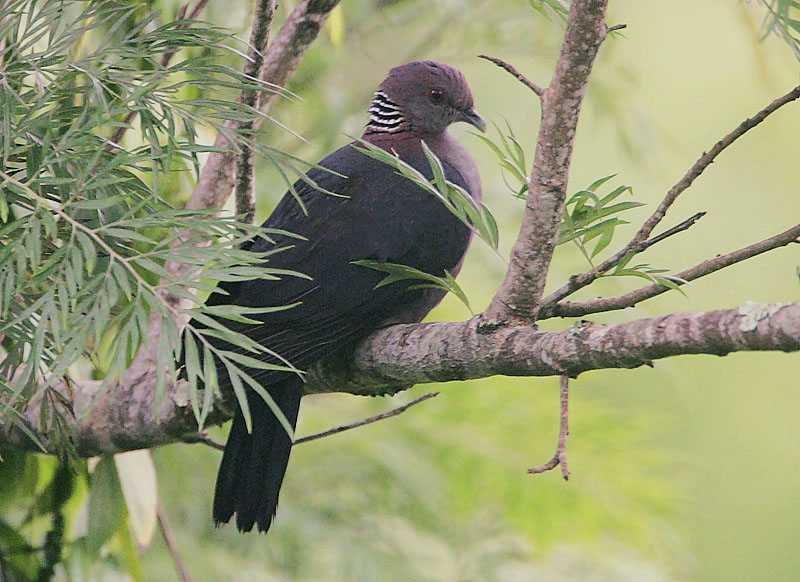
The Sri Lanka Wood-Pigeon is a medium-sized bird, about 36-40 cm in length, characterized by its striking maroon plumage on the head and breast, transitioning to a slate-gray on the wings and back. The bird's eyes are a piercing red, adding to its distinctive appearance. Juveniles resemble adults but with a duller coloration and a less pronounced maroon hue.
Male and female Sri Lanka Wood-Pigeons are similar in appearance, making gender identification in the field challenging. A key feature to look for is the white-tipped tail, which is visible during flight and helps distinguish it from other pigeon species in the region. The bird's flight silhouette is broad-winged and strong, typically seen gliding between forest canopies.
In comparison to similar species, the Sri Lanka Wood-Pigeon can be confused with the more common Rock Pigeon due to its size. However, its unique coloration and forest-dwelling habits set it apart. When perched, it maintains an upright posture, often observed quietly sitting in the upper canopy, blending seamlessly with its surroundings.
Having trouble telling birds apart? Upload a photo to our bird identification tool for an instant species match.
Sri Lanka Wood-Pigeon Habitat and Range
Preferred Habitat
The Sri Lanka Wood-Pigeon resides predominantly in the dense montane and sub-montane forests of Sri Lanka. These habitats provide the bird with ample food resources and nesting sites. It is commonly found in forested areas such as the Horton Plains, Knuckles Range, and Sinharaja Forest Reserve. These regions offer the high-elevation environments where the pigeon thrives.
The bird typically inhabits elevations between 900 and 2200 meters, with a preference for undisturbed forest canopies. Seasonal habitat shifts occur as the pigeon moves to lower elevations during colder months, seeking food and more favorable temperatures. While primarily a forest inhabitant, the Sri Lanka Wood-Pigeon occasionally ventures into forest edges and clearings but is rarely seen in urban environments.
Its preference for high-altitude forests underscores the importance of conserving these habitats to ensure the species' survival. The pigeon's reliance on these ecosystems makes it vulnerable to habitat destruction caused by deforestation and land conversion.
Geographic Range
The Sri Lanka Wood-Pigeon is endemic to Sri Lanka, with its range confined to the island's central highlands. It breeds and resides year-round in regions such as the Knuckles Mountain Range, Horton Plains, and Sinharaja Forest Reserve. Unlike migratory species, it does not travel long distances but may exhibit altitudinal migration within the island.
During colder months, the pigeon may descend to lower elevations, adapting to the shifting availability of food resources. Despite its limited range, the Sri Lanka Wood-Pigeon is relatively widespread within suitable habitats across the highlands. Population density is highest in protected areas where habitat integrity remains largely intact.
The restricted distribution of the Sri Lanka Wood-Pigeon highlights its vulnerability to environmental changes and habitat fragmentation. Conservation efforts in these regions are crucial to maintaining the ecological balance and ensuring the survival of this unique species.
Want to know which birds visit your area? Browse our backyard birds by location guides for region-specific species lists.
What Does the Sri Lanka Wood-Pigeon Eat?
The diet of the Sri Lanka Wood-Pigeon primarily consists of fruits and seeds, which it forages in the upper canopy. It plays a vital role in seed dispersal, contributing to forest regeneration. The pigeon favors a variety of native fruits such as wild figs and berries, with a preference for ripe, succulent offerings.
Seasonal changes significantly influence its diet, with peak fruit consumption occurring from November to March. During these months, the pigeon often joins mixed-species flocks to exploit abundant food resources. It employs a methodical foraging technique, moving deliberately through the canopy, plucking fruits with precision.
Occasionally, the Sri Lanka Wood-Pigeon supplements its diet with small invertebrates, providing additional protein during leaner seasons. The bird's feeding schedule is primarily diurnal, with peak activity occurring in the early morning and late afternoon when temperatures are cooler.
Sri Lanka Wood-Pigeon Behavior and Social Structure
The Sri Lanka Wood-Pigeon exhibits a solitary or paired lifestyle for most of the year, reflecting its territorial nature. During the breeding season, pairs become more evident as they engage in courtship displays, which include soft cooing and mutual preening.
This pigeon is known for its strong territorial instincts, often defending its chosen area from intruders with low-pitched calls and short flights. Flocking behavior becomes more apparent outside the breeding season, particularly when food resources are abundant. At these times, the Sri Lanka Wood-Pigeon may form small groups with other fruit-eating birds, enhancing foraging success.
Predation pressure from raptors such as the Crested Goshawk influences its behavior, prompting quick evasive flights and a preference for dense canopy cover. Daily activity patterns see the bird most active during dawn and dusk, taking advantage of the cooler temperatures and reduced predator activity.
Sri Lanka Wood-Pigeon Nesting and Reproduction
The nesting habits of the Sri Lanka Wood-Pigeon involve constructing a relatively simple platform nest made of twigs and leaves. These nests are typically located high in the forest canopy to avoid ground predators and human disturbance.
A typical clutch consists of one to two eggs, which both parents incubate diligently for approximately 17-19 days. The shared responsibility continues after hatching, with both male and female feeding the chicks through regurgitation of partially digested food.
Fledging occurs around 21-25 days post-hatching, with chicks gradually gaining independence under the watchful eyes of their parents. The Sri Lanka Wood-Pigeon generally produces one to two broods per year, contingent on food availability and environmental conditions.
Sri Lanka Wood-Pigeon Sounds and Vocalizations
The Sri Lanka Wood-Pigeon is known for its distinctive cooing, a soft and melodious series of notes that may be heard echoing through the forest. The primary song consists of a series of low-pitched 'coo-coo' sounds, repeated at regular intervals. These calls serve to establish territory and attract mates.
In addition to its song, the pigeon emits softer, more rapid call notes during courtship, which are lower in volume but similar in rhythm. Alarm calls are more abrupt, serving as a warning to other birds of nearby predators.
While not known for a vibrant dawn chorus, the Sri Lanka Wood-Pigeon's calls are most frequently heard in the early morning and late afternoon, providing a serene background to the forest soundscape. The gentle cooing is reminiscent of the familiar mourning dove, yet distinctly more resonant.
Interesting Facts About the Sri Lanka Wood-Pigeon
- 1The Sri Lanka Wood-Pigeon is one of only two pigeon species endemic to Sri Lanka, highlighting its unique ecological niche.
- 2Despite its limited range, the Sri Lanka Wood-Pigeon is a crucial seed disperser, aiding in the regeneration of Sri Lanka's montane forests.
- 3The bird's maroon plumage provides excellent camouflage against the backdrop of the forest canopy, making it elusive to birdwatchers.
- 4Sri Lanka Wood-Pigeons are known to form mixed-species flocks with other frugivores, increasing foraging efficiency.
- 5The pigeon’s distinct cooing calls are often used by researchers to identify territories and estimate population densities.
- 6Although primarily a forest bird, the Sri Lanka Wood-Pigeon occasionally ventures into adjacent tea plantations in search of food.
- 7The bird’s presence in a forest is often an indicator of high biodiversity and habitat quality.
Sri Lanka Wood-Pigeon Conservation Status
The Sri Lanka Wood-Pigeon is listed as Vulnerable on the IUCN Red List, with population numbers exhibiting a declining trend. The primary threat to this species is habitat loss due to deforestation and land conversion for agriculture and development. Conservation efforts focus on protecting remaining forest habitats, with several protected areas established in key regions such as the Central Highlands. These efforts aim to curb habitat fragmentation and promote sustainable land-use practices. Historically, the Sri Lanka Wood-Pigeon has faced periods of population decline due to hunting and habitat destruction. Current conservation strategies emphasize habitat restoration and community involvement to ensure the long-term viability of this iconic species.
Other Columbidae Species


Birds Similar to the Sri Lanka Wood-Pigeon
These species are often confused with the Sri Lanka Wood-Pigeon due to similar appearance or overlapping range.
