
St. Lucia Parrot
Amazona versicolor
Order: Psittaciformes / Family: Psittacidae
Wikimedia Commons
About the St. Lucia Parrot
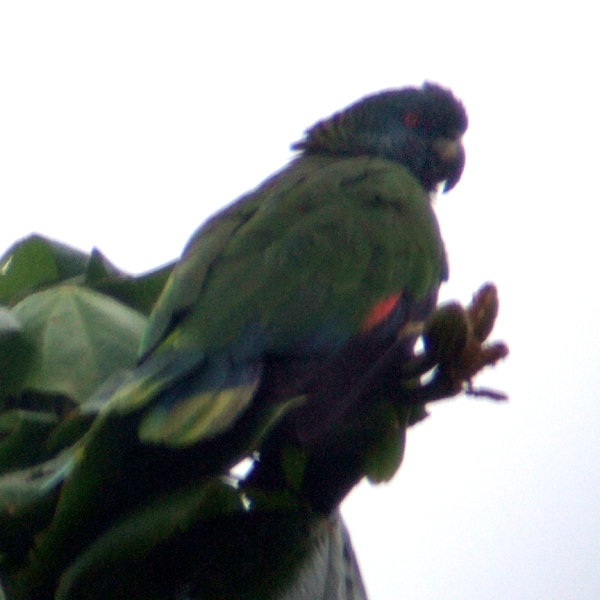
The St. Lucia Parrot, or Amazona versicolor, is an emblematic species found exclusively on the Caribbean island of Saint Lucia. Revered as the national bird, its vibrant plumage distinguishes it from other parrot species. The bird's feathers showcase a striking array of colors, featuring a green body, a blue face, a red forehead, and a vivid yellow-tipped tail. This parrot is not just a visual wonder but an ecological keystone species within its native habitat. It plays a crucial role in seed dispersal, thus maintaining the health of the rainforest ecosystems it inhabits.
The St. Lucia Parrot primarily resides in the island's mountainous regions, particularly favoring the lush, humid rainforests that cover much of the interior highlands. These forests, such as the Quilesse and Edmund Forest Reserves, provide the food resources and nesting sites necessary for the species' survival. The parrot's presence in these areas indicates a healthy ecosystem, as it relies on a stable supply of fruits, seeds, and flowers available in the dense canopy.
Ecologically, the St. Lucia Parrot contributes significantly to the maintenance of biodiversity. By consuming a wide variety of fruits and seeds, the parrot aids in the regeneration of plant species, a process vital to sustaining its habitat. The bird's seed dispersal activities encourage forest renewal, boosting plant diversity and, by extension, supporting other wildlife. Understanding the parrot's role underscores the importance of preserving its environment, particularly in light of its status as a vulnerable species. While the parrot can be observed year-round, certain behaviors, such as breeding, occur seasonally and are influenced by environmental conditions.
The St. Lucia Parrot belongs to the family Psittacidae, within the order Psittaciformes. These birds typically live typically 20-30 years, with individuals in captivity living over 40 years..
How to Identify a St. Lucia Parrot
The St. Lucia Parrot stands out with its spectacular coloration, which makes it relatively easy to identify in the field. Adult Amazona versicolor have a predominantly green plumage, which serves as excellent camouflage among the rainforest foliage. The blue face and red forehead provide contrast, while a yellow-tipped tail adds to its colorful appearance. Juveniles resemble adults but may exhibit duller colors, lacking the full intensity of the adult's palette.
Males and females look alike, making sex differentiation challenging without close observation or genetic testing. There is minimal sexual dimorphism, so both genders share the same brilliant color patterns. The parrot's strong, hooked beak, typical of the Psittacidae family, aids in cracking open hard nuts and fruits, an adaptation to its diet.
In flight, the St. Lucia Parrot's silhouette is distinctive, characterized by broad wings and a relatively short tail. When perched, it often adopts a relaxed posture, occasionally seen preening or engaging in social interactions with other parrots. Confusion with other species is unlikely within its range, given its unique coloration and restricted habitat.
Having trouble telling birds apart? Upload a photo to our bird identification tool for an instant species match.
St. Lucia Parrot Habitat and Range
Preferred Habitat
The St. Lucia Parrot inhabits the dense rainforest regions of Saint Lucia, primarily within the island's central and southern mountain ranges. These areas, such as the Quilesse and Edmund Forest Reserves, provide the necessary resources for the species' survival. The rainforest's dense canopy offers protection and abundant food supplies, including fruits and seeds integral to the parrot's diet.
Typically found at elevations ranging from 300 to 900 meters, the parrot shows a preference for undisturbed primary forests. Seasonal shifts are minimal due to the island's stable climate, allowing the parrot to remain within its chosen habitat year-round. Urban presence is rare, as the parrot tends to avoid areas with significant human activity, opting instead for secluded forested areas.
Despite this preference for remote locations, habitat fragmentation poses a threat. Conservation efforts focus on protecting these regions from deforestation, ensuring that the parrot's habitat remains intact.
Geographic Range
The St. Lucia Parrot is endemic to the island of Saint Lucia, meaning it is found nowhere else in the world. Its range is restricted to the island's central and southern mountainous regions, where it occupies primary and secondary rainforests. The parrot does not migrate or undertake seasonal movements, remaining in its established territories throughout the year.
The island's interior, particularly the protected areas like the Quilesse and Edmund Forest Reserves, serves as the primary stronghold for the St. Lucia Parrot population. Within these regions, the parrot's population density is highest, supported by the abundance of food and nesting sites. However, outside these protected areas, habitat loss and fragmentation due to human activity pose significant threats to its range.
Conservation measures have been crucial in stabilizing the population, with efforts focusing on habitat protection and restoration. While the parrot's range remains limited, ongoing initiatives aim to expand its habitats, ensuring long-term survival.
Want to know which birds visit your area? Browse our backyard birds by location guides for region-specific species lists.
What Does the St. Lucia Parrot Eat?
The St. Lucia Parrot has a diet primarily composed of fruits, nuts, seeds, and flowers, reflecting its role as a vital seed disperser in its ecosystem. It shows a marked preference for fruits from native trees, such as the gommier and bois bande, which provide essential nutrients. Seasonal changes influence diet composition, with certain fruits and seeds becoming more prominent depending on availability.
Foraging often occurs in the early morning and late afternoon, times when the parrot is most active. It employs a robust, hooked beak to crack open hard shells and access the nutritious contents within. This ability allows it to exploit food sources unavailable to many other species.
The parrot's foraging technique involves moving deliberately through the canopy, using its feet and beak to manipulate and consume food. While primarily a frugivore, it may also ingest leaves and flowers, particularly during periods when fruits are less abundant. This dietary flexibility aids its survival in the fluctuating conditions of the rainforest.
St. Lucia Parrot Behavior and Social Structure
The St. Lucia Parrot exhibits a complex social structure, often forming small groups or pairs rather than large flocks. These groups engage in mutual preening and vocalizations, reinforcing social bonds. During the breeding season, pairs become more territorial, defending their nesting sites aggressively.
Courtship displays involve intricate vocalizations and synchronized movements, enhancing pair bonding. The parrot's vocal repertoire is diverse, including a variety of calls used for communication within groups and to signal alarm in response to predators. The dawn and dusk hours see increased vocal activity, as the parrot establishes its presence and interacts with others.
Daily activity patterns are influenced by the need to forage and avoid predators, such as raptors. The parrot is most active during cooler parts of the day, resting during the midday heat. Despite its striking appearance, the parrot's behavior in the canopy helps it remain inconspicuous, a necessary adaptation for avoiding predation.
St. Lucia Parrot Nesting and Reproduction
The St. Lucia Parrot typically nests in natural cavities found in large, mature trees, particularly favoring those with substantial height for added protection. The nest site selection is crucial, with pairs often inspecting multiple cavities before choosing a suitable location. Nesting materials include wood chips and leaves, which provide cushioning for the eggs.
A typical clutch consists of 2 to 3 eggs, which the female incubates for approximately 28 days. During this period, the male plays a vital role in providing food for the female, ensuring she remains on the nest as much as possible. Once hatched, the chicks are altricial, requiring significant parental investment.
Fledging occurs around 8 to 10 weeks after hatching, but juvenile parrots remain dependent on their parents for several months. The birds typically raise one brood per year, though favorable conditions may lead to a second.
Parental roles are well-defined, with both sexes contributing to feeding and protecting the young. This cooperation ensures higher survival rates for the offspring.
St. Lucia Parrot Sounds and Vocalizations
The St. Lucia Parrot is known for its varied vocalizations, which include harsh squawks and melodic whistles. Its primary song, often heard at dawn, consists of a series of rhythmic squawks interspersed with trills. These sounds serve to establish territory and strengthen pair bonds.
Call notes are typically sharp and piercing, used for communication within flocks. Alarm calls are distinct, usually higher-pitched and faster, alerting others to potential dangers. The parrot's vocalizations bear some resemblance to those of other Amazona species but are unique in their rhythm and structure.
During the dawn chorus, the parrot's vocal activity peaks, contributing to the vibrant soundscape of the rainforest. These vocal displays are not only crucial for maintaining social structures but also play a role in mate attraction.
Interesting Facts About the St. Lucia Parrot
- 1The St. Lucia Parrot is the national bird of Saint Lucia and features prominently in local culture and folklore.
- 2Despite their vibrant colors, St. Lucia Parrots are adept at blending into the rainforest canopy, making them difficult to spot.
- 3The population of St. Lucia Parrots was once critically low, but conservation efforts have helped stabilize their numbers.
- 4These parrots are monogamous, often forming lifelong pair bonds that begin with elaborate courtship rituals.
- 5The St. Lucia Parrot can live up to 40 years in the wild, although lifespan can vary based on environmental conditions.
- 6The parrot's diet includes more than 20 different species of plants, showcasing its ecological importance in seed dispersal.
- 7Unlike many parrot species, the St. Lucia Parrot exhibits minimal sexual dimorphism, with males and females looking nearly identical.
St. Lucia Parrot Conservation Status
The St. Lucia Parrot is currently classified as vulnerable by the IUCN, with its population trend showing signs of stabilization due to conservation efforts. Key threats include habitat destruction from deforestation, illegal pet trade, and natural disasters such as hurricanes. Conservation initiatives on Saint Lucia have focused on habitat protection and public education. Establishing protected areas, such as the Quilesse and Edmund Forest Reserves, has been pivotal in providing safe havens for the parrot. Additionally, legal protections have been enacted to prevent poaching and illegal trade. Historically, the parrot's population faced significant declines due to habitat loss and hunting. However, concerted efforts by local and international conservation groups have reversed some of these trends, emphasizing the importance of ongoing vigilance and habitat restoration.


