Strange-tailed Tyrant
Alectrurus risora
Order: Passeriformes / Family: Tyrannidae

Wikimedia Commons
About the Strange-tailed Tyrant
The Strange-tailed Tyrant, known scientifically as Alectrurus risora, is a striking member of the Tyrannidae family. This passerine bird is notable for its extraordinary tail, particularly in males, which sport elongated, ribbon-like tail feathers. These birds inhabit grassland ecosystems, primarily found in the savannas and marshy areas of South America, particularly in Argentina, Paraguay, and southern Brazil. They favor regions characterized by tall grasses and scattered shrubs, which provide both shelter and feeding grounds.
Ecologically, the Strange-tailed Tyrant plays a crucial role in its habitat. As an insectivore, it helps control insect populations, contributing to the balance of its ecosystem. The bird’s presence in a region often indicates healthy grassland environments, as it requires specific habitat conditions to thrive. Its preference for open grasslands makes it susceptible to habitat loss due to agricultural expansion and land degradation, highlighting its status as a species of conservation concern.
Throughout the year, the Strange-tailed Tyrant exhibits varied behaviors depending on the season. During the breeding season, from September to February, males display their elaborate tails in flight displays designed to attract females. Outside of the breeding season, these birds are less conspicuous, their tails less pronounced in the dense grasses. The seasonal shifts in behavior and appearance make them a fascinating subject of study for ornithologists and bird enthusiasts alike.
The Strange-tailed Tyrant belongs to the family Tyrannidae, within the order Passeriformes. These birds typically live average 3-5 years with a max recorded of 7 years..
How to Identify a Strange-tailed Tyrant
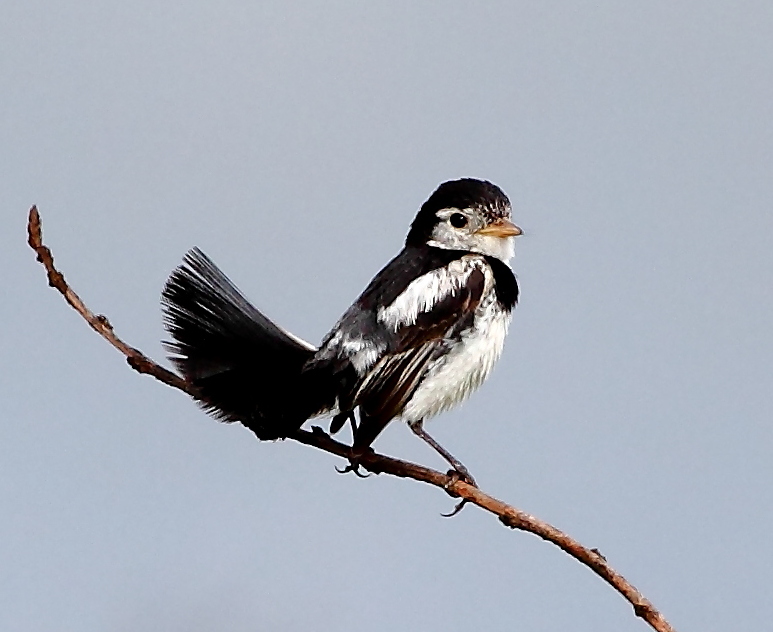
The Strange-tailed Tyrant is a medium-sized bird with males and females exhibiting notable sexual dimorphism. Adult males are particularly striking, with an overall black and white plumage highlighted by their long, ribbon-like tail feathers which can extend up to 30 centimeters. These tail feathers are the bird's most distinguishing feature, used prominently during courtship displays.
Females, by contrast, lack the elongated tail feathers and instead possess a more subdued coloration. They are predominantly brown with buff streaks, providing excellent camouflage in their grassland habitats. Juvenile birds resemble females but have a slightly duller appearance, with more pronounced streaking.
In flight, the male’s silhouette is unmistakable due to the unique tail. Perched, the bird typically holds its tail in a drooping posture, further enhancing its distinctive profile. While similar in size to other tyrant flycatchers, the Strange-tailed Tyrant can be differentiated by its tail and contrasting black and white coloration in males.
Having trouble telling birds apart? Upload a photo to our bird identification tool for an instant species match.
Strange-tailed Tyrant Habitat and Range
Preferred Habitat
Strange-tailed Tyrants inhabit specific grassland ecosystems, favoring tall, dense grasses interspersed with shrubs. These birds are found at low elevations, primarily in the floodplains and marshy areas of Argentina's Pampas region, Paraguay, and parts of southern Brazil. They thrive in open environments that offer ample foraging opportunities and nesting sites.
Seasonally, these birds may shift slightly within their grassland habitats in response to flooding or changes in vegetation. Unlike some other species, the Strange-tailed Tyrant is not typically found in urban areas, as it relies on natural grassland habitats for survival. Conservation of these specific habitats is crucial to maintaining their populations.
Geographic Range
The Strange-tailed Tyrant is primarily located in the southern regions of South America. Its breeding range spans across the grasslands of northeastern Argentina, southern Paraguay, and parts of southern Brazil. These areas provide the ideal conditions for breeding and feeding, with extensive grasslands and marshes.
There is little evidence of long-distance migration in this species. Instead, they exhibit some local movement in response to seasonal changes in water levels and habitat quality. The highest population densities are found in protected areas where grasslands remain undisturbed. Conservation efforts focus on preserving these critical habitats to support sustainable populations.
Want to know which birds visit your area? Browse our backyard birds by location guides for region-specific species lists.
What Does the Strange-tailed Tyrant Eat?
The diet of the Strange-tailed Tyrant consists mainly of insects, which it captures with agility and precision. Primary food sources include grasshoppers, beetles, and various other small invertebrates. During the breeding season, insects become particularly abundant, providing ample food for adults and their young.
Foraging typically occurs low to the ground, with the birds perching on tall grasses or shrubs to spot prey. This vantage point allows them to swoop down swiftly to capture insects. The availability of insects can fluctuate seasonally, influencing their foraging behavior and habitat preference.
Strange-tailed Tyrant Behavior and Social Structure
Strange-tailed Tyrants exhibit fascinating social and territorial behaviors. During the breeding season, males establish territories and engage in elaborate display flights to attract females. These aerial displays showcase their long tails, an important factor in mate selection.
Outside the breeding season, these birds can be more solitary or found in loose groupings. They maintain a diurnal activity pattern, foraging actively during the day. In response to predators, they rely on their camouflaged plumage and the dense grasslands for concealment, often flushing only at the last moment to evade capture.
Strange-tailed Tyrant Nesting and Reproduction
The nesting habits of the Strange-tailed Tyrant involve building cup-shaped nests hidden within tall grasses. These nests, constructed with grasses and lined with softer materials, offer protection from predators and harsh weather. The female typically lays a clutch of 2-3 eggs, which she incubates for approximately 14 days.
Both parents participate in feeding the chicks, which fledge about two weeks after hatching. The rate of brood production is influenced by environmental conditions, with some pairs managing two broods in favorable years.
Strange-tailed Tyrant Sounds and Vocalizations
The Strange-tailed Tyrant's vocalizations consist of a series of sharp, whistled notes. The primary song, often delivered during display flights, features a repetitive, rhythmic series of whistles that can be heard over considerable distances. In contrast, their call notes are softer and more subdued, used for communication between mates or signaling alarm.
During the dawn chorus, males are particularly vocal, using their songs to establish territory and attract mates. The quality of their song, with its clear, whistled tones, is distinctive and provides an auditory cue to their presence within the expansive grasslands.
Interesting Facts About the Strange-tailed Tyrant
- 1Male Strange-tailed Tyrants can have tail feathers up to 30 centimeters long, significantly longer than their body.
- 2During courtship, males perform dramatic aerial displays, showcasing their remarkable tails to attract females.
- 3Strange-tailed Tyrants are primarily insectivorous, playing a crucial role in controlling insect populations in grassland ecosystems.
- 4These birds are most active during the day, foraging in grasslands and displaying during the breeding season.
- 5Strange-tailed Tyrants prefer habitats with tall grasses, which provide ideal conditions for nesting and foraging.
- 6Despite their striking appearance, Strange-tailed Tyrants rely on camouflage for protection, blending into their grassland surroundings.
- 7The species' range is limited to specific regions in South America, highlighting the importance of habitat preservation for their survival.
Strange-tailed Tyrant Conservation Status
The International Union for Conservation of Nature (IUCN) lists the Strange-tailed Tyrant as Near Threatened, with population trends indicating a decline. Primary threats include habitat loss due to agricultural expansion and land conversion. Grasslands are increasingly plowed for crops or degraded by livestock grazing, reducing available habitat. Conservation efforts focus on protecting large tracts of natural grasslands and implementing sustainable agricultural practices. Historically, the bird's range has contracted due to these pressures, making conservation actions critical for its future survival.
Other Tyrannidae Species


Birds Similar to the Strange-tailed Tyrant
These species are often confused with the Strange-tailed Tyrant due to similar appearance or overlapping range.