
Stresemann's Bush-Crow
Zavattariornis stresemanni
Order: Passeriformes / Family: Corvidae
Wikimedia Commons
About the Stresemann's Bush-Crow
The Stresemann's Bush-Crow, known scientifically as Zavattariornis stresemanni, belongs to the family Corvidae and is an intriguing bird endemic to the dry savannas of southern Ethiopia. With its limited range, the species is a prime example of a habitat-specialist. It thrives in the semi-arid regions, particularly in the Borana Zone of Ethiopia, where the landscape consists largely of Acacia woodland interspersed with patches of open grassland. This environment provides the Bush-Crow with both the resources it needs for foraging and the sparse cover suitable for roosting and nesting. Unlike many other members of the Corvidae family, the Stresemann's Bush-Crow exhibits a somewhat communal lifestyle. It typically forms small, cohesive groups that cooperate in both foraging and territorial defense. This social structure is crucial for survival in the challenging climates of its native range, where food resources can be unpredictable and competition with other species is a constant challenge. Ecologically, the Stresemann's Bush-Crow plays a significant role as both a predator and prey. As insectivores, these birds help control the populations of various invertebrates, particularly during the wet season when insect abundance peaks. In turn, they form part of the diet of larger avian predators and small mammals. Seasonally, the Stresemann's Bush-Crow adapts its behavior to match environmental conditions. During the dry season, its movement patterns become more localized, with groups staying near water sources and reliable food supplies. Conversely, the onset of the rainy season triggers more extensive foraging expeditions as food becomes more abundant. This bird's restricted distribution and specialized habitat requirements make it a focal species for conservation in Ethiopia, reflecting broader environmental health in its region.
The Stresemann's Bush-Crow belongs to the family Corvidae, within the order Passeriformes. These birds typically live average 8-10 years with a maximum recorded of 15 years..
How to Identify a Stresemann's Bush-Crow
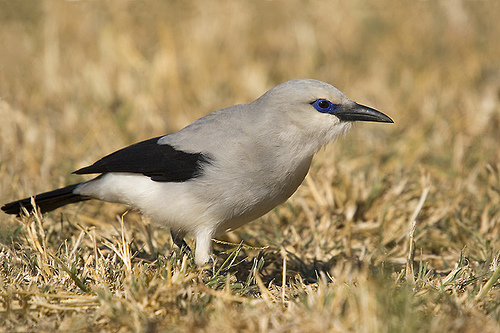
The Stresemann's Bush-Crow is a medium-sized bird, measuring about 30 cm in length. It is easily identifiable by its striking bluish-gray plumage, which covers most of its body, combined with a contrasting white belly. The head features a prominent black facial mask that extends to the throat, giving it a distinctive appearance among corvids. Juveniles resemble adults but with slightly duller plumage and less defined facial markings. Male and female Stresemann's Bush-Crows are similar in appearance, lacking any sexual dimorphism in plumage or size, which is typical for corvid species. Their wings are relatively short but broad, aiding in agile flight through their bushland habitat. In flight, the bird's short tail and rounded wing tips are visible, helping distinguish it from other sympatric species. Confusion with other local birds is unlikely due to its unique coloration and social behavior. When perched, the Stresemann's Bush-Crow often sits upright, showcasing its sleek body and long-legged stance. This posture, combined with frequent flicking of its tail, can help observers spot the bird even at a distance.
Having trouble telling birds apart? Upload a photo to our bird identification tool for an instant species match.
Stresemann's Bush-Crow Habitat and Range
Preferred Habitat
Stresemann's Bush-Crow inhabits the dry, thorny savannas and Acacia-dominated woodlands of southern Ethiopia. It thrives in elevations ranging from 1,200 to 1,500 meters above sea level, where the climate is semi-arid. The bird shows a strong preference for areas with sparse tree cover, allowing for easy movement and foraging while providing enough shelter for nesting. During the wet season, the Bush-Crow may venture into slightly denser woodlands in search of increased insect activity. Unlike many birds, it does not adapt well to urban environments, largely due to its specialized feeding and nesting habits.
Geographic Range
The Stresemann's Bush-Crow is endemic to southern Ethiopia, specifically within the Borana Zone, where it occupies a narrow range of approximately 6,000 square kilometers. It does not migrate and remains within this geographic area year-round. The species is primarily concentrated in areas where its preferred Acacia woodland and grassland habitats overlap. Population density is highest in regions like the Yabello Wildlife Sanctuary, where conservation efforts aim to protect its limited habitat.
Want to know which birds visit your area? Browse our backyard birds by location guides for region-specific species lists.
What Does the Stresemann's Bush-Crow Eat?
The diet of the Stresemann's Bush-Crow is primarily insectivorous, with a strong preference for ants, beetles, and termites. During the rainy season, when insects are more abundant, it actively forages on the ground, using its long bill to probe into soil and leaf litter. Occasionally, it supplements its diet with small fruits and seeds, particularly during the dry season when insect availability decreases. The bird employs a cooperative foraging technique, often working in small groups to flush out prey. Feeding activity peaks in the early morning and late afternoon, coinciding with periods of cooler temperatures.
Stresemann's Bush-Crow Behavior and Social Structure
Stresemann's Bush-Crow exhibits a highly social structure, typically forming groups of 5 to 12 individuals. These groups are essential for cooperative foraging and territorial defense. Group members maintain constant vocal communication, using a series of calls to coordinate activities and warn of predators. The bird displays strong territorial instincts, often engaging in aggressive displays to deter intruders. During the breeding season, pairs within the group engage in courtship displays, which include mutual preening and food sharing. The species' diurnal activity pattern sees it foraging and socializing during the day, with peak activity occurring during cooler morning and late afternoon hours.
Stresemann's Bush-Crow Nesting and Reproduction
Stresemann's Bush-Crow constructs its nests in the forks of Acacia trees, using twigs, grass, and other plant materials to build a sturdy cup-shaped structure. The nest is typically positioned 2 to 4 meters above the ground, providing protection from ground predators. The species lays a clutch of 2 to 4 eggs, which are pale blue with brown speckles. Both parents share incubation duties, a process that lasts about 18 to 21 days. After hatching, the chicks remain in the nest for another 20 to 24 days before fledging. The Bush-Crow generally produces one brood per year, although favorable conditions can occasionally lead to a second.
Stresemann's Bush-Crow Sounds and Vocalizations
The vocalizations of the Stresemann's Bush-Crow include a variety of calls, ranging from harsh, raspy notes to softer, more melodic whistles. Its primary song is a series of chattering notes delivered in rapid succession, often compared to the sound of a mechanical rattle. Alarm calls are sharp and abrupt, used to alert group members to potential threats. During the dawn chorus, the Bush-Crow's vocalizations blend with those of other local birds, creating a lively soundscape vital for reinforcing social bonds within the group.
Interesting Facts About the Stresemann's Bush-Crow
- 1Stresemann's Bush-Crow is one of the few bird species endemic to Ethiopia, highlighting the region's unique biodiversity.
- 2Despite its name, the Stresemann's Bush-Crow is more closely related to starlings than true crows.
- 3The species was named in honor of the German ornithologist Erwin Stresemann, who contributed significantly to ornithology.
- 4Stresemann's Bush-Crow exhibits cooperative breeding, with non-breeding individuals helping to raise chicks.
- 5The bird's limited range of just 6,000 square kilometers makes it highly susceptible to environmental changes.
- 6Its social structure and vocal communication are key to its survival in the harsh climates of southern Ethiopia.
- 7Stresemann's Bush-Crow's preference for specific habitats makes it an important indicator species for ecosystem health.
Stresemann's Bush-Crow Conservation Status
The IUCN currently classifies the Stresemann's Bush-Crow as Endangered, due to its limited range and declining population. Habitat loss from agricultural expansion poses the greatest threat, as does climate change, which can alter the semi-arid ecosystems it depends on. Conservation efforts focus on habitat protection and management, particularly in protected areas like Yabello Wildlife Sanctuary. Monitoring of population trends continues, aiming to identify and mitigate factors contributing to its decline.
Other Corvidae Species


Birds Similar to the Stresemann's Bush-Crow
These species are often confused with the Stresemann's Bush-Crow due to similar appearance or overlapping range.
