
Swallow Tanager
Tersina viridis
Order: Passeriformes / Family: Thraupidae
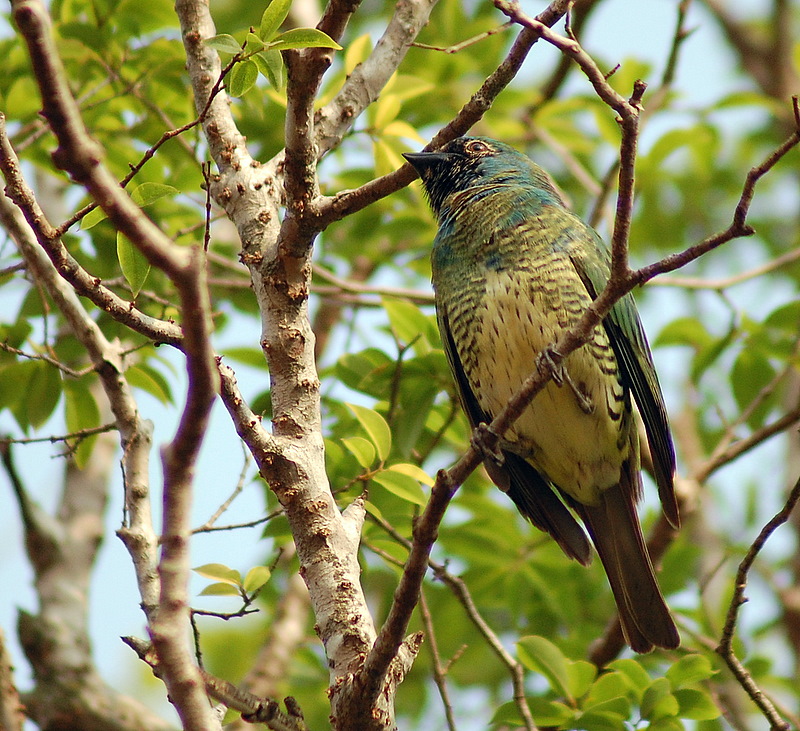
Wikimedia Commons
About the Swallow Tanager
The Swallow Tanager, scientifically known as Tersina viridis, is a striking bird primarily found in the tropical regions of South America. Its presence spans diverse countries including Brazil, Colombia, and Bolivia. This species thrives in the lush, verdant canopies of humid forests and is often encountered in the Amazon Basin, where it plays an integral ecological role. The Swallow Tanager's vivid blue-green coloring not only makes it a birdwatcher's favorite but also indicates its adaptation to densely forested environments. The rich hues aid in camouflage amidst the foliage, enabling them to evade predators while foraging. These birds are particularly significant as they contribute to seed dispersal, a crucial ecological process, by consuming a variety of fruits. Seasonally, the Swallow Tanager exhibits a degree of altitudinal migration, moving to lower elevations during harsher weather conditions. This movement ensures access to food resources year-round, highlighting the species' adaptability. As a member of the Thraupidae family, the Swallow Tanager shares its habitat with several other tanagers, yet it remains distinctive due to its unique feeding habits and social behaviors. Observers often spot them in mixed-species flocks, which enhances their foraging efficiency and offers protection against predators. The seasonal behaviors of the Swallow Tanager are equally captivating. During breeding periods, their territorial displays become more pronounced, with males showcasing their plumage to attract mates. In contrast, non-breeding seasons see a more subdued demeanor, as the focus shifts to foraging and survival. The Swallow Tanager's influence extends beyond its immediate ecosystem, as it serves as a key indicator species for the health of tropical forests. Conservationists monitor its populations to gauge forest ecosystem vitality, making it a pivotal species in environmental studies. Overall, the Swallow Tanager is not just a visual marvel but also a linchpin in the complex web of tropical forest ecology.
The Swallow Tanager belongs to the family Thraupidae, within the order Passeriformes. These birds typically live typically around 5-8 years, with some living up to 10 years..
How to Identify a Swallow Tanager
The Swallow Tanager is most easily recognized by its vivid turquoise plumage, which covers the male's head, back, and tail. This striking coloration makes it one of the more visually arresting species in South American forests. In contrast, females exhibit a greener hue with subtle scaling on their undersides, offering a more muted palette that aids in camouflage. Juveniles resemble females but with a less defined coloration. The bird's size is modest, measuring around 15 cm in length, with a wingspan that enhances its agile flight capabilities. Males and females can be differentiated by the intensity of their colors, with males exhibiting a more vibrant and uniform blue, while females show a mix of green and blue with distinctive white underparts. The Swallow Tanager's flight silhouette is characterized by swift, direct movements, much like that of a swallow, from which its common name is derived. When perching, it maintains a typically upright posture, often seen on exposed branches where it can survey the surroundings for food. The Swallow Tanager can occasionally be confused with other blue-green tanagers, yet its unique combination of color and shape, along with its distinct flight style, makes it identifiable to experienced birders.
Having trouble telling birds apart? Upload a photo to our bird identification tool for an instant species match.
Swallow Tanager Habitat and Range
Preferred Habitat
The Swallow Tanager favors tropical and subtropical forests, often thriving in the expansive lowland rainforests of the Amazon. These habitats provide ample food resources and nesting sites, essential for their survival and reproduction. They also inhabit montane forests, particularly during certain seasons, which offer cooler temperatures and varied food availability. The elevation range for this species typically spans from sea level to about 1,500 meters. Seasonal habitat shifts are common, with the Swallow Tanager moving to lower elevations or more open areas during non-breeding periods. In addition to forests, these birds are occasionally found in semi-open areas such as plantations and forest edges, where they have adapted to human-altered landscapes. While primarily a forest inhabitant, the Swallow Tanager can sometimes be seen in rural gardens and urban parks, although less frequently than in its native forest home.
Geographic Range
The Swallow Tanager's range covers a significant portion of northern and central South America. During the breeding season, they are predominantly found in the Amazon Basin, extending through Brazil to parts of Colombia, Venezuela, and the Guyanas. They also inhabit the eastern slopes of the Andes, providing a unique ecological niche. In terms of migration, the Swallow Tanager is mostly a resident species, but some populations exhibit local movements in response to food availability and climatic conditions. Outside the breeding season, they may disperse to adjacent areas, including the Atlantic Forest of Brazil and the cerrado regions, to exploit different ecological opportunities. Population density is particularly high in the Amazon Basin, where their numbers are sustained by the rich biodiversity and availability of food resources. The Swallow Tanager, although not considered migratory in the traditional sense, exhibits movements that ensure their survival across the varying landscapes of South America.
Want to know which birds visit your area? Browse our backyard birds by location guides for region-specific species lists.
What Does the Swallow Tanager Eat?
The Swallow Tanager primarily feeds on fruits, making it a crucial player in seed dispersal within its habitat. Its diet includes a wide array of berries and small fruits, which are abundant in the tropical forests it inhabits. During certain seasons, especially when fruits are scarce, they supplement their diet with insects. This adaptability in feeding habits allows them to maintain a balanced diet year-round. Their foraging technique is agile and efficient; they often sally from a perch to catch flying insects or deftly pluck fruits from branches while in flight. Prey size is generally small, with insects like beetles and caterpillars forming the bulk of their protein intake. The Swallow Tanager exhibits a flexible feeding schedule, engaging in foraging activities throughout the day but with peaks during the early morning and late afternoon when insect activity is high. This opportunistic feeding strategy ensures they can exploit the available resources effectively, contributing to their ecological success.
Swallow Tanager Behavior and Social Structure
The Swallow Tanager is a social bird, often seen in small flocks that enhance their foraging success and provide safety in numbers. These flocks can comprise both Swallow Tanagers and other tanager species, illustrating their cooperative feeding behavior. Territorial behavior is most pronounced during the breeding season, when males engage in displays to ward off competitors and attract mates. Courtship involves a series of visual displays, with the male showcasing his vibrant plumage through elaborate flight patterns and perching displays. Outside of the breeding season, the Swallow Tanager becomes less territorial and more focused on foraging. Their response to predators is typically cautious, often retreating to higher branches or denser foliage when threatened. Daily activity patterns reveal a preference for early morning and late afternoon foraging, coinciding with the peak activity of many of their insect prey. The Swallow Tanager's adaptability to different social structures and feeding strategies underscores its resilience in the face of ecological challenges.
Swallow Tanager Nesting and Reproduction
The Swallow Tanager constructs its nest in tree cavities or sometimes in old woodpecker holes, preferring sites that offer protection from predators and environmental elements. The nest itself is a shallow cup made from fine plant materials, feathers, and sometimes mud, reflecting their ability to utilize available resources. Clutch size typically ranges from 2 to 3 eggs, which the female incubates for about 14 days. During the incubation period, the male plays a supportive role by providing food to the female. After hatching, both parents participate in feeding the chicks, which fledge approximately 20 days post-hatching. The Swallow Tanager usually rears one brood per year, although in optimal conditions, a second brood may be attempted. Nest placement in tree cavities not only provides protection but also aligns with their habitat preferences, ensuring the young are raised in an environment abundant in food resources.
Swallow Tanager Sounds and Vocalizations
The Swallow Tanager's vocalizations are a mix of melodic and harsh notes, with the primary song consisting of a series of high-pitched, rapid whistles that can seem almost mechanical in quality. These songs serve various purposes, from mate attraction to territory defense. Call notes, often heard during flight, are sharp and short, serving as contact calls within flocks. Alarm calls, while less musical, are more piercing and serve to alert others of potential threats. During the dawn chorus, the Swallow Tanager's song blends with those of other forest inhabitants, creating a rich tapestry of sound that marks the beginning of a new day. Their vocalizations, while not as elaborate as some other songbirds, are distinctive enough to aid in identification during field observations.
Interesting Facts About the Swallow Tanager
- 1The Swallow Tanager's striking blue coloration is due to structural coloration, not pigments.
- 2Despite their name, Swallow Tanagers are more closely related to tanagers than swallows.
- 3These birds can consume up to 60% of their body weight in fruit daily during peak feeding periods.
- 4Swallow Tanagers are one of the few tanager species that regularly use tree cavities for nesting.
- 5Their agile flight and foraging behavior resemble those of swallows, inspiring their common name.
- 6In some regions, the Swallow Tanager's song is considered a herald of the rainy season.
- 7The Swallow Tanager's diet shifts from predominantly frugivorous to insectivorous during nesting.
Swallow Tanager Conservation Status
The Swallow Tanager is currently listed as Least Concern by the IUCN, with a stable population trend. However, habitat destruction due to deforestation poses a significant threat. Conservation efforts focus on preserving tropical forests, which are vital for their survival. Initiatives include protected areas and sustainable forestry practices. Historically, the Swallow Tanager's population has remained relatively stable, yet continuous monitoring is essential to ensure this stability is maintained amidst ongoing environmental changes. Their role as seed dispersers further underscores their importance in maintaining healthy ecosystems, emphasizing the need for proactive conservation measures.
Other Thraupidae Species


Birds Similar to the Swallow Tanager
These species are often confused with the Swallow Tanager due to similar appearance or overlapping range.

