
Tawny Owl
Strix aluco
Order: Strigiformes / Family: Strigidae
Wikimedia Commons
About the Tawny Owl
The Tawny Owl (Strix aluco) stands as a quintessential woodland owl across Europe and parts of Asia, displaying a remarkable adaptability to various forested environments. This medium-sized owl, belonging to the family Strigidae, plays an essential role in controlling small mammal populations, thus maintaining ecological balance in its habitats. Characteristically nocturnal, the Tawny Owl thrives in deciduous and mixed forests, where it finds ample cover and a diverse prey base. It is widely recognized for its hauntingly melodic hoot, which echoes through the woods, making it an emblematic sound of the night.
The Tawny Owl's significance extends beyond its ecological role. It features prominently in folklore and literature, often symbolizing wisdom and mystery. Its adaptability enables it to occupy a range of habitats, from rural woodlands to suburban parks. In the UK, the Tawny Owl is one of the most common owl species, with an estimated population of over 50,000 pairs. Its presence in urban areas highlights its ability to coexist with human developments, although it requires mature trees for nesting and roosting.
Seasonally, the Tawny Owl exhibits some territorial behavior, especially during the breeding season. During this time, males become more vocal, establishing their presence with a series of hoots to deter rivals and attract females. This territoriality ensures that each pair has sufficient hunting grounds to rear their young. The Tawny Owl's ecological role as a predator of rodents, small birds, and insects underscores its importance in maintaining ecological balance. Its presence in a region often indicates a healthy, functioning ecosystem with ample biodiversity.
The Tawny Owl belongs to the family Strigidae, within the order Strigiformes. These birds typically live average 4 years with a max recorded of 18 years..
How to Identify a Tawny Owl
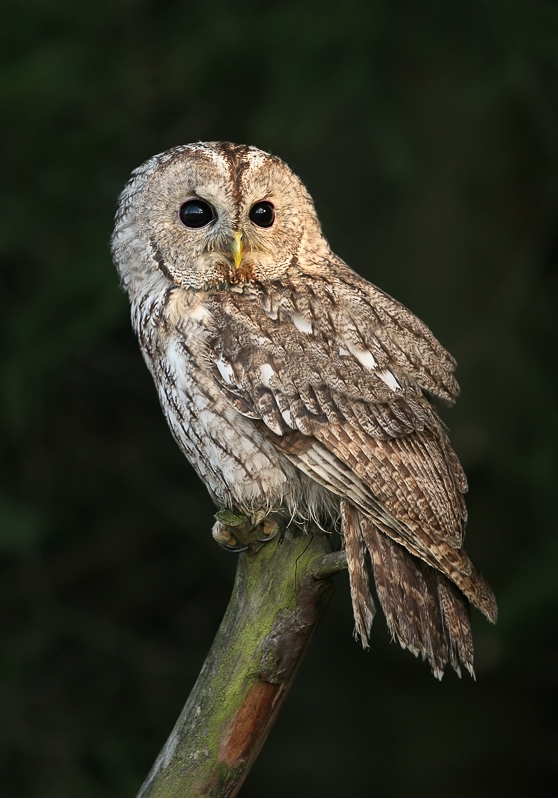
Adult Tawny Owls exhibit a robust, rounded appearance with a large, rounded head lacking ear tufts. Their plumage varies from reddish-brown to grey, with darker streaks and bars providing excellent camouflage against tree bark. Typical length ranges from 37 to 43 cm, and they possess a wingspan of approximately 81 to 105 cm. The eyes are large and dark, enhancing their nocturnal vision.
Juveniles differ from adults by having downy feathers and a more mottled appearance. Gender differences in Tawny Owls are subtle, with females generally being slightly larger but not markedly different in plumage. A key field mark is their facial disk, which is pale and edged with dark feathers, framing the eyes and enhancing their auditory senses.
When comparing to similar species, note that the Tawny Owl lacks the long ear tufts seen in the Long-eared Owl. In flight, the Tawny Owl presents a silent, buoyant silhouette, aided by its large wings which facilitate silent flight. When perched, its upright posture and the cryptic plumage allow it to blend seamlessly into its surroundings, often going unnoticed during the day.
Having trouble telling birds apart? Upload a photo to our bird identification tool for an instant species match.
Tawny Owl Habitat and Range
Preferred Habitat
Tawny Owls predominantly inhabit deciduous and mixed woodlands, favoring areas with mature trees for nesting and roosting. They can thrive at elevations from sea level up to about 1500 meters in mountainous regions. While primarily a forest dweller, the Tawny Owl also adapts to urban and suburban environments, utilizing parks and gardens that provide suitable nesting sites and sufficient prey.
In rural areas, they often reside in small woodlands or hedgerows, using tree cavities or old buildings for nesting. Seasonal habitat shifts are minimal, as Tawny Owls are non-migratory, remaining in their territories year-round. This sedentary nature means that suitable habitat availability directly impacts their population density and distribution.
Geographic Range
The Tawny Owl's range extends across much of Europe and into parts of Asia. It breeds from the British Isles and Scandinavia in the north, through Central Europe, and into the Mediterranean region. Its range extends eastward into western Russia and parts of Iran. The Tawny Owl typically remains resident within its breeding territory throughout the year, as it does not engage in long-distance migrations.
Population density is highest in the United Kingdom, Germany, and France, where suitable woodland habitats are abundant. In more mountainous regions, such as the Alps and Pyrenees, Tawny Owls inhabit suitable forested areas but at lower densities due to limited habitat availability. Their distribution is influenced by the presence of mature trees for nesting and a stable food supply.
Want to know which birds visit your area? Browse our backyard birds by location guides for region-specific species lists.
What Does the Tawny Owl Eat?
Tawny Owls primarily feed on small mammals, particularly rodents like voles and mice. Secondary food sources include small birds, insects, and occasionally amphibians. Their diet changes seasonally, with a higher intake of insects and birds during summer when these prey types are more abundant.
Tawny Owls employ a sit-and-wait hunting strategy, perching silently before swooping down on their prey with precision. They hunt mostly at night, relying on their acute hearing and silent flight to surprise their prey. Prey size typically ranges from small mammals weighing 20-30 grams to larger birds or mammals up to 100 grams. Feeding occurs predominantly during the night but can extend into twilight hours during summer when prey is more active.
Tawny Owl Behavior and Social Structure
Tawny Owls exhibit solitary behavior outside the breeding season, maintaining territories through vocalizations and occasional physical confrontations. They are highly territorial, with males defending their area by hooting to establish presence and ward off intruders. Each pair typically occupies a territory of 5-10 hectares, which they defend vigorously.
During courtship, males perform elaborate displays, including hoots and flights around the female to strengthen pair bonds. Tawny Owls are generally monogamous, with pairs staying together for several years. They show strong site fidelity, often using the same nesting sites annually.
In response to predators like goshawks or humans, Tawny Owls may mob or remain motionless to avoid detection. Their activity is primarily nocturnal, with peak activity occurring shortly after dusk and before dawn. During the day, they roost in dense foliage or tree cavities, remaining well-camouflaged and inactive.
Tawny Owl Nesting and Reproduction
Tawny Owls prefer nesting in tree cavities, but they will also use old nests of other birds, nest boxes, or structures like barns. They show a preference for mature trees, which provide secure nesting sites and protection from predators. The female lays 2-4 eggs, with incubation lasting about 28-30 days, performed solely by the female while the male provides food.
Upon hatching, the young are altricial and remain in the nest for 30-35 days under parental care. Both parents participate in feeding the chicks, with the male primarily responsible for hunting. Fledging occurs about five weeks after hatching, but young owls may remain dependent on their parents for several months. Tawny Owls typically produce one brood per year, though they may attempt a second if conditions are favorable.
Tawny Owl Sounds and Vocalizations
The primary song of the Tawny Owl is a series of hoots, characterized by a drawn-out, tremulous 'hoo-hoo-ooo'. Males often initiate this call, which serves as a territorial marker and attracts females. Tawny Owls also emit a variety of call notes, including a sharp 'kee-wick' used as an alarm call.
During the dawn chorus, the Tawny Owl’s vocalizations contribute to the nocturnal soundscape, often heard as a duet between male and female. The rhythmic hooting carries well through the night air, announcing their presence and reinforcing their territorial boundaries.
Interesting Facts About the Tawny Owl
- 1Tawny Owls have asymmetrical ears, enhancing their ability to pinpoint prey by sound alone.
- 2Unlike many owl species, Tawny Owls do not migrate, maintaining the same territory year-round.
- 3Tawny Owls have been known to live up to 18 years in the wild, making them one of the longer-lived owl species.
- 4In folklore, the Tawny Owl's hoot is often considered an omen of change or impending events.
- 5The Tawny Owl is extremely adaptable, thriving in both rural woodlands and urban parks across its range.
- 6Tawny Owls can rotate their heads up to 270 degrees, allowing them to have an extensive field of view without moving their bodies.
- 7The Tawny Owl's eyes are tubular rather than spherical, which aids in focusing on distant objects at night.
Tawny Owl Conservation Status
The Tawny Owl holds a stable conservation status, classified as Least Concern by the IUCN. While populations in some regions remain stable, habitat loss and fragmentation pose significant threats. Urban expansion and deforestation reduce available nesting sites and prey abundance. Conservation efforts focus on preserving mature woodland habitats and installing nest boxes in areas where natural cavities are scarce. Historical population analysis shows fluctuations tied to changes in land use practices and woodland management. Continuous monitoring ensures that conservation strategies remain effective in supporting healthy Tawny Owl populations.


