
Thick-billed Ground-Pigeon
Trugon terrestris
Order: Columbiformes / Family: Columbidae
Wikimedia Commons
About the Thick-billed Ground-Pigeon
The Thick-billed Ground-Pigeon, scientifically known as Trugon terrestris, is a unique member of the Columbidae family, primarily found in the dense, humid lowland forests of New Guinea. This ground-dwelling bird is a master of camouflage, often overlooked due to its cryptic plumage that blends seamlessly with the forest floor. The species plays a crucial ecological role as both a seed disperser and a prey item for larger forest predators. Its presence indicates a healthy forest ecosystem, as it relies on undisturbed habitats with abundant leaf litter and fruit-bearing trees. The Thick-billed Ground-Pigeon is an important subject of study for ornithologists interested in avian adaptation to terrestrial life. Unlike its arboreal relatives, this pigeon forages primarily on the ground, searching for fallen fruits and seeds. Seasonal behaviors of the Thick-billed Ground-Pigeon include intricate courtship displays and territorial defense, particularly during the breeding season, which coincides with the peak fruiting period of many forest plants. These factors make the Thick-billed Ground-Pigeon an integral part of its native ecosystem, as it influences both plant dynamics and predator-prey interactions. Its role as a seed disperser is especially significant, since many forest plants depend on birds like the Thick-billed Ground-Pigeon for reproduction and dispersal. The bird's preference for undisturbed, mature forests makes it vulnerable to habitat destruction, underscoring the need for effective conservation strategies. With increasing deforestation in New Guinea, the Thick-billed Ground-Pigeon faces challenges that threaten its survival. Understanding its ecological needs and behaviors is crucial for developing measures to preserve not only the pigeon itself but also the biodiversity and ecological balance of its forest habitat.
The Thick-billed Ground-Pigeon belongs to the family Columbidae, within the order Columbiformes. These birds typically live average 5-7 years, with limited data on maximum lifespan..
How to Identify a Thick-billed Ground-Pigeon
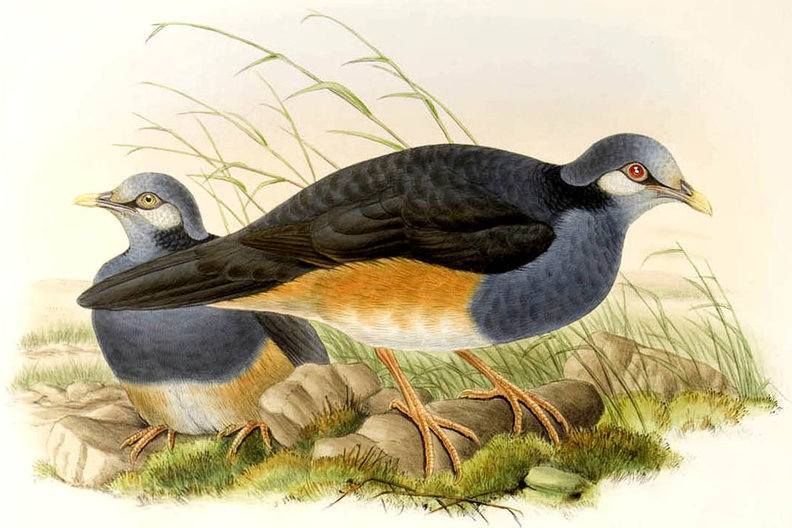
The Thick-billed Ground-Pigeon is a medium-sized bird, measuring approximately 33 cm in length. Its most distinctive feature is its thick, robust bill, adapted for cracking hard seeds and fruits. The plumage is predominantly brown with subtle mottling, providing excellent camouflage against the forest floor. Adults have a more pronounced chestnut hue on the wings and back, while juveniles display a duller, more uniform brown. There is little sexual dimorphism; both males and females share similar plumage, though males may appear slightly larger. The bird's eyes are a striking deep red, adding a splash of color to its otherwise subdued appearance. In flight, the Thick-billed Ground-Pigeon exhibits short, rounded wings and a relatively short tail, giving it a distinctive silhouette compared to other pigeons. Its flight is strong and direct, though it prefers to walk or run rather than fly, only taking to the air when disturbed. When perched, it often remains motionless for long periods, relying on its camouflage to avoid detection. It's unlikely to be confused with other species due to its unique bill and ground-dwelling habits, although beginners might mistake it for other forest-dwelling pigeons if not observed carefully.
Having trouble telling birds apart? Upload a photo to our bird identification tool for an instant species match.
Thick-billed Ground-Pigeon Habitat and Range
Preferred Habitat
The Thick-billed Ground-Pigeon thrives in the lowland rainforests of New Guinea, favoring areas with dense understory vegetation and abundant leaf litter. These habitats provide ample food resources and protective cover from predators. The bird is typically found at elevations ranging from sea level to about 1,000 meters, though it prefers the flatter, more stable environments of the lowlands. Seasonal habitat shifts are minimal, as the pigeon is a year-round resident of its forest home, with no migratory behavior observed. While it primarily inhabits remote, undisturbed forests, its presence in secondary growth or edge habitats is rare. Unlike some other pigeon species, the Thick-billed Ground-Pigeon does not adapt well to urban or heavily altered landscapes, reflecting its strong dependence on pristine, natural environments.
Geographic Range
The Thick-billed Ground-Pigeon is endemic to New Guinea, with its range encompassing both Papua New Guinea and the Indonesian region of West Papua. It inhabits the vast lowland rainforests that stretch across the island, from the Vogelkop Peninsula in the west to the southeastern lowlands. The bird's range is relatively stable, as it does not undertake long-distance migrations or significant seasonal movements. Population density tends to be higher in areas with abundant fruiting trees and minimal human disturbance, such as the remote interior forests. While the pigeon is not considered migratory, its localized movements within its home range may occur in response to fluctuations in food availability or breeding conditions. Despite its restricted geographic range, the Thick-billed Ground-Pigeon remains widespread within suitable habitats across New Guinea.
Want to know which birds visit your area? Browse our backyard birds by location guides for region-specific species lists.
What Does the Thick-billed Ground-Pigeon Eat?
The diet of the Thick-billed Ground-Pigeon consists primarily of fallen fruits and seeds, which it forages from the forest floor. It exhibits a preference for a variety of fruiting trees and shrubs native to its rainforest habitat. Seasonal changes in fruit availability can influence its diet, with the pigeon adjusting its foraging behavior to exploit the most abundant food sources at any given time. Its robust bill is well-suited for cracking open hard seeds, allowing it to access a range of food items that might be unavailable to less specialized birds. The Thick-billed Ground-Pigeon typically forages alone or in pairs, walking methodically across the forest floor, pecking and probing among the leaf litter. Its foraging activity peaks during the cooler morning and late afternoon hours, when temperatures are more moderate and fruit is less likely to have been consumed by other animals.
Thick-billed Ground-Pigeon Behavior and Social Structure
Thick-billed Ground-Pigeons are generally solitary or found in pairs, rarely forming flocks. They exhibit strong territorial behavior, particularly during the breeding season when males actively defend their chosen areas through vocalizations and physical displays. Courtship involves a series of low, cooing calls, accompanied by a ritualized display where the male puffs up his chest and struts on the ground to attract a mate. Despite their ground-dwelling nature, these pigeons are surprisingly adept flyers, though they prefer to escape threats by running swiftly into dense vegetation. Their response to predators involves freezing in place, relying on their camouflage to avoid detection. The Thick-billed Ground-Pigeon is most active during the early morning and late afternoon, resting during the heat of midday. Its daily routine consists of foraging, preening, and occasionally sunning itself in small clearings.
Thick-billed Ground-Pigeon Nesting and Reproduction
The Thick-billed Ground-Pigeon constructs a simple nest on the ground, often at the base of a tree or within dense undergrowth. The nest consists of a shallow depression lined with leaves and twigs. The female typically lays a single egg per clutch, which both parents incubate for approximately 20 to 23 days. The fledging period lasts about 18 to 20 days, during which the parents diligently feed and protect the young. Parental roles are fairly evenly divided, with both male and female sharing incubation duties and feeding the chick through regurgitation. The nesting season is closely tied to the availability of fruit, ensuring ample food supply for the growing chick. The Thick-billed Ground-Pigeon generally raises one brood per year, though in particularly fruitful years, a second brood may be attempted.
Thick-billed Ground-Pigeon Sounds and Vocalizations
The Thick-billed Ground-Pigeon produces a soft, low-pitched 'coo' that is repeated in a rhythmic sequence, serving both as a territorial call and a mate-attracting song. Its calls are less melodic compared to arboreal pigeons, possessing a more muted and resonant quality. Alarm calls consist of a sharp, quick 'hoot' used to warn of approaching danger. During the dawn chorus, its calls blend subtly with those of other forest dwellers, adding to the symphony of the waking rainforest. Unlike some more vocal pigeon species, the Thick-billed Ground-Pigeon relies heavily on its calls during the breeding season but remains relatively quiet outside of this period.
Interesting Facts About the Thick-billed Ground-Pigeon
- 1The Thick-billed Ground-Pigeon is one of the few pigeon species that spends almost its entire life on the forest floor.
- 2Despite its preference for ground-dwelling, this pigeon is known for its powerful and direct flight when startled.
- 3The species is an important seed disperser, helping to maintain the diversity of the rainforest understory.
- 4Thick-billed Ground-Pigeons have a unique courtship display involving chest puffing and ground strutting.
- 5The bird's robust bill is specifically adapted to crack open hard seeds, giving it access to diverse food sources.
- 6The Thick-billed Ground-Pigeon relies on its mottled brown plumage for camouflage against the forest floor.
- 7This pigeon is less commonly observed due to its secretive nature and preference for dense, undisturbed forests.
Thick-billed Ground-Pigeon Conservation Status
The Thick-billed Ground-Pigeon is currently listed as Least Concern by the IUCN, although its population trend appears to be decreasing due to habitat loss. The primary threat to its survival is deforestation, driven by logging and agricultural expansion in New Guinea. Conservation efforts focus on protecting large swathes of intact rainforest and promoting sustainable land-use practices. Historically, the species has maintained stable populations in undisturbed habitats, but recent increases in human activity pose significant challenges. Continued monitoring and habitat preservation are crucial to ensuring the long-term survival of the Thick-billed Ground-Pigeon and the ecosystems it inhabits.


