
Torresian Crow
Corvus orru
Order: Passeriformes / Family: Corvidae
Wikimedia Commons
About the Torresian Crow
The Torresian Crow (Corvus orru) is a striking member of the Corvidae family, recognized for its sleek black plumage and intelligence. This bird thrives in a variety of environments, ranging from open woodlands to urban areas, showcasing its adaptability. Commonly found in northern and eastern Australia, as well as New Guinea, the Torresian Crow plays a crucial role in its ecosystem as both a scavenger and predator. Its presence in agricultural regions often benefits farmers by controlling insect populations. The bird's ability to exploit human-modified environments has allowed it to maintain stable populations, even in areas of rapid urbanization. Seasonal behaviors of the Torresian Crow include localized movements in search of food resources, though they are not migratory. As resourceful omnivores, they adapt their diet according to availability, which may involve foraging in coastal areas during low tides, exploiting intertidal zones for mollusks and other marine life. While generally sedentary, they may travel short distances in response to environmental changes, such as droughts or food shortages. The Torresian Crow's intelligence is evident in its problem-solving abilities and complex social structures. These crows often form loose flocks, especially outside of the breeding season, to increase their foraging efficiency and protection against predators. Their social interactions are complex, involving vocalizations and displays that reinforce their hierarchies and breeding pairs. The Torresian Crow's adaptability and intelligence make it a fascinating study subject for ornithologists and naturalists alike, providing insights into avian cognition and social behavior.
The Torresian Crow belongs to the family Corvidae, within the order Passeriformes. These birds typically live average 15 years, with some living over 20 years..
How to Identify a Torresian Crow
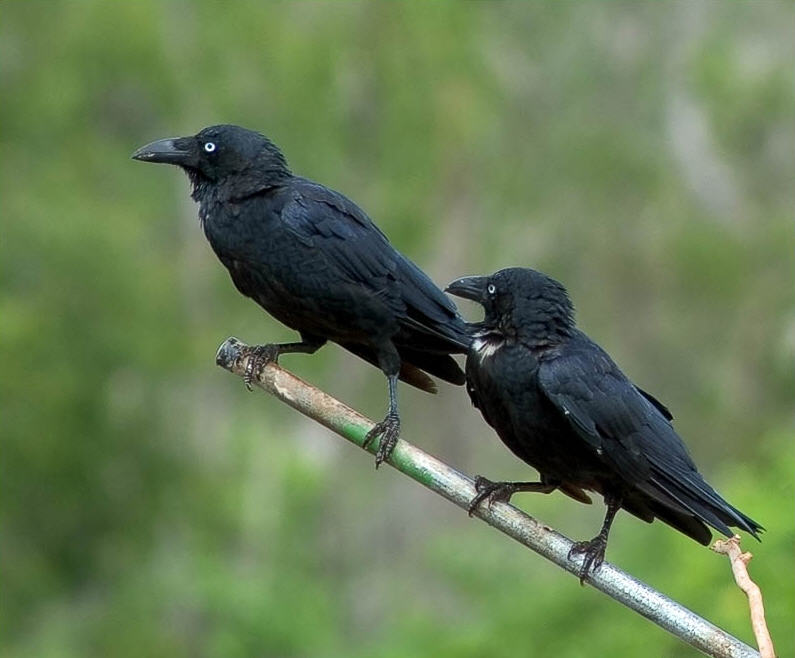
The adult Torresian Crow is a medium-sized bird, measuring around 48 to 53 cm in length, with a wingspan of approximately 100 cm. Its plumage is uniformly glossy black, which can appear iridescent in sunlight. The eyes of this crow are stark white, contrasting sharply with its dark feathers, a feature that distinguishes it from the closely related Australian Raven, which has dark eyes. Juvenile Torresian Crows have darker, brownish eyes and less glossy plumage, which gradually brightens as they mature. Males and females are similar in appearance, with no significant sexual dimorphism in size or coloration. In flight, the Torresian Crow exhibits a steady, purposeful wingbeat and a slightly rounded tail. Its flight silhouette is characterized by broad, rounded wings, which differ from the more slender wings of ravens. When perched, the crow often adopts an upright posture, showing off its sleek body. Its bill is strong and slightly curved, suitable for a wide range of feeding activities. The Torresian Crow's vocalizations are another key identification feature, consisting of a series of nasal, croaky calls distinct from the more melodious sounds of other corvids.
Having trouble telling birds apart? Upload a photo to our bird identification tool for an instant species match.
Torresian Crow Habitat and Range
Preferred Habitat
The Torresian Crow occupies a diverse range of habitats, reflecting its adaptability. It thrives in open woodlands, savannas, and along coastal regions, often seen near urban centers and suburban areas. This crow is commonly found at low elevations but can also inhabit mountainous regions up to 1000 meters. In urban areas, the Torresian Crow exploits parks, gardens, and landfills, benefiting from human activity. Unlike some other crow species, it does not exhibit significant seasonal habitat shifts, remaining largely in the same areas year-round. Its presence in both rural and urban settings highlights its ability to navigate and exploit human-dominated landscapes effectively.
Geographic Range
The Torresian Crow's range extends across northern and eastern Australia, including Queensland and New South Wales, and into New Guinea. It is a resident species, with no extensive migrations, although some local movement occurs in response to environmental conditions. Breeding populations are densest along coastal and inland regions where food resources are abundant. In New Guinea, the Torresian Crow is found in both lowland and montane forests. The bird's adaptability to various environments ensures it is a common sight across its range, often overlapping with other crow species, but distinguishable by its unique features and vocalizations.
Want to know which birds visit your area? Browse our backyard birds by location guides for region-specific species lists.
What Does the Torresian Crow Eat?
The Torresian Crow is an opportunistic omnivore, with a diet that includes insects, small mammals, carrion, and a variety of plant materials. Seasonal diet changes are evident, with a higher intake of insects and larvae during breeding season to support the nutritional needs of growing chicks. In coastal areas, they forage for marine life such as mollusks and crabs, using their strong bills to crack open shells. The crow also scavenges on roadkill and other carrion, playing a vital role in the ecosystem as a cleaner. Foraging usually occurs during daylight hours, with peaks in the early morning and late afternoon when temperatures are cooler and food is abundant.
Torresian Crow Behavior and Social Structure
Torresian Crows exhibit complex social behaviors, often forming loose flocks that provide mutual benefits in foraging and protection against predators. These social structures are hierarchical, with dominant individuals typically securing better access to resources and breeding opportunities. Territorial behavior is most pronounced during the breeding season, with pairs defending their nesting sites vigorously. Courtship displays involve synchronized flights and vocalizations, reinforcing pair bonds. The crow's response to predators includes mobbing behavior, where groups of crows harass larger birds of prey to drive them away. Daily activity patterns are diurnal, with most foraging and social interactions occurring during daylight hours.
Torresian Crow Nesting and Reproduction
Nesting in Torresian Crows involves constructing large, bulky nests made from sticks, usually situated high in trees or on secluded ledges. The nest is lined with softer materials like grass and feathers to provide insulation. Preferred nesting sites include tall eucalyptus trees and man-made structures such as towers. Clutch size typically ranges from 3 to 5 eggs, with an incubation period of about 20 days. Both parents participate in feeding and caring for the young, which fledge approximately 35 days after hatching. The Torresian Crow typically raises one brood per year, though favorable conditions may allow for a second.
Torresian Crow Sounds and Vocalizations
The primary vocalization of the Torresian Crow is a series of nasal, harsh calls that serve various communicative purposes. These calls vary in rhythm and pitch, often described as a repeated 'aark-aark'. Alarm calls are sharper and more insistent, used to alert other crows of potential threats. During the dawn chorus, their vocalizations are less frequent compared to songbirds, but they still contribute to the morning soundscape with their distinctive calls. These sounds are crucial in maintaining social bonds and establishing territory.
Interesting Facts About the Torresian Crow
- 1Torresian Crows have been observed using tools to access food, showcasing their remarkable intelligence.
- 2The Torresian Crow's white eyes are a unique trait that helps distinguish it from other crows in its range.
- 3These crows are known to engage in playful behavior, such as sliding down snowy or grassy slopes for fun.
- 4Their complex vocalizations include over 20 different calls used for communication within flocks.
- 5Torresian Crows have been recorded imitating human-made noises and the calls of other bird species.
- 6They are adept at using traffic to crack open nuts, placing them on roads for cars to drive over.
- 7The Torresian Crow is often considered a cultural symbol in Aboriginal folklore, representing cunning and adaptability.
Torresian Crow Conservation Status
The IUCN lists the Torresian Crow as a species of Least Concern, with stable population trends due to its adaptability and wide range. Primary threats include habitat destruction and human persecution in some areas, though its ability to thrive in urban environments mitigates these impacts. Conservation efforts focus on habitat preservation and reducing human-wildlife conflicts. Historical population changes have been minimal, with the crow maintaining a robust presence across its range due to its opportunistic nature and broad diet.


