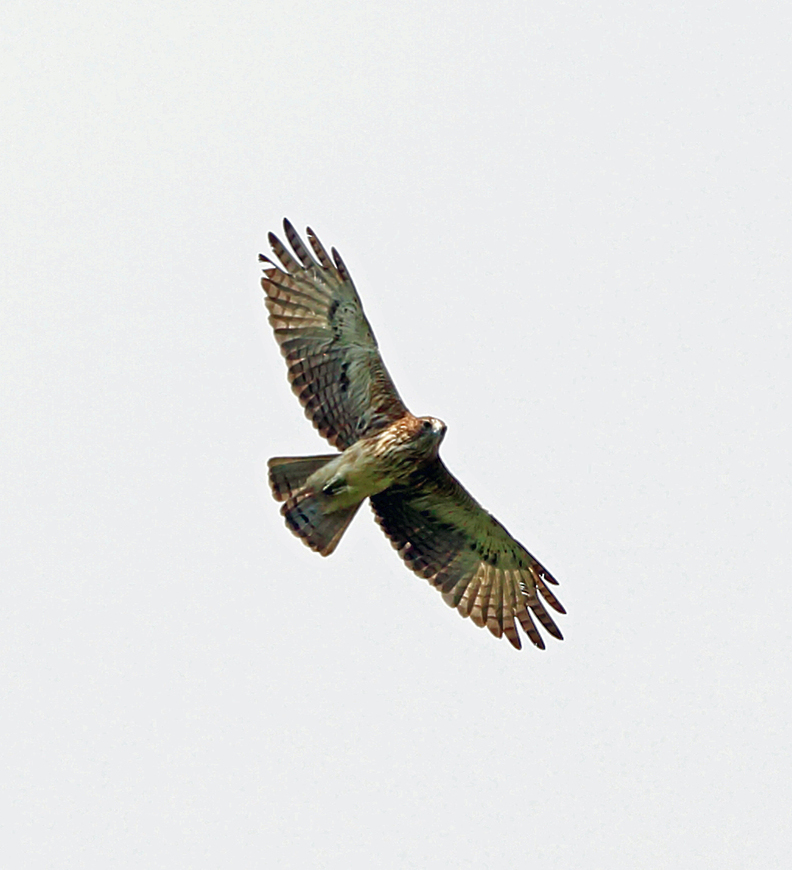
Wahlberg's Eagle
Hieraaetus wahlbergi
Order: Accipitriformes / Family: Accipitridae

Wikimedia Commons
About the Wahlberg's Eagle
Wahlberg's Eagle (Hieraaetus wahlbergi) is a fascinating raptor that commands the skies across the sub-Saharan regions of Africa. This medium-sized eagle exhibits a mastery of flight, adapted to a variety of habitats ranging from open savannas to dense woodlands. Its adaptability is key to its survival in the diverse environments of countries like South Africa, Namibia, and Kenya. The eagle plays a significant ecological role as both a predator and a scavenger, maintaining the balance in its ecosystem by controlling the populations of small mammals, birds, and reptiles.
Ecologically, Wahlberg's Eagle is a keystone species, indicative of the health of its habitat. It is often spotted soaring at great heights, using thermals to conserve energy while scouting for prey. During the breeding season, which coincides with the rainy season in many parts of its range, the eagle becomes more territorial, engaging in elaborate aerial displays to ward off competitors and attract mates. These displays, coupled with its characteristic calls, make the Wahlberg's Eagle an engaging subject for bird watchers and ornithologists alike.
The Wahlberg's Eagle is also a migratory species, undertaking seasonal movements in response to rainfall patterns and prey availability. It typically migrates within the African continent, moving between breeding and non-breeding areas. This migration is not just a survival strategy but also a natural spectacle that highlights the eagle's resilience and adaptability.
In its role as an apex predator, Wahlberg's Eagle influences the structure of its ecosystem. Its predation on rodents and other small animals helps control potential pest populations, benefiting agricultural areas nearby. Furthermore, as a scavenger, it contributes to the natural cycle of decomposition, ensuring nutrients are returned to the soil. The eagle's presence is an indicator of biodiversity and ecological health, making it a valuable subject for conservation efforts.
The Wahlberg's Eagle belongs to the family Accipitridae, within the order Accipitriformes. These birds typically live averages 15 years, with some living up to 25 years..
How to Identify a Wahlberg's Eagle
Wahlberg's Eagle is characterized by its medium size and long, narrow wings which give it a distinctive silhouette in flight. Adult birds exhibit a uniform dark brown plumage, which can appear almost black in certain lighting conditions. The tail is relatively long and rounded, often showing a faint barring pattern. Juvenile Wahlberg's Eagles can be distinguished by their lighter, streaked plumage, which gradually darkens as they mature.
Differences between males and females are subtle, with females generally being larger and heavier than males. This sexual dimorphism is common among raptors and can aid in identification during close observation. In comparison to similar species, such as the Booted Eagle (Hieraaetus pennatus), Wahlberg's Eagle lacks the pale underwing coverts and distinct black and white patterning, making it less conspicuous.
When perched, the Wahlberg's Eagle often presents a hunched posture, with its wings slightly drooped. Its legs are feathered down to the toes, and the eyes are a piercing yellow, providing a stark contrast to its dark plumage. Observers can often spot this eagle at the top of tall trees or on rocky outcrops, scanning the environment for prey.
Having trouble telling birds apart? Upload a photo to our bird identification tool for an instant species match.
Wahlberg's Eagle Habitat and Range
Preferred Habitat
Wahlberg's Eagle inhabits a wide range of environments, reflecting its adaptability. It thrives in open savannas and woodlands, particularly favoring areas with scattered trees that provide ample perching opportunities. These habitats are typically found at elevations ranging from sea level to about 2,000 meters.
While the eagle is predominantly found in rural areas, it can occasionally be seen in the outskirts of urban environments, especially where natural landscapes are still intact. Seasonal shifts in rainfall influence its habitat preferences, with the eagle moving to wetter areas during the dry season to maintain access to prey.
Despite its preference for open areas, Wahlberg's Eagle occasionally ventures into more densely forested regions, particularly during migration or when searching for food. This versatility in habitat selection ensures it can exploit a wide range of ecological niches.
Geographic Range
The range of Wahlberg's Eagle spans much of sub-Saharan Africa, with populations established from South Africa to Ethiopia. During the breeding season, the eagle is commonly found in countries such as Botswana, Namibia, and Zimbabwe, where it nests in tall trees within savanna and woodland ecosystems.
In the non-breeding season, Wahlberg's Eagle is known to migrate northward, reaching as far as the Sahel region, including parts of Chad and Sudan. This migration is primarily driven by the availability of prey and suitable conditions for breeding.
Certain areas, such as the Okavango Delta in Botswana and the Kruger National Park in South Africa, serve as population density hotspots, providing ideal conditions for nesting and hunting. These regions are critical to the survival of Wahlberg's Eagle, supporting both resident and migratory individuals.
Want to know which birds visit your area? Browse our backyard birds by location guides for region-specific species lists.
What Does the Wahlberg's Eagle Eat?
Wahlberg's Eagle primarily feeds on a diet consisting of small to medium-sized mammals, birds, and reptiles. Its primary prey includes rodents and small birds, which it hunts with precision using its keen eyesight from high perches or while soaring.
During the wet season, when prey is more abundant, the eagle's diet may also include insects and amphibians. This seasonal diet shift reflects the eagle's opportunistic feeding strategy, allowing it to exploit available food resources efficiently.
The eagle employs a hunting technique characterized by patient observation followed by a swift, silent dive to capture prey. Typically, it hunts alone, although it may join others in areas where prey is particularly abundant. Its feeding schedule often peaks during the early morning and late afternoon, times when prey is most active.
Wahlberg's Eagle Behavior and Social Structure
Wahlberg's Eagle exhibits territorial behavior, particularly during the breeding season, when pairs become more vigilant in defending their nesting sites. This territoriality is often marked by aerial displays and vocalizations aimed at deterring intruders.
The eagle's social structure is primarily solitary, although it forms monogamous pairs during the breeding season. These pairs engage in cooperative hunting and share parenting duties, ensuring the successful rearing of their young.
Courtship displays in Wahlberg's Eagle involve dramatic aerial acrobatics, with the pair performing synchronized flights and mutual calling. These displays reinforce pair bonds and contribute to successful mating.
Daily activity patterns of Wahlberg's Eagle are diurnal, with most hunting and territorial activities occurring during daylight. The eagle exhibits a distinct pattern of morning and late afternoon activity, taking advantage of cooler temperatures and rising thermals for flight.
Wahlberg's Eagle Nesting and Reproduction
Wahlberg's Eagle constructs its nest high in tall trees, often choosing sites that provide a commanding view of the surrounding area. The nest is a large structure made from sticks and lined with softer materials such as leaves and grass.
The typical clutch size for Wahlberg's Eagle is one to two eggs, which are incubated primarily by the female over a period of approximately 42 to 45 days. During this time, the male provides food for the female.
Once hatched, the chicks are altricial and rely heavily on parental care for feeding and protection. The fledging period ranges from 60 to 75 days, during which both parents contribute to feeding and defending the young.
Wahlberg's Eagle typically raises a single brood per year, although in years of abundant food, a second brood might be attempted. Nesting success is highly dependent on food availability and environmental conditions.
Wahlberg's Eagle Sounds and Vocalizations
The vocalizations of Wahlberg's Eagle are a key part of its communication, particularly during the breeding season. Its primary call is a series of high-pitched, whistling notes, 'ki-ki-ki', often used to establish territory and communicate with mates.
Alarm calls are sharper and more urgent, used to warn off potential threats or intruders. These vocalizations are less melodious and more abrupt, reflecting the urgency of the situation.
During the dawn chorus, Wahlberg's Eagle may join other birds in vocal displays, though its calls tend to be more sporadic and less sustained compared to songbirds. Its use of sound is more about practical communication than elaborate song.
Interesting Facts About the Wahlberg's Eagle
- 1Wahlberg's Eagle can travel up to 150 kilometers in a single day during migration, showcasing its impressive stamina.
- 2The eagle was named after Swedish naturalist Johan August Wahlberg, who explored southern Africa in the 19th century.
- 3Wahlberg's Eagle is known to use old nests of other large birds, such as herons, adapting them for its own use.
- 4During courtship, both male and female Wahlberg's Eagles engage in spectacular aerial displays, involving intricate spirals and dives.
- 5This eagle species is one of the few that can adapt to both wet and arid environments, making it highly versatile.
- 6Wahlberg's Eagles have been observed hunting cooperatively in pairs, an unusual behavior among solitary raptors.
- 7The call of Wahlberg's Eagle has been compared to the sound of a distant steam engine, distinct and recognizable.
Wahlberg's Eagle Conservation Status
Wahlberg's Eagle currently holds a status of Least Concern on the IUCN Red List, with stable population trends across most of its range. Despite this, the eagle faces threats from habitat destruction, particularly due to agricultural expansion and deforestation. Conservation efforts focus on habitat preservation and minimizing human-wildlife conflict. Protected areas such as national parks and reserves provide crucial refuges for the eagle, ensuring it has access to safe breeding sites and abundant prey. Historically, Wahlberg's Eagle populations have fluctuated with environmental changes, but targeted conservation initiatives have helped stabilize numbers in recent years. Continued monitoring and protection are essential to maintain this stability.
Other Accipitridae Species


Birds Similar to the Wahlberg's Eagle
These species are often confused with the Wahlberg's Eagle due to similar appearance or overlapping range.