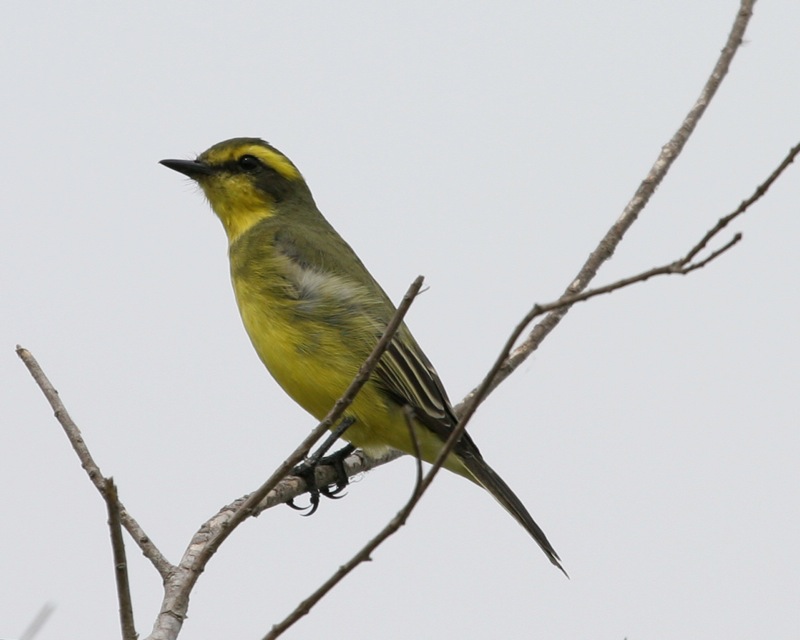
Warbling Doradito
Pseudocolopteryx flaviventris
Order: Passeriformes / Family: Tyrannidae

Wikimedia Commons
About the Warbling Doradito
The Warbling Doradito (Pseudocolopteryx flaviventris) is a vibrant member of the Tyrannidae family, which includes tyrant flycatchers. This small bird is celebrated for its striking appearance and lively behavior, found predominantly in the wetlands and marshes of South America. Its presence is particularly noted in countries such as Argentina, Uruguay, and southern Brazil, where it plays a significant ecological role in controlling insect populations.
The Warbling Doradito thrives in areas with abundant water sources, often seen darting through reeds and bushes in search of prey. During the breeding season, it becomes particularly vocal, utilizing its melodious warbling to establish territories and attract mates. This period coincides with the warmer months in the Southern Hemisphere, typically from September to February, when the wetlands are lush with life.
Ecologically, the Warbling Doradito serves as both a predator and a prey species. Its diet consists largely of insects, which helps control pest populations, thus maintaining a balanced ecosystem. In turn, it provides sustenance for larger predators, including birds of prey. This intricate web of interactions highlights the Warbling Doradito's importance within its habitat.
Beyond its ecological contributions, the Warbling Doradito is a favored subject among birdwatchers and ornithologists due to its vibrant plumage and engaging behavior. Its presence in protected wetland areas also underscores the importance of conservation efforts aimed at preserving these critical habitats. As wetlands face threats from agriculture and urban development, understanding and protecting the Warbling Doradito's habitat becomes increasingly vital.
The Warbling Doradito belongs to the family Tyrannidae, within the order Passeriformes. These birds typically live average 3-4 years with a max recorded of 6 years.
How to Identify a Warbling Doradito
The Warbling Doradito is a small bird, approximately 11-12 cm in length, with a distinctively bright yellow belly that makes it relatively easy to identify in the field. Adult Doraditos feature olive-green upperparts, which contrast with their vibrant underparts. Their crown and nape are subtly streaked with darker tones, providing camouflage among the reeds and grasses of their wetland homes.
Juvenile Warbling Doraditos exhibit slightly duller plumage compared to adults, with less pronounced yellow on their underbellies. They gradually acquire the full coloration as they mature, usually by the end of their first breeding season. Male and female Doraditos look similar, though females may have marginally less vibrant colors.
In flight, the Warbling Doradito presents a compact silhouette with rapid, fluttering wingbeats. It often perches on reeds and low shrubs, where it maintains an upright posture, frequently flicking its tail as it scans for insects. Similar species, such as the Subtropical Doradito (Pseudocolopteryx acutipennis), can be differentiated by more muted colors and slightly larger size.
Having trouble telling birds apart? Upload a photo to our bird identification tool for an instant species match.
Warbling Doradito Habitat and Range
Preferred Habitat
The Warbling Doradito is commonly associated with wetlands, including marshes and swamps, where dense vegetation meets open water. It favors areas with abundant grasses and reeds, providing ample cover and foraging opportunities. This bird is typically found at low elevations, although it may inhabit higher wetland areas during migration.
Seasonal habitat shifts occur as the Warbling Doradito relocates in response to water levels and food availability. While it primarily occupies rural areas, it can occasionally be observed in suburban regions where wetland habitats remain undisturbed. Its adaptability to various wetland ecosystems underscores its resilience, though it remains dependent on the preservation of these environments.
Geographic Range
The Warbling Doradito's range spans several South American countries, with a prominent presence in Argentina, Uruguay, Paraguay, and southern Brazil. During the breeding season, it is most commonly found in the southern parts of its range, particularly in the Pampas and other grassland regions rich in wetland habitats.
In the non-breeding season, the Warbling Doradito may move northward, reaching as far as eastern Bolivia and parts of southern Brazil. Migration corridors often follow major river systems and wetland networks, providing the necessary resources for resting and refueling.
Population density hotspots include the Paraná Delta in Argentina and the Pantanal region, where large swathes of suitable habitat support thriving Doradito populations. These areas also serve as crucial stopover points during migration.
Want to know which birds visit your area? Browse our backyard birds by location guides for region-specific species lists.
What Does the Warbling Doradito Eat?
The Warbling Doradito's diet primarily consists of insects, making it an essential participant in controlling insect populations within its ecosystem. It frequently preys on small insects such as flies, beetles, and caterpillars, employing a technique known as 'sallying' where it captures prey in mid-flight.
Seasonal changes in diet occur as the availability of prey fluctuates. During the breeding season, the abundance of insects allows the Warbling Doradito to feed more frequently, supporting the increased energy demands of nesting and rearing young. In the non-breeding season, it may diversify its diet slightly, incorporating seeds and other plant material when insects are less abundant.
Foraging often takes place during the cooler hours of the morning and late afternoon, when insect activity peaks. The Warbling Doradito exhibits remarkable agility as it navigates through dense vegetation, demonstrating its adaptability and efficiency as a forager.
Want to attract Warbling Doraditos to your yard? See our recommended feeders and seed types for the best results.
Warbling Doradito Behavior and Social Structure
The Warbling Doradito exhibits a range of intriguing behaviors that reflect its adaptation to wetland environments. Socially, it is generally solitary or found in pairs, especially during the breeding season when territoriality becomes pronounced. Males establish territories through song, using their melodious calls to ward off rivals and attract females.
Courtship displays involve a combination of vocalizations and physical gestures, including fluttering flights and tail flicks. Once paired, both partners engage in nest building and rearing of young, showing a high degree of parental cooperation.
Outside the breeding season, the Warbling Doradito may join mixed-species flocks, enhancing its foraging efficiency and offering protection against predators. In response to threats, such as birds of prey, it employs evasive maneuvers and emits sharp alarm calls, alerting others to the danger.
Daily activity patterns of the Warbling Doradito include periods of intense foraging interspersed with rest and preening. It remains most active during the early morning and late afternoon, aligning its activity with peak insect availability.
Warbling Doradito Nesting and Reproduction
The Warbling Doradito constructs its nest using fine grasses and plant fibers, weaving a compact cup shape typically situated in dense vegetation. Preferred nesting sites include reeds and low shrubs, which offer concealment from predators and protection from environmental elements.
A typical clutch consists of 2-3 eggs, which both parents incubate over a period of approximately 14-16 days. After hatching, the chicks are altricial, requiring extensive care and feeding from both adults. The fledging period lasts about 12-14 days, during which time the young develop rapidly, preparing for independence.
The Warbling Doradito may raise two broods per year, depending on environmental conditions and food availability. Parental roles are shared, with both male and female participating in feeding and defending the nest, demonstrating a high level of cooperation and commitment to offspring survival.
Warbling Doradito Sounds and Vocalizations
The Warbling Doradito's primary song is a melodious series of warbles and trills, characterized by a clear, musical quality that carries well over distances. These vocalizations serve important functions in territory establishment and mate attraction during the breeding season.
In addition to its primary song, the Warbling Doradito emits a variety of call notes and alarm calls. These are typically sharp, quick notes used to communicate with mates or signal the presence of predators. During the dawn chorus, its voice mingles with those of other wetland birds, creating a rich tapestry of sound.
Comparable to the song of a canary, the Warbling Doradito's vocalizations are pleasing to the ear and often a highlight for birdwatchers in its range. Its ability to produce a range of sounds demonstrates adaptability in communication, enhancing its interactions within the diverse wetland environments it inhabits.
Interesting Facts About the Warbling Doradito
- 1The Warbling Doradito's song can be heard from over 100 meters away, making it an effective tool for territory defense.
- 2Despite its small size, the Warbling Doradito plays a crucial role in insect control within its wetland habitat.
- 3The Warbling Doradito is known to join mixed-species flocks outside of the breeding season, enhancing its foraging success.
- 4This bird's vibrant yellow plumage helps it stand out in the dense greenery of its wetland home, aiding in mate attraction.
- 5The Warbling Doradito's nesting sites are often cleverly concealed in reeds, providing protection from predators.
Warbling Doradito Conservation Status
The Warbling Doradito is currently listed as Least Concern by the IUCN, with stable population trends across its range. However, it faces potential threats from habitat loss and degradation, particularly due to agricultural expansion and water management practices that alter wetland ecosystems. Conservation efforts aimed at preserving wetland habitats are crucial for maintaining healthy Warbling Doradito populations. Protected areas, such as national parks and wildlife reserves, play a vital role in safeguarding critical breeding and foraging sites. Historically, the Warbling Doradito has demonstrated resilience in the face of environmental changes, yet ongoing monitoring and habitat conservation remain essential to ensure its continued survival. Public awareness and engagement in wetland conservation initiatives can further bolster efforts to protect this and other wetland species.
Attracting Warbling Doraditos to Your Feeder
The Warbling Doradito is a regular visitor to backyard bird feeders across its range. At the Eye On The Fly feeding station, we observe Warbling Doraditos regularly and capture footage with our feeder cameras.
Other Tyrannidae Species


Birds Similar to the Warbling Doradito
These species are often confused with the Warbling Doradito due to similar appearance or overlapping range.