
White-barred Piculet
Picumnus cirratus
Order: Piciformes / Family: Picidae
Wikimedia Commons
About the White-barred Piculet
The White-barred Piculet (Picumnus cirratus) is a fascinating member of the woodpecker family, Picidae, and is notable for its diminutive size and distinctive plumage. This bird is primarily found in the tropical and subtropical forests of South America, particularly in countries such as Brazil, Argentina, and Paraguay. These regions provide a rich tapestry of ecosystems that support the diverse behaviors and ecological roles of the White-barred Piculet. Unlike many larger woodpecker species, these piculets are specialized for life in dense forest undergrowth, where they play a significant role in controlling insect populations. The bird's small size and agile movements allow it to access insects hidden in bark crevices and beneath leaves. During the breeding season, which varies slightly depending on the region, the White-barred Piculet becomes a more conspicuous presence as it establishes territories and attracts mates through various displays. Its role in the ecosystem extends beyond insect control; it also acts as a key pollinator for certain plant species as it moves through the forest. Seasonal behaviors of the White-barred Piculet reflect its adaptability to changes in food availability and habitat conditions. In the wetter months, the bird takes advantage of an abundance of insect prey, while in drier periods, it may supplement its diet with fruits. This adaptability ensures its survival across a range of environmental conditions. The White-barred Piculet is an intriguing subject for ornithologists and bird enthusiasts alike, offering insights into the complex dynamics of tropical ecosystems.
The White-barred Piculet belongs to the family Picidae, within the order Piciformes. These birds typically live average 5 years with a maximum recorded of 8 years..
How to Identify a White-barred Piculet
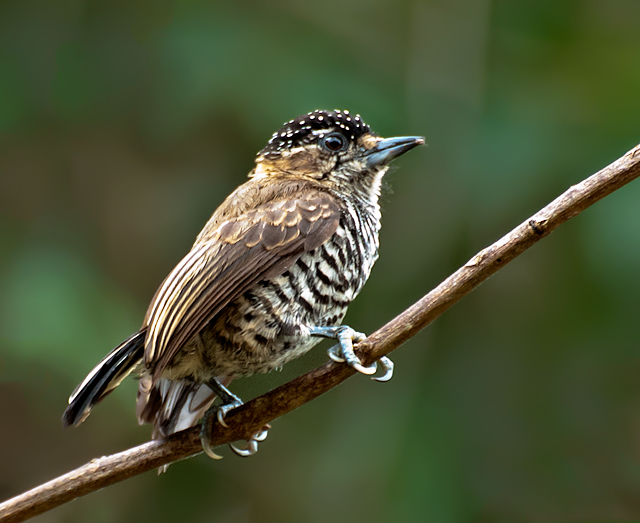
The White-barred Piculet is a small bird, measuring approximately 10 cm in length, making it one of the smallest members of the woodpecker family. Its plumage is characterized by a striking pattern of white bars against a dark background, giving it its name. The adult male has a distinctive red patch on the crown of its head, which is absent in females and juveniles. This sexual dimorphism aids in identifying the sexes in the field. Juveniles resemble females but have a duller plumage with less distinct barring. When observing the White-barred Piculet, note its short tail and slightly curved bill, which are adapted for its specialized foraging techniques. In flight, its silhouette is less undulating compared to larger woodpeckers, maintaining a more direct path. Perching posture often includes a slightly tilted head as it inspects bark surfaces for prey. Confusion with similar species, such as other piculets within its range, can be avoided by paying attention to its unique barring pattern and size.
Having trouble telling birds apart? Upload a photo to our bird identification tool for an instant species match.
White-barred Piculet Habitat and Range
Preferred Habitat
The White-barred Piculet predominantly inhabits tropical and subtropical forests. It thrives in lowland rainforests, secondary growth forests, and edge habitats where dense undergrowth provides ample foraging opportunities. This species shows a preference for areas with abundant deadwood and decaying vegetation, which support a diverse insect community. The bird is typically found from sea level up to elevations of about 1,200 meters, although it is less common in montane regions. Unlike some other woodpeckers, the White-barred Piculet is not frequently found in urban areas, preferring instead the seclusion and resources of forested environments. Seasonal habitat shifts are minimal as the species remains in its preferred habitats year-round.
Geographic Range
The White-barred Piculet is primarily non-migratory, residing year-round in South America. Its range encompasses a broad swath of the continent, including Brazil, Argentina, Paraguay, and Uruguay. Within these countries, it is particularly prevalent in the Atlantic Forest region, a biodiversity hotspot that supports a high density of piculet populations. While it does not undertake long-distance migrations, the bird may exhibit local movements in response to changes in food availability or habitat conditions. Such movements are generally limited to short distances within its established range. Despite its restricted geographic distribution, the White-barred Piculet is considered fairly common in suitable habitats, with population densities highest in regions where forest cover remains intact.
Want to know which birds visit your area? Browse our backyard birds by location guides for region-specific species lists.
What Does the White-barred Piculet Eat?
The diet of the White-barred Piculet is primarily insectivorous, with ants and beetle larvae constituting major components of its food intake. During the rainy season, when insect populations peak, the piculet capitalizes on this abundance by foraging intensively on tree trunks and branches. The bird employs a distinctive foraging technique, using its sharp bill to probe under bark and into decaying wood. In drier periods, the piculet supplements its diet with small fruits and seeds, demonstrating its dietary flexibility. Prey size typically ranges from tiny ants to medium-sized beetles. The piculet forages throughout the day, with peak activity occurring in the early morning and late afternoon when temperatures are cooler.
White-barred Piculet Behavior and Social Structure
The White-barred Piculet exhibits a range of behaviors that reflect its adaptation to forest life. It is generally solitary or found in pairs, particularly during the breeding season. Territorial behavior is evident, with males defending small territories through vocalizations and drumming displays. Courtship involves mutual preening and subtle displays of the male's crown patch. Unlike many woodpecker species, the piculet does not form large flocks, although it may associate loosely with mixed-species foraging groups. When faced with predators, the bird employs evasive flight and seeks cover in dense vegetation. Daily activity patterns are influenced by environmental conditions, with foraging concentrated during cooler periods of the day.
White-barred Piculet Nesting and Reproduction
The White-barred Piculet nests in cavities, often excavated in decaying trees or branches. The choice of nest site reflects the bird's preference for areas with abundant deadwood. Nest construction involves both sexes, with the male typically initiating the excavation. The clutch size ranges from 2 to 4 eggs, which are incubated for approximately 12 to 14 days. Both parents share incubation duties and subsequent feeding of the hatchlings. Fledging occurs about 20 days after hatching, with young remaining dependent on parents for several weeks post-fledging. The species may raise one to two broods per year, depending on environmental conditions and food availability.
White-barred Piculet Sounds and Vocalizations
The White-barred Piculet's primary vocalization is a series of rapid, high-pitched notes, often described as a 'tinkling' sound. This song serves both territorial and mate attraction purposes. The bird also produces various call notes, including sharp 'tick' sounds used for communication between mates and to signal alarm. During the dawn chorus, the piculet's song can be heard amidst the cacophony of other forest birds, adding a unique component to the soundscape. Its drumming, though less pronounced than in larger woodpeckers, serves as an additional acoustic signal within its territory.
Interesting Facts About the White-barred Piculet
- 1The White-barred Piculet is one of the smallest woodpeckers, measuring just 10 cm in length.
- 2Unlike most woodpeckers, piculets do not have stiff tail feathers for bracing against tree trunks.
- 3The bird's distinctive drumming sounds are less pronounced than those of larger woodpeckers.
- 4Males are easily recognized by the red patch on their crown, absent in females.
- 5White-barred Piculets play a crucial role in controlling insect populations in their habitats.
- 6During courtship, mutual preening between pairs strengthens their bond.
- 7The species' primary call is a rapid series of high-pitched notes, easily distinguishable in the forest.
White-barred Piculet Conservation Status
The White-barred Piculet is currently listed as Least Concern by the IUCN, with stable population trends across its range. Primary threats include habitat loss due to deforestation and conversion of forested areas to agricultural land. Conservation efforts focus on preserving the Atlantic Forest and other key habitats through protected areas and reforestation projects. Historical population changes have been influenced by fluctuating rates of habitat destruction, but concerted conservation actions have mitigated some impacts. Continued monitoring and habitat protection remain crucial for ensuring the longevity of this species.
Other Picidae Species


Birds Similar to the White-barred Piculet
These species are often confused with the White-barred Piculet due to similar appearance or overlapping range.

