White-crowned Forktail
Enicurus leschenaulti
Order: Passeriformes / Family: Muscicapidae
Wikimedia Commons
About the White-crowned Forktail
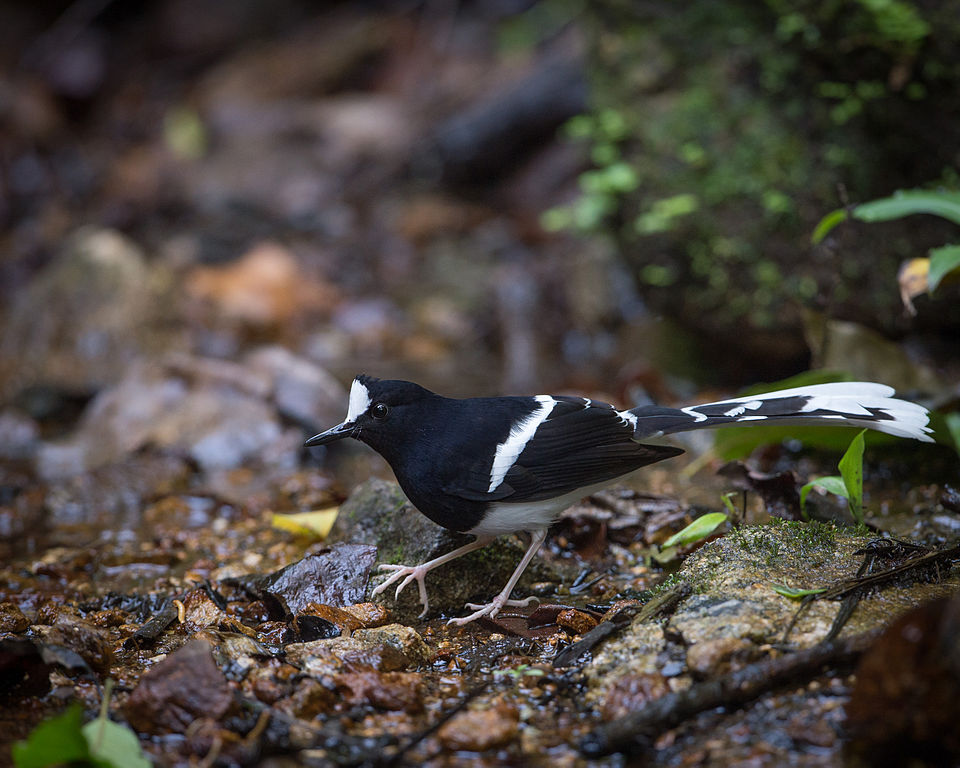
The White-crowned Forktail (Enicurus leschenaulti) is a captivating member of the Muscicapidae family, well known for its striking black and white plumage and characteristic tail that gives it its name. This bird inhabits the lush, dense undergrowth of lowland and montane forests, often near streams and rivers throughout Southeast Asia. The species plays a significant ecological role as an insectivore, controlling insect populations in its habitats.
The White-crowned Forktail is typically found in countries such as Thailand, Malaysia, and Indonesia, where it frequents subtropical and tropical moist lowland and montane forests. Its presence in these regions underscores the importance of forest conservation, as these habitats are increasingly threatened by deforestation and land development. The forktail's dependence on such specific ecological niches makes it a vital indicator of forest health.
Seasonal behaviors of the White-crowned Forktail include subtle altitudinal movements rather than long-distance migrations. During the breeding season, which generally peaks from March to July, these birds become more conspicuous as they sing to establish territories and attract mates. Outside the breeding season, they might descend to lower elevations in search of food, particularly in response to seasonal changes in insect availability. These movements highlight the bird's adaptability within its ecological niche, although its reliance on forested areas makes it vulnerable to habitat loss.
The White-crowned Forktail belongs to the family Muscicapidae, within the order Passeriformes. These birds typically live average 6-9 years, with a maximum recorded of 12 years..
How to Identify a White-crowned Forktail
Identifying the White-crowned Forktail involves noting its distinct coloration and shape. Adults display a bold black and white pattern, with a white crown and a contrasting black back and wings. The long, deeply forked tail, predominantly white with black bands, is a key feature, especially when seen in flight.
Juvenile White-crowned Forktails differ from adults with their duller, more muted coloration, lacking the stark contrast of mature birds. Both males and females exhibit similar plumage, though females may appear slightly less vibrant. This lack of sexual dimorphism can occasionally lead to confusion in the field.
Observers might confuse the White-crowned Forktail with other forktail species, like the Black-backed Forktail, but the latter lacks the white crown and has a more restricted range. In flight, the White-crowned Forktail's perching posture, often low to the ground near water, and its flicking tail are distinguishing behaviors that aid in identification.
Having trouble telling birds apart? Upload a photo to our bird identification tool for an instant species match.
White-crowned Forktail Habitat and Range
Preferred Habitat
The White-crowned Forktail thrives in subtropical and tropical moist lowland and montane forests. These habitats often feature dense undergrowth and proximity to streams or rivers, essential for the bird's foraging and nesting needs. The species typically resides at elevations ranging from sea level to 2,000 meters.
While primarily found in rural and forested areas, the White-crowned Forktail may occasionally venture into less disturbed urban edges where suitable riparian habitats exist. Seasonal habitat shifts occur primarily in response to food availability, with the birds moving to slightly lower elevations during non-breeding seasons.
In Southeast Asia, locations like the Kinabalu National Park in Malaysia and Thailand's Khao Sok National Park offer prime habitats for observing this species. The bird's preference for pristine forest environments highlights the need for conservation in these regions.
Geographic Range
The range of the White-crowned Forktail extends across Southeast Asia, encompassing countries such as Thailand, Malaysia, Indonesia, and parts of Myanmar. This bird resides year-round in these areas, with no significant long-distance migrations reported.
Populations are densest in well-protected forest reserves where suitable riparian habitats are abundant. The bird's range also extends to the islands of Sumatra and Borneo, where it occupies higher elevation forests as well.
While the White-crowned Forktail does not undertake vast migratory journeys, it exhibits altitudinal movements within its range. During non-breeding seasons, it descends to lower elevations, often in search of more abundant food sources. These movements ensure that it remains within its preferred ecological zones throughout the year.
Want to know which birds visit your area? Browse our backyard birds by location guides for region-specific species lists.
What Does the White-crowned Forktail Eat?
Primarily insectivorous, the White-crowned Forktail's diet consists of a wide variety of insects and other small invertebrates. It forages by the water's edge, where it adeptly picks off prey from the ground and foliage.
During the breeding season, when energy demands are high, the bird may expand its diet to include larger insects and occasionally small amphibians. This seasonal dietary shift reflects its opportunistic feeding habits and adaptability to fluctuating food availability.
The forktail employs a distinctive foraging technique, characterized by short dashes and frequent tail flicks, which may assist in startling hidden prey. Feeding typically occurs during daylight hours, with peak activity in the early morning and late afternoon when insect activity is highest.
White-crowned Forktail Behavior and Social Structure
The White-crowned Forktail exhibits a primarily solitary lifestyle, though it forms monogamous pairs during the breeding season. Territorial behavior intensifies at this time, with males singing to establish and defend territories, often engaging in aerial displays to deter rivals.
Courtship involves elaborate displays, including wing flicking and tail spreading, as males attempt to attract mates. Once paired, both sexes participate in territory defense and nurturing young.
These birds are diurnal, with peak activity in the early morning and late afternoon. When threatened by predators, the White-crowned Forktail relies on its agility and knowledge of dense underbrush for cover. Flocking behavior is uncommon outside of family groups, though they may occasionally join mixed-species flocks in non-breeding seasons.
White-crowned Forktail Nesting and Reproduction
The White-crowned Forktail constructs its nest on sheltered ledges or within crevices near water, often utilizing moss, leaves, and rootlets to form a cup-shaped structure. This strategic location near water provides an ample supply of food and a degree of protection from predators.
Clutch size ranges from 2 to 4 eggs, with both parents sharing incubation duties over a period of approximately 15 to 17 days. After hatching, the chicks remain in the nest for another 12 to 14 days before fledging.
Parental roles are shared, with both male and female foraging for food and feeding the young. The White-crowned Forktail typically raises one to two broods per year, depending on environmental conditions and food availability.
White-crowned Forktail Sounds and Vocalizations
The White-crowned Forktail's primary song is a series of melodious whistles, often described as clear and penetrating, with a rhythmic pattern that varies in pitch and intensity. These songs serve as both territorial calls and mate attraction signals.
In addition to their songs, these birds emit short, sharp call notes used for communication between mates and signaling alarm. During the dawn chorus, their song can be heard more frequently, reflecting heightened territorial activity.
The calls of the White-crowned Forktail are sometimes compared to those of the Pied Fantail, though the forktail's notes are generally more melodic and continuous.
Interesting Facts About the White-crowned Forktail
- 1The White-crowned Forktail's long tail not only aids in balance while hopping along streams but also plays a critical role in its courtship displays.
- 2Despite being primarily insectivorous, the White-crowned Forktail will occasionally consume small fish, showcasing its adaptability in opportunistic feeding.
- 3Migratory behavior is minimal in the White-crowned Forktail, with most movements being altitudinal rather than long-distance migrations.
- 4The White-crowned Forktail's distinct black and white plumage provides effective camouflage in the dappled light of forested stream edges.
- 5Its name, 'forktail,' refers to the bird's deeply forked tail, which is constantly flicked, aiding in startling insects into motion.
- 6The White-crowned Forktail often shares its habitat with other riparian species, forming a critical component of diverse forest ecosystems.
- 7The species is known for its resilience in the face of moderate habitat changes, yet remains sensitive to large-scale deforestation.
White-crowned Forktail Conservation Status
The White-crowned Forktail currently holds a status of Least Concern on the IUCN Red List, though its population trend shows a gradual decline due to habitat loss. Deforestation and river pollution pose significant threats to its riparian habitats. Conservation efforts focus on preserving forested areas and maintaining the ecological health of river systems. Protected areas like national parks play a crucial role in safeguarding populations. Historically, the White-crowned Forktail has maintained stable populations, though increased human encroachment and climate change continue to challenge its ecological stability. Ongoing monitoring and habitat restoration efforts remain essential for its conservation.