
White-eyed Buzzard
Butastur teesa
Order: Accipitriformes / Family: Accipitridae
Wikimedia Commons
About the White-eyed Buzzard
The White-eyed Buzzard (Butastur teesa) is a medium-sized raptor belonging to the family Accipitridae. This species is primarily found in the Indian subcontinent, including India, Pakistan, Nepal, and Bangladesh. It thrives in open habitats such as grasslands, agricultural fields, and scrublands, often near water bodies. Unlike many other raptors that prefer dense forests, the White-eyed Buzzard has adapted well to human-altered landscapes, making it a common sight in rural areas. Its presence in these regions highlights its adaptability and significant role in the local ecosystem as a predator of small mammals, reptiles, and large insects. In terms of its ecological role, the White-eyed Buzzard serves as an important regulator of prey populations, thus maintaining ecological balance. It often perches conspicuously on poles and trees, scanning the ground for potential prey. During the breeding season, which typically spans from March to June, the buzzard becomes more vocal and territorial, engaging in aerial displays to court mates and ward off rivals. Although currently listed as Least Concern by the IUCN, the species faces threats from habitat loss and pesticide use, which can impact its prey base. Conservation efforts focus on preserving its natural habitats and promoting sustainable agricultural practices to ensure the long-term survival of the species.
The White-eyed Buzzard belongs to the family Accipitridae, within the order Accipitriformes. These birds typically live average 10 years, with a maximum recorded of 14 years..
How to Identify a White-eyed Buzzard
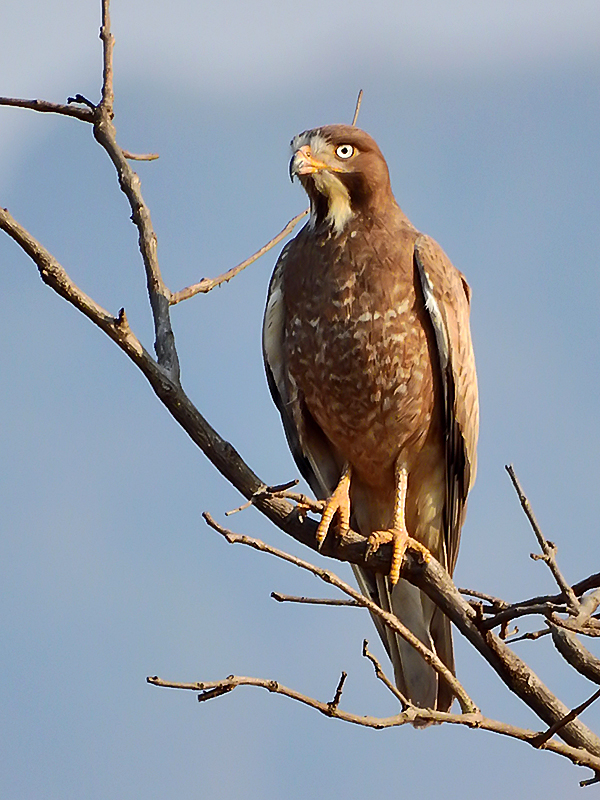
The White-eyed Buzzard is characterized by its distinctive white iris, which contrasts with its brown plumage. Adults have a rich brown upper body with a rufous tail that is barred with black. The underparts are pale with streaking, and the underwing coverts are white, which are visible during flight. Juveniles are generally duller, with more pronounced streaking on the underparts and less defined rufous coloring on the tail. Males and females appear similar, though females tend to be slightly larger. The White-eyed Buzzard may be confused with other small raptors like the Common Buzzard, but its white eyes and rufous tail are key differentiators. In flight, it displays broad wings and a short tail, often soaring with a slight dihedral. When perched, it adopts an upright posture, often on open perches where it can easily survey the landscape.
Having trouble telling birds apart? Upload a photo to our bird identification tool for an instant species match.
White-eyed Buzzard Habitat and Range
Preferred Habitat
The White-eyed Buzzard inhabits a range of open habitats, including grasslands, scrublands, and agricultural fields. It often prefers areas with scattered trees and water bodies, which provide perching sites and prey availability. This buzzard is typically found at elevations up to 1500 meters, though it is more common at lower elevations. During the breeding season, it may frequent deciduous forests' edges but generally avoids dense forests. Its adaptability allows it to coexist in rural and semi-urban areas, though it is less common in heavily urbanized locations.
Geographic Range
The White-eyed Buzzard's range includes much of the Indian subcontinent. It breeds primarily in India and extends into Pakistan, Nepal, and Bangladesh. Some populations may also be found in Myanmar and Sri Lanka. The species is largely sedentary, with some local movements in response to prey availability and climatic conditions. During the non-breeding season, it may expand its range slightly in search of food, though it does not undertake long-distance migrations. Population densities are highest in northern and central India, where suitable habitats are abundant.
Want to know which birds visit your area? Browse our backyard birds by location guides for region-specific species lists.
What Does the White-eyed Buzzard Eat?
The White-eyed Buzzard has a diverse diet, primarily feeding on small mammals, lizards, frogs, and large insects such as grasshoppers and crickets. Its diet shifts seasonally, with an increase in insect consumption during the monsoon when these prey are more abundant. The buzzard employs a sit-and-wait hunting strategy, often perching on elevated sites to scan for prey. Once a target is spotted, it swoops down swiftly to capture it with its talons. Its ability to adapt its diet based on prey availability highlights its ecological flexibility.
White-eyed Buzzard Behavior and Social Structure
The White-eyed Buzzard is generally a solitary bird outside the breeding season, though it may sometimes be seen in loose associations when food is plentiful. It is territorial, especially during breeding, often engaging in aerial displays and vocalizations to assert dominance. Courtship involves elaborate displays, with the male performing dives and loops to attract a mate. This species is diurnal, active primarily during the early morning and late afternoon, resting during the hottest parts of the day. In response to predators, the buzzard may engage in mobbing behavior, aggressively chasing away crows and other potential threats.
White-eyed Buzzard Nesting and Reproduction
The White-eyed Buzzard nests in trees, constructing a platform nest made of twigs and lined with leaves. It prefers sites with good visibility and proximity to hunting grounds. The female typically lays 2-3 eggs, which are incubated for about 28-31 days. Both parents participate in feeding and caring for the chicks, which fledge about 35-40 days after hatching. The buzzard usually raises one brood per year, though in favorable conditions, it may attempt a second.
White-eyed Buzzard Sounds and Vocalizations
The White-eyed Buzzard's vocalizations include a variety of calls. Its primary song is a series of high-pitched, whistling notes that can be heard during the breeding season. These calls often serve both to attract mates and deter rivals. Alarm calls are sharper and more frantic, used in response to potential threats. Unlike some raptors, the White-eyed Buzzard is relatively vocal, especially during dawn and dusk when activity peaks.
Interesting Facts About the White-eyed Buzzard
- 1The White-eyed Buzzard is one of the few raptors with a distinctive white iris, making it easily recognizable.
- 2Unlike many other raptors, the White-eyed Buzzard often perches on telephone poles, taking advantage of human structures.
- 3During the breeding season, this buzzard engages in impressive aerial displays to attract mates.
- 4The White-eyed Buzzard's diet is highly adaptable, shifting from insects to small mammals as seasons change.
- 5Despite being a raptor, the White-eyed Buzzard is relatively small, typically weighing just 300-450 grams.
White-eyed Buzzard Conservation Status
The IUCN lists the White-eyed Buzzard as Least Concern, with a stable population trend. However, it faces threats from habitat destruction and pesticide use, which can reduce prey availability. Conservation efforts focus on habitat preservation and promoting practices that reduce pesticide reliance. Historically, this species has maintained stable numbers, but continued monitoring is essential to ensure its long-term survival.
Other Accipitridae Species


Birds Similar to the White-eyed Buzzard
These species are often confused with the White-eyed Buzzard due to similar appearance or overlapping range.

