
White-headed Woodpecker
Dryobates albolarvatus
Order: Piciformes / Family: Picidae
Wikimedia Commons
About the White-headed Woodpecker
The White-headed Woodpecker (Dryobates albolarvatus) is a distinctive member of the Picidae family, renowned for its unique appearance and specialized habitat preferences. Unlike many of its relatives, this woodpecker is easily identified by its striking white head and contrasting black body. It primarily inhabits mature pine forests, where its presence indicates healthy coniferous ecosystems. Found predominantly in the mountainous regions of the western United States, such as the Sierra Nevada and the Cascades, this bird plays a crucial ecological role by contributing to the health of its forest habitats. The White-headed Woodpecker is an indicator species for old-growth coniferous forests, relying on large tracts of undisturbed habitat to thrive. These woodpeckers show a strong preference for ponderosa and Jeffrey pine stands, engaging in behaviors that contribute to forest dynamics, such as controlling insect populations and facilitating seed dispersal. Throughout the year, the White-headed Woodpecker's activities shift with the seasons. During breeding months, typically from April to July, they become more vocal and territorial, focusing on nesting and raising young. In contrast, winter prompts a more subdued presence, with individuals often foraging quietly in small family groups. The bird's role extends beyond simple forest maintenance. By excavating nesting cavities, the White-headed Woodpecker creates potential homes for other cavity-nesting birds and small mammals. As a keystone species, its activities enrich the forest ecosystem, promoting biodiversity and ecological resilience. This woodpecker's presence serves as a natural barometer for the health of its habitat, making it a species of interest for conservationists and ornithologists alike. Given its reliance on specific forest conditions, the conservation of the White-headed Woodpecker is intrinsically linked to the preservation of western North America's pine forests. Efforts to maintain these habitats not only support the woodpecker's populations but also protect myriad other species that share its environment. Observing the seasonal behaviors of the White-headed Woodpecker offers insight into the dynamic nature of forest ecosystems. During winter, its diet shifts as pine seed availability changes, with the woodpecker adapting its foraging strategies accordingly. This adaptability underscores the species' resilience, yet also highlights its vulnerability to habitat alterations, such as logging or forest fires, that disrupt its food sources and nesting grounds. In essence, the White-headed Woodpecker embodies the delicate balance of forest ecology, serving as both a beneficiary and a contributor to its habitat's health.
The White-headed Woodpecker belongs to the family Picidae, within the order Piciformes. These birds typically live typically 5-7 years, with a maximum recorded lifespan of 11 years..
How to Identify a White-headed Woodpecker
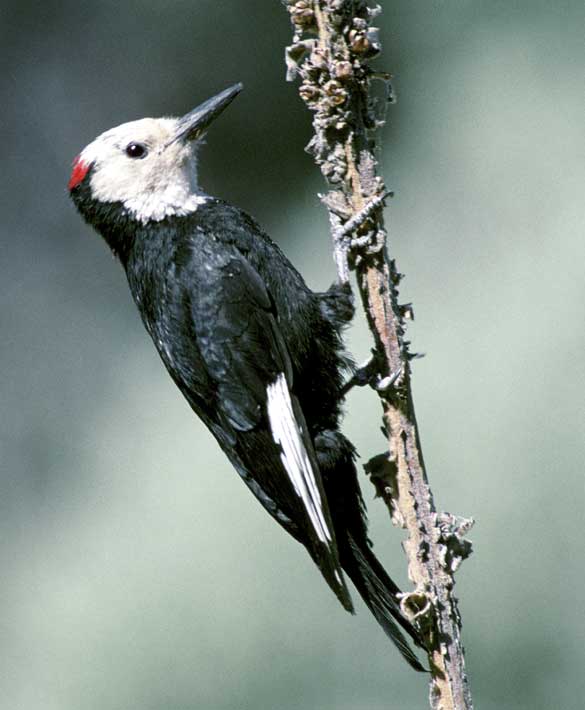
The White-headed Woodpecker is unmistakable with its stark white head, contrasting sharply with its black body. Adult males display a small red patch on the back of the head, whereas females lack this red marking, making sex identification straightforward. Juveniles resemble adults but exhibit a duller coloration and may lack the male's red patch. This woodpecker's size is moderate, approximately 20-22 cm in length, with a wingspan of about 33-41 cm. Its flight silhouette is typical of woodpeckers, featuring undulating flight patterns. When perched, it exhibits a characteristic upright posture, often clinging to tree trunks or branches. The lack of barring or spotting on its back distinguishes it from other similar-sized woodpeckers, such as the Hairy Woodpecker. Its distinctive coloration reduces confusion with other species, though novice birders might momentarily mistake it for a less common white morph of another species. The bird's vocalizations, a series of sharp, high-pitched calls, are also distinctive and aid in identification. In flight, its white wing patches become visible, adding to its distinctive appearance against the forest backdrop.
Having trouble telling birds apart? Upload a photo to our bird identification tool for an instant species match.
White-headed Woodpecker Habitat and Range
Preferred Habitat
The White-headed Woodpecker thrives in mature coniferous forests, particularly favoring stands of ponderosa and Jeffrey pine. These environments provide essential foraging and nesting opportunities. Typically found at elevations ranging from 1,200 to 3,000 meters, it inhabits regions with large tracts of old-growth forest. Seasonal habitat shifts are minimal, though some altitudinal movement may occur in response to food availability. In urban areas, sightings are rare, as the woodpecker's habitat requirements are specific and not easily met in developed areas. Instead, they are more commonly observed in rural and wilderness settings, where extensive pine forests remain intact. Habitat fragmentation poses a significant threat, as this species depends on large, contiguous forest areas for breeding and foraging.
Geographic Range
The White-headed Woodpecker's range is primarily in western North America. It is resident in the mountains of California, Oregon, and Washington, extending into the southern parts of British Columbia, Canada. Breeding populations are concentrated in the Sierra Nevada, the Cascade Range, and the eastern slopes of the Rockies. Unlike many migratory woodpeckers, the White-headed Woodpecker does not undertake long migrations, though some populations may exhibit local movements in response to food availability. Population density is highest in regions with extensive mature pine forests, where the bird finds optimal conditions for nesting and feeding. During winter, individuals may move to lower elevations or more sheltered areas, but they generally remain within their established range. The bird's range is limited by its narrow habitat preferences, making it vulnerable to habitat changes.
Want to know which birds visit your area? Browse our backyard birds by location guides for region-specific species lists.
What Does the White-headed Woodpecker Eat?
The White-headed Woodpecker primarily feeds on insects and pine seeds. Its diet consists of ants, beetle larvae, and other forest insects, which it extracts from beneath tree bark using its strong bill. Pine seeds, particularly from ponderosa and Jeffrey pines, are a crucial food source, especially in winter when insects are less accessible. The woodpecker's foraging technique involves scaling tree trunks and branches, probing bark crevices, and occasionally flaking off bark to reach hidden insects. It also exhibits a behavior known as 'girdling,' where it removes bark sections to access sap and insects. During the breeding season, its diet shifts slightly to include more protein-rich insects, which are vital for feeding nestlings. Foraging typically occurs during daylight hours, with peak activity in the early morning and late afternoon. Prey size varies but generally includes small to medium-sized insects, which the bird captures with precision.
Want to attract White-headed Woodpeckers to your yard? See our recommended feeders and seed types for the best results.
White-headed Woodpecker Behavior and Social Structure
The White-headed Woodpecker is primarily solitary or found in small family groups outside of the breeding season. It exhibits strong territorial behavior during breeding, with pairs defending nesting sites aggressively. Courtship displays include drumming and vocalizations, alongside mutual preening and feeding between mates. Unlike some woodpecker species, it does not form large flocks but may join mixed-species foraging groups in winter. When faced with predators, it employs evasive flight and may use alarm calls to alert conspecifics. Daily activities revolve around foraging and maintaining territory, with peak activity occurring in the cooler parts of the day. The woodpecker's flight is characterized by undulating patterns, and it often uses a series of short flights between trees while foraging. It is a diurnal bird, retreating to roost in tree cavities as evening approaches.
White-headed Woodpecker Nesting and Reproduction
White-headed Woodpeckers excavate nesting cavities in dead or decaying trees, often selecting sites in ponderosa or Jeffrey pines. The excavation process can take one to two weeks, resulting in a cavity that offers protection and insulation for the eggs. The typical clutch consists of 3-6 eggs, which are white and slightly glossy. Both parents share incubation duties, lasting about 14 days, and they also cooperate in feeding and caring for the hatchlings. The fledging period lasts approximately 24-28 days, after which the young leave the nest but continue to be fed by the parents for several weeks. Typically, the species raises one brood per year, though in optimal conditions, a second brood may be attempted. Nesting success is influenced by habitat quality and availability of suitable nesting trees.
White-headed Woodpecker Sounds and Vocalizations
The primary song of the White-headed Woodpecker is a series of sharp, high-pitched notes, often described as 'peek' or 'kweek,' repeated in rapid succession. These calls serve as both territorial markers and contact signals between mates. The woodpecker also uses drumming, a rapid series of taps on resonant surfaces, as a form of communication and territorial display. Alarm calls are harsher and more urgent, designed to alert others to the presence of predators. During the dawn chorus, its vocalizations are more frequent and may include longer sequences of calls. Compared to other woodpeckers, its vocal repertoire is less varied but nonetheless effective in its forest environment.
Interesting Facts About the White-headed Woodpecker
- 1The White-headed Woodpecker is one of the few woodpecker species with a white head, a rarity among its largely black-and-white relatives.
- 2Unlike many woodpeckers, the White-headed Woodpecker doesn't usually drum on trees for insects, relying more on probing and flaking bark.
- 3This species can extract pine seeds from closed cones, a skill not all woodpeckers possess, highlighting its adaptation to pine forests.
- 4White-headed Woodpeckers are known to use sap wells created by other birds like sapsuckers, demonstrating their opportunistic feeding behavior.
- 5These woodpeckers have a longer tongue than many birds, aiding in their ability to reach insects deep within tree bark crevices.
- 6In winter, they may join mixed-species foraging flocks, a behavior that helps increase foraging efficiency and predator detection.
- 7Despite being primarily non-migratory, some populations exhibit altitudinal migration, moving to lower elevations during harsh winters.
White-headed Woodpecker Conservation Status
The White-headed Woodpecker is currently listed as Least Concern by the IUCN, but its population faces threats from habitat loss and forest management practices that reduce the availability of mature pine forests. Logging and land conversion pose significant risks, impacting both nesting and foraging habitats. Conservation efforts focus on preserving large tracts of old-growth forest and implementing sustainable forestry practices. Historical population declines have been mitigated in some areas through targeted conservation actions, though ongoing monitoring is essential to ensure long-term stability. Public education and habitat restoration initiatives also contribute to the species' conservation.
Attracting White-headed Woodpeckers to Your Feeder
The White-headed Woodpecker is a regular visitor to backyard bird feeders across its range. At the Eye On The Fly feeding station, we observe White-headed Woodpeckers regularly and capture footage with our feeder cameras.
Other Picidae Species


Birds Similar to the White-headed Woodpecker
These species are often confused with the White-headed Woodpecker due to similar appearance or overlapping range.


