
White-throated Shrike-Tanager
Lanio leucothorax
Order: Passeriformes / Family: Thraupidae
Wikimedia Commons
About the White-throated Shrike-Tanager
The White-throated Shrike-Tanager (Lanio leucothorax) is a notable member of the Thraupidae family, known for its striking plumage and distinctive vocalizations. This medium-sized songbird is primarily found in the humid lowland forests of Central America, ranging from southern Mexico through Belize, Guatemala, Honduras, Nicaragua, and into Costa Rica. Within these regions, the White-throated Shrike-Tanager plays a crucial ecological role as both a predator and seed disperser, contributing to the health and sustainability of its forest habitats.
These birds are particularly significant due to their role in mixed-species flocks, often acting as nuclear species that other birds follow during foraging. This behavior enhances feeding efficiency and provides additional protection against predators. While they are most commonly observed in humid evergreen forests, they can also inhabit secondary growth and forest edges, showcasing their adaptability to changing environments.
Ecologically, the White-throated Shrike-Tanager is a key indicator species for the health of tropical lowland forests. Its presence or absence can reflect changes in forest composition and integrity. Seasonal behaviors include forming larger mixed-species flocks during non-breeding seasons, helping to maintain ecological balance by controlling insect populations and aiding in pollination and seed dispersal. These birds are active participants in the complex web of interactions that sustain tropical forest ecosystems.
The White-throated Shrike-Tanager belongs to the family Thraupidae, within the order Passeriformes. These birds typically live average 6-9 years..
How to Identify a White-throated Shrike-Tanager
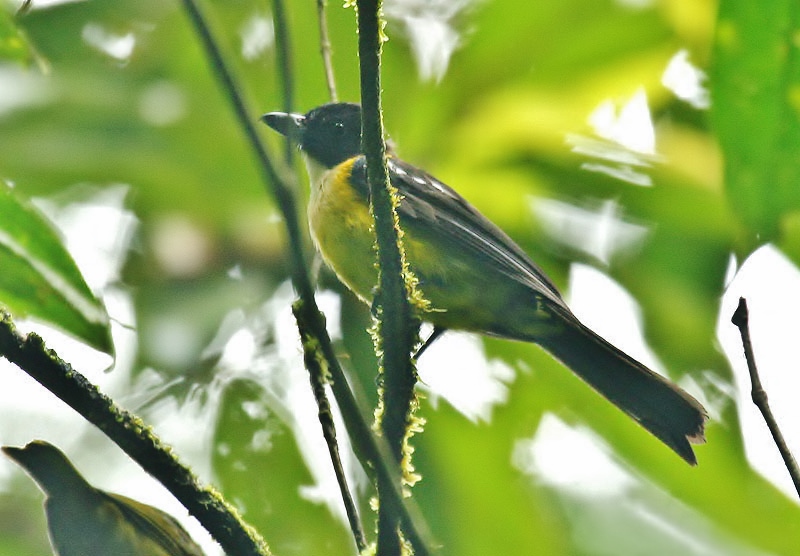
The White-throated Shrike-Tanager is easily identified by its bright white throat and contrasting black mask that extends through the eyes. Adult males have a glossy black head and mantle, with vibrant yellow underparts that make them stand out in the forest canopy. Females and juveniles, while similar in size, exhibit a more muted coloration, with olive-green upperparts and less pronounced black markings.
These birds are medium-sized tanagers, measuring approximately 16 centimeters in length. Their stout bills are well adapted for their omnivorous diet. In flight, the White-throated Shrike-Tanager displays a distinctive silhouette, with broad wings and a slightly rounded tail. When perched, they often hold their bodies horizontally, allowing birdwatchers to easily spot their characteristic plumage.
Confusion with other species may arise due to their shared habitat with similar-looking birds, such as the Black-and-yellow Tanager, but the latter lacks the white throat that is so indicative of the White-throated Shrike-Tanager. Their unique vocalizations also aid in identification, setting them apart from other forest-dwelling species.
Having trouble telling birds apart? Upload a photo to our bird identification tool for an instant species match.
White-throated Shrike-Tanager Habitat and Range
Preferred Habitat
The White-throated Shrike-Tanager thrives in the humid lowland forests of Central America, favoring regions with dense canopy cover and abundant understory vegetation. These birds are most commonly found at elevations ranging from sea level up to 1,200 meters, although they are predominantly inhabitants of lower altitudes.
Their preference for primary evergreen forests underscores the importance of these habitats in their survival. However, they are also able to adapt to secondary growth areas and forest edges, indicating some resilience to habitat alteration. Despite this adaptability, large-scale deforestation poses a significant threat to their preferred environments.
Seasonal habitat shifts are minimal, as these birds generally remain within their established territories year-round. They are not typically found in urban areas, preferring the more remote and undisturbed parts of the rainforest.
Geographic Range
The White-throated Shrike-Tanager's range stretches across the tropical belt of Central America, from the southern regions of Mexico through Belize, Guatemala, Honduras, Nicaragua, and Costa Rica. This distribution reflects their preference for the humid lowland and montane forests that characterize these areas.
During the breeding season, they occupy territories within these regions, often returning to the same nesting sites year after year. Unlike many migratory species, the White-throated Shrike-Tanager does not undertake long-distance migrations, instead opting for local movements within their extensive forest territories.
Population density varies across their range, with certain areas in Costa Rica and Honduras serving as density hotspots due to the abundance of suitable habitats. Conservation efforts in these areas are crucial to maintaining stable populations, as habitat loss continues to pose a significant threat.
Want to know which birds visit your area? Browse our backyard birds by location guides for region-specific species lists.
What Does the White-throated Shrike-Tanager Eat?
The diet of the White-throated Shrike-Tanager is diverse and reflects its role as an omnivore. Primary food sources include insects, such as beetles and caterpillars, which they actively hunt within the forest canopy. These birds also consume fruit, playing a vital role in seed dispersal for various plant species.
Seasonal changes can influence their dietary preferences, with a higher reliance on insects during the breeding season to meet increased nutritional demands. Foraging techniques are varied, often involving short sallies from perches to capture prey mid-air or glean insects from foliage.
The White-throated Shrike-Tanager typically feeds during the early morning and late afternoon, taking advantage of cooler temperatures and heightened insect activity. They are often observed feeding in mixed-species flocks, which enhances their foraging efficiency and provides safety in numbers.
White-throated Shrike-Tanager Behavior and Social Structure
The White-throated Shrike-Tanager exhibits fascinating social behaviors, most notably its participation in mixed-species flocks. These flocks provide protection and increased foraging success. As a territorial species, males defend their territories with vocal displays and occasional physical confrontations.
Courtship behavior involves elaborate displays, where males showcase their plumage and sing to attract females. Once paired, these birds remain together for the breeding season, sharing responsibilities in nest building and chick rearing.
Daily activity patterns of the White-throated Shrike-Tanager are diurnal, with peak activities occurring during the cooler hours of the day. They have a keen awareness of predators, utilizing alarm calls and flocking behavior to avoid potential threats like raptors and snakes.
White-throated Shrike-Tanager Nesting and Reproduction
The nesting habits of the White-throated Shrike-Tanager involve the construction of cup-shaped nests using twigs, leaves, and fibers. These nests are typically situated in the mid-canopy level, well hidden among dense foliage to protect against predators.
A typical clutch consists of two to three eggs, which both parents incubate for about 12 to 14 days. Once hatched, the nestlings are fed by both parents, with fledging occurring approximately 14 to 18 days post-hatching.
Parental care extends beyond fledging, with the young remaining under the watchful eyes of their parents for several weeks. The species generally raises one brood per year, although in areas with abundant resources, two broods may be possible.
White-throated Shrike-Tanager Sounds and Vocalizations
The vocalizations of the White-throated Shrike-Tanager are a key feature of its identification. Their primary song consists of a series of melodious whistles and trills, delivered with a rhythmic cadence that carries through the forest. These vocalizations are often used to establish territories and attract mates.
Their call notes include sharp 'chip' sounds, used as contact calls when foraging in flocks. Alarm calls are harsher and more urgent, effectively alerting other birds to potential threats.
During the dawn chorus, the White-throated Shrike-Tanager joins other forest species in a vibrant symphony of sounds, with its song standing out due to its clarity and melodic quality.
Interesting Facts About the White-throated Shrike-Tanager
- 1The White-throated Shrike-Tanager often leads mixed-species flocks, making it a pivotal species in its ecosystem.
- 2Despite its vibrant coloration, the White-throated Shrike-Tanager often remains hidden within the dense canopy, making sightings a treat for birders.
- 3The species has a unique feeding strategy, often performing short, agile flights to catch insects on the wing.
- 4These birds contribute significantly to seed dispersal, helping maintain the biodiversity of their forest habitats.
- 5Researchers have noted that the White-throated Shrike-Tanager's song can vary slightly between different populations, reflecting regional dialects.
- 6The bird's strong bill allows it to crack open tough seeds, showcasing its adaptability in food sourcing.
- 7The White-throated Shrike-Tanager's white throat patch is not only a key identification feature but also plays a role in communication and mate attraction.
White-throated Shrike-Tanager Conservation Status
The IUCN currently lists the White-throated Shrike-Tanager as a species of Least Concern, though its population trend is decreasing. Primary threats include habitat destruction due to logging and agricultural expansion. Conservation efforts focus on protecting primary forest habitats, with national parks and reserves playing a crucial role. Local conservation organizations also work to raise awareness about the importance of these birds and their habitats. Historically, the population has faced challenges due to increased deforestation rates, but ongoing conservation efforts aim to stabilize and eventually increase population numbers through habitat preservation and restoration.


