Yellow-collared Macaw
Primolius auricollis
Order: Psittaciformes / Family: Psittacidae

Wikimedia Commons
About the Yellow-collared Macaw
The Yellow-collared Macaw (Primolius auricollis) is an engaging and dynamic bird found predominantly in the humid forested regions of central South America. This captivating species is part of the Psittacidae family, which includes a diverse range of parrots and macaws. The Yellow-collared Macaw is notable not only for its vibrant plumage but also for its ecological significance as a seed disperser in its native habitats. Found primarily in countries such as Brazil, Bolivia, Paraguay, and Northern Argentina, this macaw inhabits subtropical and tropical forests, where it plays a pivotal role in maintaining the health and diversity of these ecosystems.
This species typically prefers the canopy layer of dense forests, making it a vital part of the forest's life cycle as it aids in the dispersal of seeds from the fruits it consumes. Due to its preference for forested environments, the Yellow-collared Macaw is an excellent indicator of forest health and biodiversity. Its presence in a region can signify a well-preserved and thriving ecosystem, as these birds require large tracts of forest to sustain their populations.
Seasonally, the Yellow-collared Macaw may exhibit some local movements in response to food availability, but it does not undergo long migrations. Instead, these birds might shift between different forest types or elevations, always remaining within a relatively limited geographic scope. Their year-round presence in these forests underscores their integral role in these ecosystems. The Yellow-collared Macaw's behaviors, such as foraging and nesting, are closely tied to the availability of food resources and suitable nesting sites, making them highly dependent on the health of their forest habitats.
The Yellow-collared Macaw's ecological role extends beyond seed dispersal; their foraging habits also contribute to the control of insect populations, as they occasionally consume insects and their larvae. Their presence in diverse forest types highlights their adaptability and resilience, yet also underscores the importance of conservation efforts to preserve their natural habitats in the face of deforestation and habitat fragmentation.
The Yellow-collared Macaw belongs to the family Psittacidae, within the order Psittaciformes. These birds typically live average 30 years with a maximum recorded of 50 years..
How to Identify a Yellow-collared Macaw
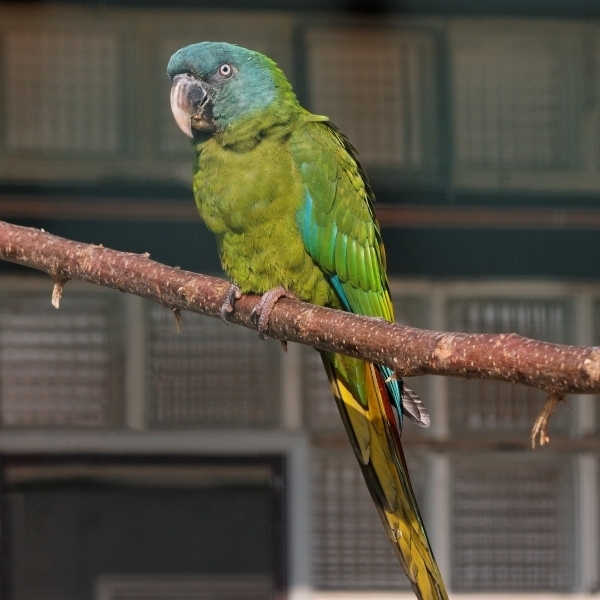
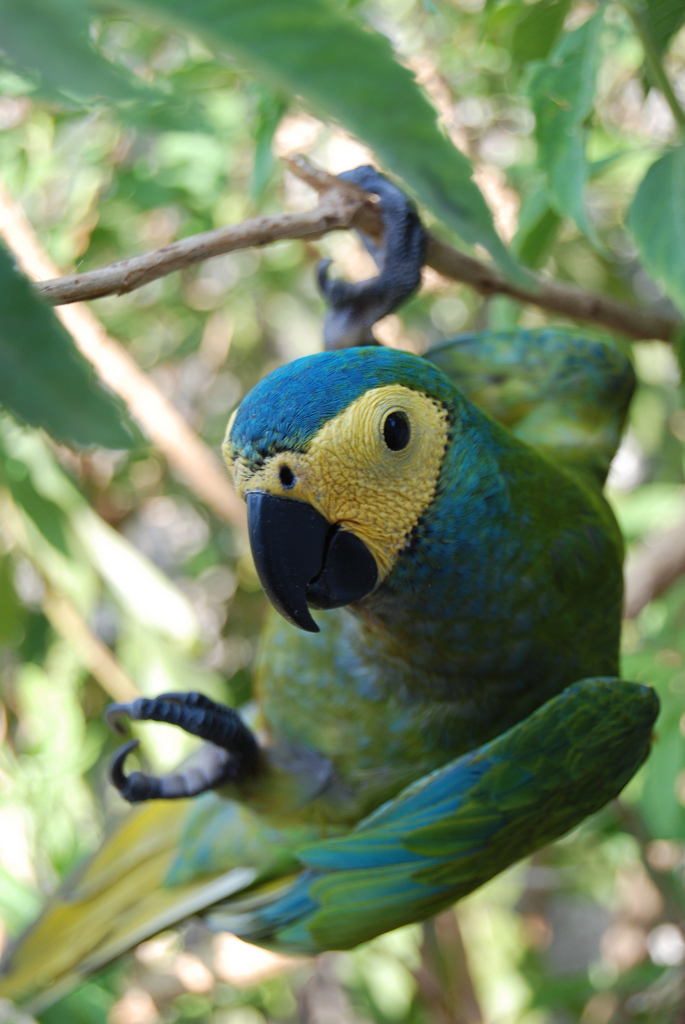
The Yellow-collared Macaw is a medium-sized parrot, measuring about 38 cm in length. Its most distinctive feature is the striking yellow band or collar around the back of its neck, which contrasts sharply with its predominantly green plumage. The rest of its body is primarily green, with bluish feathers on the upper side of its wings and tail. The underparts of the wings exhibit a more yellowish tinge, particularly visible during flight. Adults possess a bare white facial patch with fine black lines, a characteristic feature of many macaws.
Juveniles resemble adults but may have less pronounced yellow collars and slightly duller plumage overall. Both male and female Yellow-collared Macaws are similar in appearance, with no significant differences in plumage or size, making sexing in the field challenging without behavioral observations.
In flight, the Yellow-collared Macaw displays a swift and agile flight pattern, often engaging in acrobatic maneuvers. The silhouette of this macaw in flight is characterized by long, pointed wings and a tapered tail, which aid in its maneuverability through forest canopies. When perched, these macaws often adopt an alert posture, with their bodies upright and tails slightly fanned, showcasing their vibrant coloration.
Having trouble telling birds apart? Upload a photo to our bird identification tool for an instant species match.
Yellow-collared Macaw Habitat and Range
Preferred Habitat
Yellow-collared Macaws primarily inhabit subtropical and tropical forests, including both dense primary forests and secondary growth areas. They are most commonly found at elevations ranging from lowland areas up to 1,500 meters. Within these habitats, they show a preference for forest edges and clearings, where fruiting trees are abundant.
During different seasons, Yellow-collared Macaws might shift their habitat slightly in response to fruit availability, occasionally moving to more open wooded areas or even savannas adjacent to forests. They are relatively less common in urban areas, although they might occasionally be seen near human settlements where suitable feeding and nesting opportunities exist. Overall, the Yellow-collared Macaws' habitat preferences highlight their reliance on intact and diverse forest ecosystems.
Geographic Range
The Yellow-collared Macaw's range extends across central South America, with significant populations in Brazil, Bolivia, Northern Argentina, and Paraguay. These regions provide the dense forest habitats that these macaws require for breeding and feeding. While the species is largely sedentary, some local movements occur in response to food availability, especially during dry seasons.
In Brazil, they are commonly found in the southern Amazon Basin, while in Bolivia, they frequent the eastern lowlands and parts of the Chiquitania region. In Paraguay, their presence is noted in the northern regions, where they inhabit subtropical forests. Their population density tends to be highest in areas where forest conservation efforts have been successful, offering insights into the health of these ecosystems.
Want to know which birds visit your area? Browse our backyard birds by location guides for region-specific species lists.
What Does the Yellow-collared Macaw Eat?
The diet of the Yellow-collared Macaw primarily consists of fruits, nuts, and seeds, which they forage for in the forest canopy. They show a particular fondness for palm fruits, such as those from the Mauritia palm, which they skillfully extract using their strong beaks. During certain seasons, their diet may diversify to include flowers, nectar, and occasionally insects and their larvae.
Their foraging behavior is characterized by a methodical approach, often involving small groups or pairs searching for food across large areas. They use their zygodactyl feet to manipulate and hold food items, demonstrating dexterity and precision. The size of prey or food items they consume varies depending on availability, yet they are particularly adept at handling hard-shelled nuts.
Yellow-collared Macaw Behavior and Social Structure
Yellow-collared Macaws are social birds, often seen in pairs or small family groups. They exhibit strong pair bonds, with pairs frequently engaging in mutual preening and vocal exchanges. Their social structure is marked by cooperative behaviors, especially during foraging, where they maintain contact through calls to coordinate movements.
Territorial behavior is less pronounced, as these macaws are generally non-aggressive towards conspecifics. However, they do defend nesting sites vigorously. Courtship behaviors include aerial displays and vocal duets, strengthening the pair bond. Yellow-collared Macaws are diurnal, with peak activity occurring during the early morning and late afternoon. They rest during the hottest part of the day, often in shaded parts of the forest canopy.
Yellow-collared Macaw Nesting and Reproduction
Yellow-collared Macaws typically nest in tree cavities, often selecting tall, mature trees that provide ample protection from predators. They do not build traditional nests, instead using existing cavities which they may enlarge using their beaks. Clutch size generally consists of 2-4 eggs, with incubation lasting about 24-26 days.
Both parents share incubation duties and later, the feeding of the chicks. Fledging occurs approximately 8-10 weeks after hatching, although young birds may remain with the parents for several months, learning essential survival skills. Generally, Yellow-collared Macaws have one brood per year, although they may attempt a second if conditions are favorable.
Yellow-collared Macaw Sounds and Vocalizations
The vocalizations of the Yellow-collared Macaw include a range of raucous calls and squawks, which serve various communicative purposes. Their primary call is a series of harsh, resonant squawks, often emitted in flight or when perched. These calls carry over long distances, facilitating communication within dense forests.
Alarm calls are sharper and more rapid, alerting conspecifics to potential threats. During the dawn chorus, these macaws are particularly vocal, with calls that can be described as a mix of melodic and harsh notes, setting them apart from other forest sounds.
Interesting Facts About the Yellow-collared Macaw
- 1Yellow-collared Macaws can live up to 40-50 years in the wild, showcasing their longevity.
- 2They are one of the smaller macaw species, with a length of about 38 cm, yet they exhibit vibrant coloration.
- 3These macaws exhibit a remarkable ability to mimic sounds, although not as proficiently as larger parrots.
- 4In the wild, Yellow-collared Macaws often engage in playful behaviors, such as hanging upside down.
- 5Their strong beaks are not only for feeding but also for manipulating objects, showcasing their intelligence.
- 6Yellow-collared Macaws play a crucial role in seed dispersal, aiding in forest regeneration.
- 7They are known to form lifelong pair bonds, demonstrating strong social structures.
Yellow-collared Macaw Conservation Status
The Yellow-collared Macaw is currently listed as Least Concern by the IUCN, although populations face threats from habitat loss due to deforestation and illegal pet trade. Conservation efforts focus on habitat preservation and anti-poaching measures, which are crucial for maintaining stable population trends. Historically, the clearing of forests for agriculture has posed significant challenges, but recent conservation initiatives have helped stabilize populations in some regions. Continued efforts are necessary to ensure the survival of this species in the wild.
Other Psittacidae Species


Birds Similar to the Yellow-collared Macaw
These species are often confused with the Yellow-collared Macaw due to similar appearance or overlapping range.