
Yellow-footed Pigeon
Treron phoenicopterus
Order: Columbiformes / Family: Columbidae
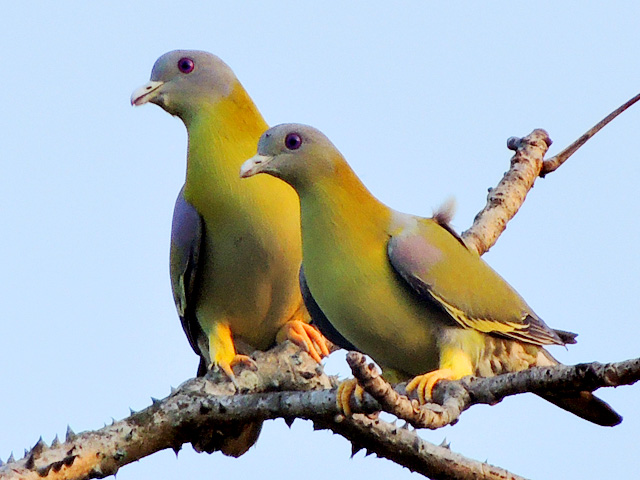
Wikimedia Commons
About the Yellow-footed Pigeon
The Yellow-footed Pigeon, known scientifically as Treron phoenicopterus, is a vibrant member of the family Columbidae. This bird thrives in the Indian subcontinent, occupying a range of habitats that include deciduous forests, scrublands, and urban areas. Its presence is a crucial component of the ecosystem, acting as a seed disperser for numerous plant species. Yellow-footed Pigeons inhabit regions such as India, Nepal, Bangladesh, and Sri Lanka, where their role in maintaining the dynamic balance of the ecosystem is profound. They are primarily residents of the lowland regions but can occasionally be found at modest elevations. The species exhibits seasonal movements in response to food availability, often forming large flocks that roam across landscapes in search of fruiting trees. This behavior underscores their significance in seed dispersal, aiding the regeneration of forested areas. Yellow-footed Pigeons are especially adept at surviving in degraded habitats, making them a resilient species in the face of environmental changes. Their adaptability to both rural and urban settings highlights their ecological versatility. Furthermore, their vibrant plumage and unassuming behavior make them a beloved subject for birdwatchers and naturalists. In the canopy, these pigeons frequently engage in social behaviors such as preening and calling, which serve to strengthen group cohesion. During the breeding season, which typically spans from March to June, they exhibit distinct courtship displays that are a delight to observe. The Yellow-footed Pigeon's ability to thrive in a variety of settings, coupled with its important ecological contributions, cements its status as a vital species within its range.
The Yellow-footed Pigeon belongs to the family Columbidae, within the order Columbiformes. These birds typically live up to 10 years in the wild, with some reaching 15 years in captivity..
How to Identify a Yellow-footed Pigeon
The Yellow-footed Pigeon stands out with its distinctive combination of subtle green and grey plumage, complemented by vibrant yellow legs. Adult birds exhibit a striking olive-green head and back, transitioning into a soft grey on their wings and tail. The contrasting yellow legs are a key identification feature, aiding in distinguishing them from similar species. Males and females share similar plumage, making them difficult to differentiate visually. Juveniles, however, are slightly duller in color with less pronounced yellow on the legs. When observing these pigeons in flight, notice their swift and direct flight pattern, characterized by broad, rounded wings and a slightly pointed tail. The Yellow-footed Pigeon can be confused with the Green Pigeon (Treron spp.), but the yellow legs serve as a definitive field mark. While perching, these pigeons maintain an upright posture, often sitting unobtrusively amidst dense foliage. The primary challenge in identification lies in their ability to blend seamlessly into their leafy surroundings due to their green-dominant plumage.
Having trouble telling birds apart? Upload a photo to our bird identification tool for an instant species match.
Yellow-footed Pigeon Habitat and Range
Preferred Habitat
Yellow-footed Pigeons are versatile in their habitat preferences, thriving in deciduous forests, open woodlands, and agricultural lands. They are frequently found in regions such as the Terai lowlands of Nepal and the forested areas of central India. These pigeons adapt well to urban environments, often seen in gardens and parks where fruiting trees are present. They typically inhabit elevations up to 1,500 meters but prefer lower altitudes where food sources are abundant. Seasonal habitat shifts occur primarily in response to food availability, with pigeons moving to areas with plentiful fruiting trees. While more commonly encountered in rural settings, their ability to exploit urban resources underlines their adaptability.
Geographic Range
The Yellow-footed Pigeon occupies a broad range across the Indian subcontinent, including India, Nepal, Bangladesh, and Sri Lanka. They are resident birds, generally non-migratory, but exhibit local movements driven by food availability. In India, they are particularly abundant in the northern and central regions, where deciduous forests and agricultural landscapes provide ideal conditions. While populations are relatively stable across their range, certain areas, such as the Terai region of Nepal, serve as population density hotspots. Their presence is less pronounced in the southern and eastern extremes of their range, where habitat conditions differ. The absence of long-distance migration is compensated by their nomadic tendencies within their established range.
Want to know which birds visit your area? Browse our backyard birds by location guides for region-specific species lists.
What Does the Yellow-footed Pigeon Eat?
The diet of the Yellow-footed Pigeon primarily consists of fruits and berries, with a preference for figs and other soft fruits. They forage in the canopy, plucking fruit directly from branches with precision. These pigeons also consume seeds, contributing significantly to seed dispersal in their habitats. Seasonal dietary shifts occur as the availability of specific fruiting trees changes. During periods when fruit is scarce, they may supplement their diet with buds and flowers. Their foraging activity peaks during the early morning and late afternoon, coinciding with cooler temperatures. The size of the prey is generally small to medium, catering to their ability to swallow whole fruits.
Want to attract Yellow-footed Pigeons to your yard? See our recommended feeders and seed types for the best results.
Yellow-footed Pigeon Behavior and Social Structure
Yellow-footed Pigeons exhibit a sociable nature, often forming flocks that can number in the dozens. These flocks move together in search of fruiting trees, showcasing cooperative foraging behavior. Territorial disputes are rare, as the abundance of resources usually negates competition. During courtship, males perform elaborate displays, including bowing and cooing, to attract mates. These displays strengthen pair bonds and are a cornerstone of their reproductive strategy. In the presence of predators, Yellow-footed Pigeons rely on their excellent camouflage and quick flight to evade capture. They are primarily diurnal, with peak activity occurring during feeding times in the morning and late afternoon.
Yellow-footed Pigeon Nesting and Reproduction
The Yellow-footed Pigeon constructs a simple platform nest using twigs and leaves, usually positioned in the canopy of a tree. Preferred nesting sites include dense foliage that provides concealment and protection. Clutch size typically consists of two white eggs, with both parents sharing incubation duties over a period of approximately 14 days. Fledging occurs around three weeks post-hatch, during which time both parents are involved in feeding and caring for the young. This species generally raises two broods per year, with the breeding season extending from March through June, coinciding with optimal food availability.
Yellow-footed Pigeon Sounds and Vocalizations
The primary vocalization of the Yellow-footed Pigeon is a soft, repetitive cooing that resonates through their forested habitat. The rhythm is slow and deliberate, with a mellow pitch that can be heard in the early morning. Their call notes are gentler and less distinct than those of many other pigeon species, often described as a soothing, melodious murmur. Alarm calls are rare but tend to be sharper and more abrupt, serving as a warning to nearby flock members. The species participates in a dawn chorus, with males vocalizing to establish territory and attract mates.
Interesting Facts About the Yellow-footed Pigeon
- 1Yellow-footed Pigeons can consume fruits whole, aiding in seed dispersal across large areas.
- 2The species exhibits a unique flight call that differs from its typical vocalizations, providing cues to flock members.
- 3Despite their vibrant coloration, Yellow-footed Pigeons blend seamlessly into green foliage, an effective camouflage.
- 4Their adaptability to urban environments has led to increased sightings in city parks and gardens.
- 5Yellow-footed Pigeons contribute significantly to the maintenance of forest ecosystems through their seed dispersal activities.
- 6They are one of the few pigeon species that show a marked preference for figs as a primary food source.
- 7The Yellow-footed Pigeon is known to form mixed-species flocks with other fruit-eating birds, enhancing foraging efficiency.
Yellow-footed Pigeon Conservation Status
The Yellow-footed Pigeon currently holds a status of Least Concern on the IUCN Red List, with a stable population trend. Primary threats include habitat degradation and loss due to agricultural expansion and urbanization. Conservation efforts focus on habitat preservation and the promotion of sustainable agricultural practices. Historically, their population has shown resilience despite environmental pressures, aided by their adaptability to human-altered landscapes. Continued monitoring and habitat protection are essential to ensure the long-term viability of their populations.
Attracting Yellow-footed Pigeons to Your Feeder
The Yellow-footed Pigeon is a regular visitor to backyard bird feeders across its range. At the Eye On The Fly feeding station, we observe Yellow-footed Pigeons regularly and capture footage with our feeder cameras.


