
Yellow-throated Hanging-Parrot
Loriculus pusillus
Order: Psittaciformes / Family: Psittacidae
Wikimedia Commons
About the Yellow-throated Hanging-Parrot
The Yellow-throated Hanging-Parrot, known scientifically as Loriculus pusillus, is a vivid jewel of the Indonesian archipelago, primarily residing in Java and Bali. This small parrot plays a significant ecological role in its native habitats, contributing to seed dispersal and pollination. Typically, these birds reside in lowland forests, often seen flitting among the upper canopy where they are essential pollinators for several plant species.
As a member of the Psittacidae family, this parrot stands out for its vibrant plumage and unique behaviors. It exhibits a remarkable affinity for hanging upside down, a trait that aids in its foraging for nectar and fruit. Throughout the year, the parrot's activities are dictated by the wet and dry seasons that characterize its tropical habitat. During the wet season, between November and April, the abundance of fruits and flowers influences its feeding and breeding behaviors, while the dry season from May to October sees a shift in diet and foraging patterns.
The Yellow-throated Hanging-Parrot contributes to the health of its ecosystem by aiding in the propagation of native flora. This species' ecological significance extends beyond seed dispersal, as its foraging habits ensure the pollination of a variety of flowering plants. Their presence is a key indicator of forest health, as they depend on dense, undisturbed forest habitats. Human encroachment and deforestation pose threats to their populations, making conservation efforts crucial to maintaining ecological balance in these regions.
The Yellow-throated Hanging-Parrot belongs to the family Psittacidae, within the order Psittaciformes. These birds typically live 5-7 years in the wild, up to 10 years in captivity.
How to Identify a Yellow-throated Hanging-Parrot
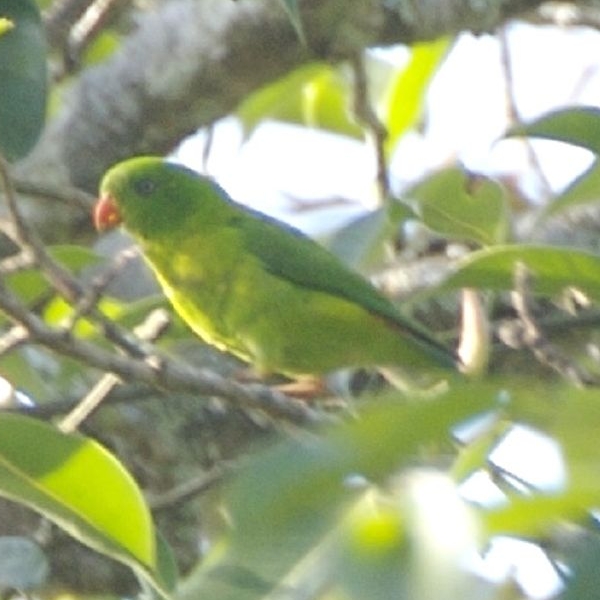
The Yellow-throated Hanging-Parrot is a small bird, measuring approximately 12 cm in length. Its most striking feature is the bright yellow throat, which contrasts with its predominantly green body. The wings are a deeper green with hints of blue in the flight feathers, adding to its visual appeal. Males and females are similar in appearance, though males may exhibit slightly brighter coloration.
Juveniles can be distinguished by their duller plumage and less pronounced yellow throat, which matures as they age. This species is often confused with the closely related Blue-crowned Hanging Parrot, but can be reliably differentiated by the absence of a blue crown and the distinctive yellow throat patch.
In flight, the Yellow-throated Hanging-Parrot displays a rapid, direct flight pattern, characterized by quick wingbeats. When perched, it often adopts an acrobatic posture, frequently seen hanging upside down from branches as it searches for food. This unique behavior not only aids in identification but also underscores its role as a specialized forager in its ecosystem.
Having trouble telling birds apart? Upload a photo to our bird identification tool for an instant species match.
Yellow-throated Hanging-Parrot Habitat and Range
Preferred Habitat
The Yellow-throated Hanging-Parrot thrives in tropical lowland forests, where dense canopy cover provides ample foraging opportunities. It favors primary and secondary forests, often venturing into forest edges and clearings where fruiting trees are plentiful.
These parrots are most commonly found at elevations below 1,000 meters, although they may occasionally ascend to higher altitudes in search of specific food sources during seasonal shifts. The presence of flowering and fruit-bearing plants is critical to their habitat selection, influencing their distribution throughout Java and Bali.
While they primarily inhabit rural forested areas, these parrots have been known to adapt to suburban environments where gardens and parks provide suitable feeding grounds. The seasonal abundance of food plays a pivotal role in their habitat preference, prompting shifts within their range to exploit different resources as availability changes throughout the year.
Geographic Range
The Yellow-throated Hanging-Parrot is endemic to Indonesia, with a range confined to the islands of Java and Bali. Within these areas, it occupies a range of habitats, from dense lowland forests to forest edges and gardens in rural and suburban settings.
Breeding populations are established across both islands, with pockets of higher density in regions where forest cover remains intact. Seasonal movements within these islands are largely influenced by food availability, particularly the flowering and fruiting cycles of native plants.
Unlike many parrot species, the Yellow-throated Hanging-Parrot does not migrate long distances, instead undertaking local movements to track seasonal food sources. This limited range and lack of significant migratory behavior make habitat protection within these islands particularly important for the species' conservation.
Want to know which birds visit your area? Browse our backyard birds by location guides for region-specific species lists.
What Does the Yellow-throated Hanging-Parrot Eat?
The diet of the Yellow-throated Hanging-Parrot is predominantly frugivorous, with a preference for the fruits of native forest trees. Figs, berries, and the seeds of various fruiting plants form the bulk of their diet, complemented by nectar and blossoms from flowering trees and shrubs.
During the wet season, the abundance of fruits and flowers allows for a diverse diet, while the dry season may prompt a shift towards a greater reliance on nectar, seeds, and any remaining ripe fruits. Their foraging technique involves acrobatic maneuvers, such as hanging upside down to access hard-to-reach fruits and flowers.
These parrots typically forage in the early morning and late afternoon, taking advantage of cooler temperatures and reduced competition from other species. Their role as pollinators is facilitated by their feeding habits, inadvertently transferring pollen as they move between blossoms.
Yellow-throated Hanging-Parrot Behavior and Social Structure
The Yellow-throated Hanging-Parrot displays a highly social structure, often found in small flocks ranging from five to ten individuals. These flocks exhibit a loose territoriality, with groups defending feeding areas from intruding conspecifics.
During the breeding season, which aligns with the wet season's peak in food availability, males engage in courtship displays that include vocalizations and acrobatic flights to attract females. Pair bonds are strong, with partners often seen preening each other and foraging in close proximity.
When faced with potential threats, these parrots rely on their agility and camouflage, often remaining motionless among foliage to avoid detection. They are most active during the cooler parts of the day, spending midday hours resting and conserving energy. Their daily activities follow a predictable pattern of foraging, social interaction, and rest, closely tied to the availability of food resources.
Yellow-throated Hanging-Parrot Nesting and Reproduction
The Yellow-throated Hanging-Parrot constructs its nest in cavities, often utilizing natural hollows in trees or abandoned holes created by woodpeckers. They show a preference for nesting sites located high in the canopy, providing safety from ground-based predators.
Nests are typically lined with soft plant material, feathers, and leaves, offering a comfortable environment for the eggs. Clutch sizes range from two to four eggs, with the female primarily responsible for incubation over a period of about 18 to 21 days.
Both parents participate in feeding and caring for the young, which fledge approximately five weeks after hatching. The species often raises one to two broods per year, depending on food availability and environmental conditions. Parental investment is significant, as both parents involve themselves in feeding and protecting the chicks until they can independently forage.
Yellow-throated Hanging-Parrot Sounds and Vocalizations
The vocalizations of the Yellow-throated Hanging-Parrot are characterized by high-pitched, melodious notes that resonate through their forested habitats. Their primary song consists of a series of rapid, repeated chirps, often utilized in social interactions and during courtship.
In addition to their song, these parrots produce a variety of call notes, including soft whistles and sharper contact calls used to maintain flock cohesion. Alarm calls are more abrupt and serve as warnings of potential threats, prompting the flock to take cover among the foliage.
During the dawn chorus, the Yellow-throated Hanging-Parrot's vocal contributions are less prominent than those of more vocal species, yet their calls play a vital role in maintaining the social structure of their flocks. These sounds are an integral part of their communication, facilitating interactions within their complex social groups.
Interesting Facts About the Yellow-throated Hanging-Parrot
- 1The Yellow-throated Hanging-Parrot can rotate its head almost 180 degrees, enhancing its ability to spot predators.
- 2This species can consume up to 15 different types of fruit in a single day, showcasing its dietary versatility.
- 3Unlike many parrots, the Yellow-throated Hanging-Parrot does not require grit to aid in digestion due to its frugivorous diet.
- 4Their hanging behavior mimics that of bats, allowing them to access food sources that are unavailable to other birds.
- 5The Yellow-throated Hanging-Parrot engages in mutual preening, strengthening pair bonds and social ties within flocks.
- 6During courtship, males offer regurgitated food to females as a display of partnership and parental potential.
- 7These parrots have been observed using their feet as tools, manipulating objects to access hidden food.
Yellow-throated Hanging-Parrot Conservation Status
The Yellow-throated Hanging-Parrot is currently listed as Least Concern by the IUCN, with stable population trends observed in its native range. However, habitat destruction due to logging and agricultural expansion poses ongoing threats to its long-term survival. Conservation efforts are focused on preserving intact forest habitats in Java and Bali, which are crucial for the species' continued well-being. Protected areas and national parks play a significant role in safeguarding their habitats, providing refuge for these birds and other forest-dependent species. Historically, the conversion of lowland forests to agricultural land has reduced available habitat, necessitating ongoing monitoring and habitat restoration efforts. While the species is not currently endangered, proactive measures are essential to prevent future declines and ensure the preservation of its forest ecosystems.


