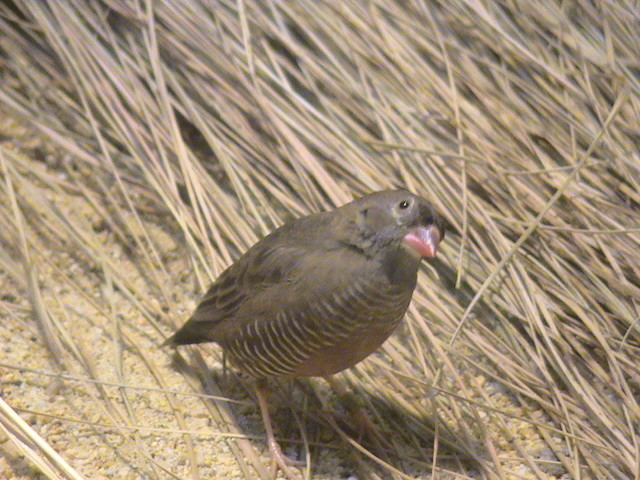
African Quailfinch
Ortygospiza fuscocrissa
Order: Passeriformes / Family: Estrildidae

Wikimedia Commons
About the African Quailfinch
The African Quailfinch, known scientifically as Ortygospiza fuscocrissa, is a small passerine bird that captivates both ornithologists and birdwatchers with its distinctive patterns and behaviors. Belonging to the family Estrildidae, this bird is an integral component of the avian biodiversity in sub-Saharan Africa. The African Quailfinch thrives predominantly in open grasslands and savannas, where it plays a crucial role in seed dispersal and insect population control. Its presence is especially notable in regions like the savannas of Kenya, the grasslands of Tanzania, and the open plains of South Africa. During the rainy season, its movements become more pronounced as it seeks out freshly sprouted grasses and the accompanying insect boom. This species contributes significantly to the ecological balance by preying on pest insects and aiding in grassland regeneration through seed dispersal. The African Quailfinch's coloration and behavior make it a subject of interest in ecological studies, particularly in understanding the dynamics of grassland ecosystems. Its adaptation to seasonal changes underscores its ecological importance, as it shifts habitats in response to rainfall patterns, thus influencing the distribution of grassland species. The bird's ability to exploit a variety of habitats, from lowland grasslands to savanna-woodland mosaics, highlights its resilience and adaptability, key traits that ensure its survival across diverse African landscapes. As a species that is often observed in mixed flocks, the African Quailfinch also serves as an indicator of the health of grassland habitats, providing insights into the broader environmental conditions of the regions it inhabits.
The African Quailfinch belongs to the family Estrildidae, within the order Passeriformes. These birds typically live average 5-7 years with a maximum of 10 years recorded..
How to Identify a African Quailfinch
The African Quailfinch is immediately recognizable by its compact size and distinctive plumage. Adult birds display a predominantly brown coloration with fine streaking, complemented by a prominent white throat patch. Males and females exhibit similar plumage, though the male often sports slightly brighter and more defined markings, particularly during the breeding season. Juveniles tend to have a more muted appearance, lacking the pronounced throat patch and possessing a more uniform brown plumage. The bird's underparts are a paler shade of brown, which aids in its camouflage among grassland habitats. In flight, the African Quailfinch's silhouette is characterized by rapid, direct wingbeats and short, rounded wings. When perched, it often adopts a horizontal posture, which, coupled with its streaked plumage, allows it to blend seamlessly into its surroundings. While similar in appearance to the Common Waxbill and other small Estrildidae species, the African Quailfinch can be distinguished by its unique white throat and more robust body. Observers also note its quick, darting movements on the ground, a behavior that sets it apart from other grassland birds.
Having trouble telling birds apart? Upload a photo to our bird identification tool for an instant species match.
African Quailfinch Habitat and Range
Preferred Habitat
The African Quailfinch predominantly inhabits open grasslands, savannas, and lightly wooded areas across sub-Saharan Africa. It favors habitats with short grasses and scattered shrubs, often found at elevations ranging from sea level up to 2,000 meters. Seasonal shifts in rainfall patterns prompt the African Quailfinch to migrate between grasslands and savannas, ensuring access to fresh food resources. This adaptability allows the bird to thrive in both rural and peri-urban settings, though it generally avoids densely populated urban areas. In regions like the Serengeti, the bird takes advantage of the seasonal grass growth that follows the rains, while in areas such as the South African Highveld, it utilizes the patchwork of grasslands and agricultural land for foraging.
Geographic Range
The African Quailfinch is widespread across sub-Saharan Africa, with its range extending from Senegal and Gambia in the west to Ethiopia and Somalia in the east, and southwards to South Africa. It breeds primarily in the grasslands and savannas of countries such as Kenya, Tanzania, and Zimbabwe. During the non-breeding season, some populations may undertake local movements within these regions in search of optimal feeding grounds. The bird is especially abundant in the East African grasslands, where it is a common sight during the wet season. Population density tends to be higher in areas that receive consistent rainfall, supporting lush grass growth that attracts the bird. While generally non-migratory, the African Quailfinch's movements are closely tied to local climatic conditions and food availability.
Want to know which birds visit your area? Browse our backyard birds by location guides for region-specific species lists.
What Does the African Quailfinch Eat?
The African Quailfinch's diet primarily consists of seeds, with a preference for grasses such as Panicum and Setaria. During the wet season, its diet expands to include a significant proportion of insects, capitalizing on the increased availability of prey such as ants and termites. This dietary flexibility allows the bird to adjust its foraging strategy according to seasonal availability, often seen probing the ground with quick, jerky movements. The bird typically forages in the early morning and late afternoon, avoiding the midday heat. Its small, conical bill is perfectly adapted for seed husking, while its agile movements enable it to capture small insects with ease. The inclusion of insects in its diet not only provides essential proteins but also plays a role in controlling pest populations within its habitat.
African Quailfinch Behavior and Social Structure
The African Quailfinch exhibits a range of social behaviors, often forming small flocks outside the breeding season. These flocks, usually comprising 10 to 20 individuals, engage in coordinated foraging activities, which provide safety in numbers and increase feeding efficiency. Territoriality becomes pronounced during the breeding season, with males establishing and defending small territories through song and aerial displays. Courtship involves males performing a series of hopping displays and wing vibrations to attract females. The bird's response to predators includes rapid, low flights into dense grass, where it remains motionless until the threat passes. Daily activity patterns show a preference for dawn and dusk when temperatures are cooler, with midday often spent resting in shaded areas. The African Quailfinch's flocking behavior outside the breeding season aids in predator detection and facilitates efficient use of food resources.
African Quailfinch Nesting and Reproduction
The nesting habits of the African Quailfinch involve constructing a domed nest with a side entrance, typically situated a few centimeters above the ground in dense grass or low shrubs. The nest is composed of fine grasses and lined with feathers for insulation. Clutch size generally ranges from 3 to 6 eggs, with incubation lasting around 11 to 13 days. Both parents share incubation duties and participate in feeding the chicks, which fledge approximately 18 to 21 days after hatching. The bird typically raises 2 to 3 broods per year, depending on environmental conditions and food availability. The choice of nesting site is influenced by the need for concealment from predators and proximity to reliable food sources.
African Quailfinch Sounds and Vocalizations
The African Quailfinch is known for its repetitive, high-pitched song, consisting of a series of rapid "zit-zit-zit" notes. This song serves as both a territorial call and a mating display. In addition to its song, the bird produces a variety of call notes, including soft contact calls used to maintain flock cohesion and sharp alarm calls that alert to potential threats. The African Quailfinch's calls are most frequently heard during the early morning and late afternoon, when activity peaks. The bird's vocalizations are reminiscent of other small Estrildidae species but can be distinguished by their faster tempo and higher pitch.
Interesting Facts About the African Quailfinch
- 1The African Quailfinch can consume up to 50% of its body weight in seeds and insects daily.
- 2Despite its name, the African Quailfinch is more closely related to finches than quails.
- 3The bird's distinctive white throat patch serves as a key identification feature among similar species.
- 4In some regions, African Quailfinches are known to form mixed-species flocks, enhancing foraging success.
- 5The African Quailfinch's rapid, direct flight is a key adaptation for evading predators in open habitats.
- 6During breeding season, males may sing continuously for hours to establish territory and attract mates.
- 7The species' adaptability to a variety of grassland types allows it to thrive in both wet and arid regions.
African Quailfinch Conservation Status
The IUCN lists the African Quailfinch as a species of Least Concern, with a stable population trend across its range. Primary threats include habitat degradation due to agricultural expansion and overgrazing, which reduce the availability of suitable grassland habitats. Conservation efforts focus on habitat protection and sustainable land management practices that support both agricultural productivity and biodiversity. Historically, the African Quailfinch has maintained stable populations, benefiting from its adaptability to changing environmental conditions. Continued monitoring is essential to ensure that local threats do not escalate to levels that could impact population stability.
Other Estrildidae Species


Birds Similar to the African Quailfinch
These species are often confused with the African Quailfinch due to similar appearance or overlapping range.