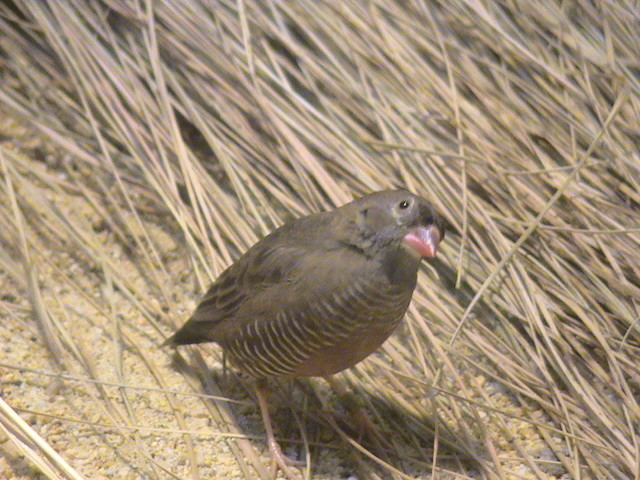
Locustfinch
Paludipasser locustella
Order: Passeriformes / Family: Estrildidae

Wikimedia Commons
About the Locustfinch
The Locustfinch, known scientifically as Paludipasser locustella, inhabits the grasslands and wetlands of sub-Saharan Africa, where its presence significantly influences the local ecosystem. This small passerine bird belongs to the Estrildidae family, which is known for its colorful plumage and complex social structures. The Locustfinch is particularly integral to its environment due to its diet, which includes various grass seeds and insects, playing a vital role in controlling insect populations and aiding in seed dispersal.
This species thrives in open habitats, including savannas and floodplains, where it can find ample food and nesting sites. During the wet season, the Locustfinch is especially active, taking advantage of the abundance of insects like locusts, from which it derives its common name. The presence of the Locustfinch in these areas supports the biodiversity of the region by contributing to the ecological balance.
The Locustfinch is observed primarily in countries such as Angola, Zambia, and Tanzania, where it is a resident species. However, its population dynamics are subject to seasonal changes. During the breeding season, which coincides with the rainy months, the Locustfinch's activities are centered around courtship and territory establishment. Outside of this period, the bird can be seen in flocks, which are crucial for its survival as they provide protection from predators and increase foraging efficiency.
Overall, the Locustfinch represents a key species within its habitat, illustrating the interconnectedness of avian life and the landscapes they inhabit. Its behaviors and ecological roles underscore the importance of preserving the grassland and wetland ecosystems of Africa, not only for the survival of the Locustfinch but also for the myriad of species that share this environment.
The Locustfinch belongs to the family Estrildidae, within the order Passeriformes. These birds typically live typically 4-6 years, with some living up to 8 years..
How to Identify a Locustfinch
The Locustfinch is a small bird, measuring approximately 11 to 12 centimeters in length, with a relatively stout body that is typical of the Estrildidae family. Adult Locustfinches are characterized by their distinctive red rump, which stands out against their otherwise subdued plumage. Their upperparts are predominantly brown with hints of gray, while the underparts are lighter, displaying a subtle buff color.
Juvenile Locustfinches, in contrast, lack the vivid red rump seen in adults and possess a more uniform brown coloration, which serves as a protective camouflage in their grassy habitats. As they mature, the red rump develops, becoming a key identification feature. Males and females are similar in appearance, although males may exhibit slightly more intense coloration during the breeding season.
In flight, the Locustfinch's silhouette is compact, with quick, direct flight patterns. When perched, it typically adopts an upright posture, often seen clinging to tall grasses or small shrubs. This posture, coupled with its vibrant rump, makes it distinguishable from other small birds in its range. The Locustfinch can sometimes be confused with other finch-like birds, such as the Red-cheeked Cordon-bleu, but the lack of blue in its plumage and the distinctive red rump help in accurate identification.
Having trouble telling birds apart? Upload a photo to our bird identification tool for an instant species match.
Locustfinch Habitat and Range
Preferred Habitat
The Locustfinch primarily inhabits grasslands and wetland areas across sub-Saharan Africa. These environments provide the necessary resources for feeding and breeding. The bird is often found at elevations ranging from lowland plains to areas just above 1,000 meters. In the wet season, the Locustfinch seeks out flooded grasslands and marshy sites, where its food sources, including seeds and insects, are abundant.
During the dry season, these birds may shift slightly to areas where moisture still supports lush vegetation. Although they prefer natural habitats, Locustfinches can occasionally be spotted on the outskirts of rural villages, where man-made water sources and agricultural fields mimic their natural environment.
The Locustfinch is not typically found in urban areas, as it requires expansive open spaces and specific vegetation types for its survival. The proximity to water bodies, whether temporary or permanent, is a critical factor in the distribution and density of Locustfinch populations.
Geographic Range
The Locustfinch's range is primarily concentrated within the central and southern regions of Africa. It is a resident species across Angola, Zambia, Malawi, and Tanzania, where it is most commonly observed in suitable habitats. While it does not undertake long migrations, the Locustfinch is known to exhibit local movements in response to seasonal environmental changes, particularly rainfall patterns.
During the breeding season, which aligns with the rainy season from November to March, the Locustfinch expands its range within its local area to exploit the increased availability of food and nesting sites. In drier months, the birds may concentrate in areas where water and food remain accessible.
Population density appears to be higher in regions with extensive grassland and wetland ecosystems. Although the Locustfinch has a fairly wide distribution, it is not uniformly common throughout its range, as local conditions heavily influence its abundance.
Want to know which birds visit your area? Browse our backyard birds by location guides for region-specific species lists.
What Does the Locustfinch Eat?
The Locustfinch primarily feeds on a combination of seeds and insects, with its diet shifting seasonally to reflect resource availability. During the wet season, the abundance of insects such as locusts, grasshoppers, and other small arthropods provides a rich protein source, crucial for breeding and raising young.
In drier periods, seeds from grasses and other herbaceous plants become more prominent in its diet. The Locustfinch forages both on the ground and within lower layers of vegetation, using its short, powerful bill to extract seeds and catch insects. It often employs a methodical approach to foraging, hopping along the ground and pecking at potential food sources.
Prey size tends to be small, suitable for its size and feeding capabilities. The Locustfinch typically feeds during the cooler parts of the day, such as early morning and late afternoon, reducing competition and avoiding the heat of midday.
Locustfinch Behavior and Social Structure
The Locustfinch exhibits a variety of behaviors that reveal its complex social and ecological interactions. It is generally gregarious, forming small flocks outside of the breeding season. These flocks serve multiple purposes, including enhancing foraging efficiency and providing safety in numbers against predators.
The Locustfinch is notably territorial during the breeding season, with males establishing and defending territories through song and display flights. Courtship involves a series of vocalizations and physical displays, with males showcasing their red rumps to attract females. Once paired, Locustfinches exhibit monogamous behavior, often remaining together for the duration of the breeding period.
Daily activity patterns include periods of intense foraging interspersed with resting and preening. The Locustfinch responds to predators with alarm calls and evasive flight, often taking refuge in dense vegetation. The bird's social structure and behavior are adapted to maximize survival and reproductive success in the dynamic environments it inhabits.
Locustfinch Nesting and Reproduction
Locustfinch nesting is a carefully coordinated activity timed with the wet season's peak. Nests are typically constructed low to the ground within dense grass or shrubbery, providing concealment from predators. The nest itself is a compact structure, crafted from grasses and lined with finer materials to ensure comfort and insulation for the eggs.
A typical clutch consists of three to six eggs, with both male and female sharing incubation duties. The incubation period lasts approximately 11 to 14 days, after which the chicks hatch. Following hatching, the parents continue their cooperative efforts, feeding regurgitated food to the young.
Fledging occurs around three weeks post-hatching, with the young birds remaining close to their natal nest for several days as they learn to forage independently. The Locustfinch may raise multiple broods per year if conditions are favorable, particularly if the wet season extends or if food remains plentiful.
Locustfinch Sounds and Vocalizations
The primary song of the Locustfinch is a series of melodious, high-pitched notes that are both rhythmic and persistent, often described as a soft warble. These songs serve both territorial and courtship functions, with males singing from exposed perches to advertise their presence.
Call notes are shorter and vary depending on the context, often used in communication between flock members or as alarm signals in the presence of predators. The alarm calls are more abrupt and sharp, effectively alerting nearby birds to potential danger.
During the dawn chorus, Locustfinches contribute with their distinctive song, adding a unique layer to the symphony of sounds characteristic of African grasslands and wetlands.
Interesting Facts About the Locustfinch
- 1Locustfinches are capable of consuming a significant number of locusts, making them natural pest controllers.
- 2The vibrant red rump of the Locustfinch is a key feature used in courtship displays to attract mates.
- 3During breeding season, male Locustfinches often engage in song duets with their mates.
- 4The Locustfinch's nest is often hidden in tall grasses to protect against ground predators.
- 5Locustfinches participate in mixed-species flocks, enhancing foraging success and predator detection.
- 6Their diet shifts notably between wet and dry seasons, showcasing their adaptability to changing resources.
- 7Despite their small size, Locustfinches are known for their tenacity in defending territories during breeding.
Locustfinch Conservation Status
The Locustfinch is currently listed as Least Concern by the IUCN, with its population considered stable across its range. Despite this status, the species faces threats from habitat loss due to agricultural expansion and wetland drainage. Climate change also poses a potential risk, as alterations in rainfall patterns could impact their breeding and foraging. Conservation efforts focus on preserving critical habitats, particularly in areas where human activities encroach on natural environments. Historical population changes have been minimal, although localized declines have occurred in regions with significant habitat alteration. Continued monitoring and habitat protection are essential to ensure the long-term viability of Locustfinch populations.
Other Estrildidae Species


Birds Similar to the Locustfinch
These species are often confused with the Locustfinch due to similar appearance or overlapping range.