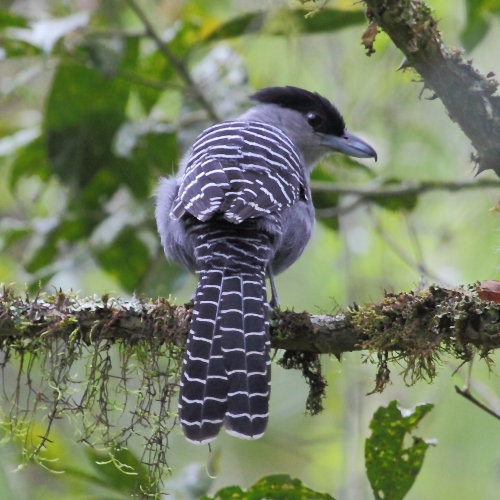
Alagoas Antwren
Myrmotherula snowi
Order: Passeriformes / Family: Thamnophilidae

Wikimedia Commons
About the Alagoas Antwren
The Alagoas Antwren, scientifically known as Myrmotherula snowi, is a small passerine bird that belongs to the family Thamnophilidae. This bird is of particular interest to ornithologists due to its critically endangered status and extremely limited range. Found only in the Brazilian Atlantic Forest, specifically in the state of Alagoas, this antwren faces significant threats from habitat destruction and fragmentation. Historically, the Alagoas Antwren inhabited dense undergrowth in humid lowland forests, but much of its habitat has been lost to agriculture and urban expansion.
This bird plays a crucial ecological role as an insectivore, helping to control insect populations in its habitat. The Alagoas Antwren forages in pairs or small family groups, moving quickly through the understory to glean insects from leaves and branches. Its presence indicates the overall health and biodiversity of its forest environment. As a resident species, it does not migrate and remains within its limited range year-round. This sedentary nature makes the Alagoas Antwren particularly vulnerable to habitat changes.
The significance of the Alagoas Antwren extends beyond its ecological role. It serves as a flagship species for conservation efforts in the Atlantic Forest, one of the most diverse and endangered ecosystems on the planet. Efforts to preserve this species' habitat benefit a wide range of other flora and fauna as well. The Alagoas Antwren's plight has prompted increased research and conservation focus, highlighting the urgent need to protect what remains of its native environment.
The Alagoas Antwren belongs to the family Thamnophilidae, within the order Passeriformes. These birds typically live 2-4 years, with max recorded at 6 years.
How to Identify a Alagoas Antwren
The Alagoas Antwren is easily identifiable by its striking black-and-white plumage. Adult males have predominantly black upperparts and wings, with contrasting white underparts that are often marked with fine black streaks. The face features a prominent white supercilium (eyebrow) that contrasts sharply with the black crown and lores. Females, while similar, tend to have more subdued coloration, with brownish tones mixed into their plumage, particularly on the back and wings. Juveniles resemble females but are generally duller in appearance.
In comparison to similar species, the Alagoas Antwren's sharp contrast between black and white makes it distinct. However, it can be confused with other antwrens in overlapping ranges. Observers should note the specific pattern of streaking and the unique facial markings to make a positive identification. The bird's silhouette in flight is compact, with rapid wing beats and a characteristic bobbing motion as it moves from branch to branch.
When perched, the Alagoas Antwren often adopts a horizontal posture, with its tail slightly cocked upward. This posture, along with its active foraging behavior, aids birders in distinguishing it from less active species. The Alagoas Antwren's behavior and subtle vocalizations further assist in identification, as they often occur in dense thickets where visual contact can be challenging.
Having trouble telling birds apart? Upload a photo to our bird identification tool for an instant species match.
Alagoas Antwren Habitat and Range
Preferred Habitat
The Alagoas Antwren is a specialist of the Atlantic Forest's dense, humid lowland habitats. It thrives in areas with thick undergrowth and a continuous canopy, which provide ample foraging opportunities and protection from predators. This bird typically inhabits elevations from sea level to around 600 meters. The forest structure in these areas consists of a rich variety of broadleaf trees, lianas, and epiphytes, creating a biodiverse environment.
While historically found in more extensive forested areas, the Alagoas Antwren's current habitat is severely fragmented. It now occupies smaller forest patches and remnants, which increases its risk of extinction. Despite these challenges, the antwren does not exhibit significant seasonal habitat shifts, remaining in the same areas year-round.
This species is not known to adapt well to urban or heavily disturbed environments. Unlike some more adaptable bird species, the Alagoas Antwren requires intact forest ecosystems to thrive. Conservation of its habitat is thus critical, focusing on preserving and restoring the Atlantic Forest's unique ecological characteristics.
Geographic Range
The range of the Alagoas Antwren is extremely limited, confined to the northeastern part of Brazil. Specifically, it inhabits the state of Alagoas in the Atlantic Forest biome. This region is characterized by its high biodiversity and endemism, but also by severe habitat loss.
The Alagoas Antwren does not migrate, making its range even more restricted and its population particularly vulnerable to local environmental pressures. Its distribution is patchy, and populations are concentrated in the few remaining forest fragments within its historical range. The area of occupancy is estimated to be less than 10 square kilometers, with the bird's presence confirmed in only a handful of small protected areas and private reserves.
As a result, the Alagoas Antwren's population density is very low, and individuals are rarely encountered even within suitable habitats. Conservationists focus on these hotspots to conduct monitoring and habitat restoration efforts. The range of this bird highlights the critical importance of protecting and connecting forest remnants to ensure its survival.
Want to know which birds visit your area? Browse our backyard birds by location guides for region-specific species lists.
What Does the Alagoas Antwren Eat?
The Alagoas Antwren's diet is primarily insectivorous, focusing on small insects and arthropods. Its foraging strategy involves gleaning prey from the foliage, branches, and occasionally the forest floor. It exhibits a preference for foraging in the lower to mid-level strata of the forest, where it can access a diverse range of insect prey hiding in the dense vegetation.
Common prey items include ants, beetles, spiders, and caterpillars. The bird's diet may vary slightly with seasonal changes in prey availability, but it remains consistently focused on insect consumption year-round. The Alagoas Antwren employs a methodical approach to foraging, moving through its habitat with agility and precision to pick off insects efficiently.
This antwren typically feeds during daylight hours, with a peak in activity during the early morning and late afternoon when insect activity is highest. Its role as an insectivore contributes significantly to the ecological balance of its habitat, helping to control insect populations and support the forest's health.
Alagoas Antwren Behavior and Social Structure
The Alagoas Antwren exhibits intriguing behavioral patterns that reflect its adaptation to the dense forest environment. It often forages in pairs or small family groups, rarely observed in larger flocks. This social structure facilitates efficient foraging and provides some level of vigilance against predators. The bird's territory is defended through vocalizations and displays, ensuring access to food resources and nesting sites.
Territorial behavior is particularly evident during the breeding season, when pairs become more vocal and aggressive toward intruders. Courtship displays involve both vocalizations and physical posturing, with males showcasing their plumage to attract females. Outside the breeding season, the Alagoas Antwren remains relatively sedentary, maintaining its territory throughout the year.
In response to predators, this bird often relies on its cryptic plumage and the dense vegetation for concealment. If threatened, it may freeze in place or emit alarm calls to alert its mate or neighboring birds. The daily routine of the Alagoas Antwren includes periods of foraging interspersed with rest and preening, ensuring that the bird maintains its plumage in optimal condition for both insulation and camouflage.
Alagoas Antwren Nesting and Reproduction
The Alagoas Antwren constructs its nest in dense undergrowth, typically choosing well-hidden sites to avoid detection by predators. The nest is a small cup-like structure made from fine plant fibers, leaves, and occasionally spider silk, providing both strength and camouflage. It is usually situated a few meters above the ground, nestled among branches or vines.
The breeding season for the Alagoas Antwren coincides with the onset of the wet season, providing ample food resources for raising young. A typical clutch consists of two eggs, which are incubated by both parents. The incubation period lasts approximately 14 to 16 days.
After hatching, the chicks remain in the nest for about 12 to 15 days, during which time both parents share feeding duties. The fledglings are relatively well-developed at the time of leaving the nest but continue to receive parental care for several weeks as they learn to forage independently. The Alagoas Antwren generally raises one brood per year, although favorable conditions may occasionally allow for a second.
Alagoas Antwren Sounds and Vocalizations
The Alagoas Antwren's primary song is a series of soft, high-pitched notes delivered in rapid succession. The rhythm is steady, and the pitch remains relatively constant, creating a gentle yet persistent melody. This song serves both as a territorial proclamation and a means of communication between mates.
In addition to its song, the Alagoas Antwren produces various call notes, including sharp 'chip' sounds used to maintain contact with its partner while foraging. Alarm calls are more abrupt and urgent, often triggered by the presence of predators or intruders within the territory.
During the dawn chorus, the Alagoas Antwren's song contributes to the vibrant soundscape of the Atlantic Forest, blending with the calls of other bird species. Its vocalizations, though not loud, are distinctive to those familiar with the region's avian community.
Interesting Facts About the Alagoas Antwren
- 1The Alagoas Antwren was only discovered in 1979, making it one of the more recent additions to ornithology.
- 2Its critically endangered status highlights the importance of Brazil's Atlantic Forest, one of the most biodiverse regions on Earth.
- 3Despite its small size, the Alagoas Antwren plays a significant role in controlling insect populations in its habitat.
- 4The bird's name honors the state of Alagoas in Brazil, emphasizing its strict endemism to this region.
- 5The Alagoas Antwren's discovery added to the understanding of forest fragmentation impacts on endemic species.
- 6Conservation efforts for the Alagoas Antwren also benefit countless other species within its ecosystem.
- 7The Alagoas Antwren's vocalizations are quieter compared to many other antbird species, aiding in its reclusive lifestyle.
Alagoas Antwren Conservation Status
The Alagoas Antwren is listed as Critically Endangered by the IUCN due to its extremely limited range and declining population. The primary threats to its survival include habitat destruction from agriculture, logging, and urbanization. Historical population declines have been significant, and without intervention, the species faces a high risk of extinction. Conservation efforts focus on protecting and restoring its native habitat within the Atlantic Forest. Initiatives include the establishment of protected areas, habitat corridors, and reforestation projects. These efforts aim to increase habitat connectivity and reduce edge effects that harm small populations. Awareness and education campaigns are crucial for local communities to understand the importance of preserving the Alagoas Antwren's habitat. By highlighting the bird's ecological role and cultural significance, conservationists hope to garner support for ongoing and future conservation initiatives.