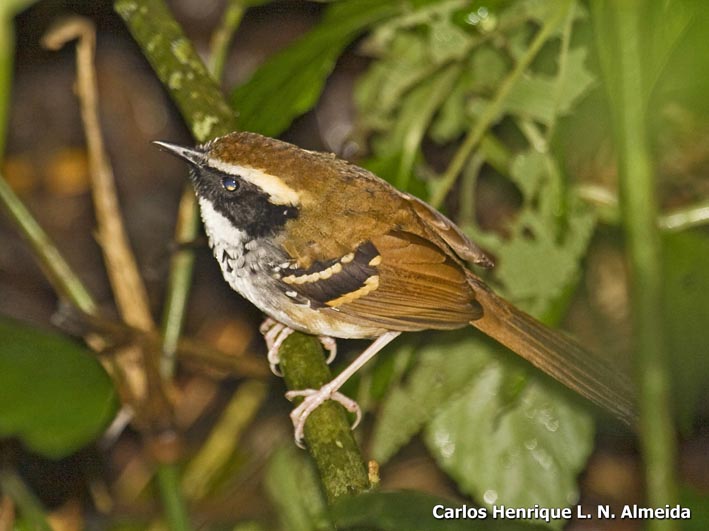
White-shouldered Antbird
Myrmeciza melanoceps
Order: Passeriformes / Family: Thamnophilidae

Wikimedia Commons
About the White-shouldered Antbird
The White-shouldered Antbird (Myrmeciza melanoceps) is a captivating bird native to the dense tropical forests of South America, particularly in regions such as the Amazon Basin. Its presence is a testament to the intricate biodiversity that defines the ecological tapestry of these forests. The bird plays a significant role in the ecosystem as both a predator of insects and a participant in mixed-species foraging flocks. This antbird is often found in the understory of primary and secondary forests, where it contributes to the control of insect populations. The White-shouldered Antbird's preference for lowland humid forests and its reliance on intact forest habitats make it an important indicator of forest health. Throughout the year, this bird remains a resident species, showcasing minimal seasonal movement. However, its behavior can vary with the rainy and dry seasons, as it adjusts its foraging strategies and habitat use according to food availability. During the rainy season, when insect abundance is high, the White-shouldered Antbird becomes more active and vocal, often participating in dawn choruses. In contrast, the dry season may see it becoming more elusive, as it conserves energy and focuses on territories with reliable food sources. The bird's ecological role extends beyond its immediate environment, as it indirectly supports larger predators by maintaining a balance in the insect population. The White-shouldered Antbird's significance is further highlighted by its interactions with ant swarms, where it partakes in a fascinating ecological relationship. As army ants move through the forest, they flush out insects and other prey, creating a feeding opportunity for the antbird. This behavior is a critical aspect of its existence and showcases the complex interdependencies within its habitat. Observing the White-shouldered Antbird within its natural environment offers insight into the intricate dynamics of tropical ecosystems, making it an essential species for both scientific study and conservation efforts.
The White-shouldered Antbird belongs to the family Thamnophilidae, within the order Passeriformes. These birds typically live average 6-8 years with a maximum recorded of 12 years..
How to Identify a White-shouldered Antbird
Identifying the White-shouldered Antbird involves noting its distinctive plumage and size. Adult males exhibit a striking appearance with glossy black plumage contrasted by conspicuous white shoulder patches. These patches are visible when the bird is perched or in flight, providing a key field mark. In contrast, females and juveniles display more subdued coloration, with brownish tones replacing the black, and smaller, less prominent white shoulder patches. This sexual dimorphism aids in distinguishing males from females and juveniles. The White-shouldered Antbird can be confused with other antbird species, but its unique shoulder patches and overall size, approximately 15 centimeters in length, help in accurate identification. In flight, the bird's silhouette is compact and rounded, characteristic of many antbirds, with rapid wingbeats and short flights typical of understory birds. When perched, it often adopts a horizontal posture, allowing a clear view of its shoulder patches and stout bill, adapted for insect hunting. The bird's behavior and habitat preferences further aid in identification, as it often associates with ant swarms and inhabits lowland tropical forests, areas rich in biodiversity and potential confounding species.
Having trouble telling birds apart? Upload a photo to our bird identification tool for an instant species match.
White-shouldered Antbird Habitat and Range
Preferred Habitat
The White-shouldered Antbird predominantly inhabits lowland tropical forests, especially those found in the Amazon Basin. It favors dense understory environments where leaf litter and tangled foliage provide optimal foraging conditions. These habitats are typically below 1,500 meters in elevation, as the bird shows a preference for humid, undisturbed forests. Seasonal shifts in habitat use are minimal, as this species is non-migratory. However, the bird may adjust its range slightly within the forest to follow areas of higher insect activity, particularly during the rainy season. The White-shouldered Antbird's reliance on primary and well-preserved secondary forests underscores its sensitivity to habitat disturbance. It rarely ventures into urban or heavily modified landscapes, preferring the rich, biodiverse environments of mature tropical forests.
Geographic Range
The White-shouldered Antbird is a resident species with a range primarily confined to the Amazon Basin, encompassing parts of northern Brazil, southern Venezuela, eastern Colombia, and the Guianas. Its range extends into Peru and Bolivia, where it occupies suitable forested habitats. This antbird does not undertake long-distance migrations, opting instead for localized movements within its range to exploit seasonal food resources. Population density is highest in regions with extensive, intact forest cover, particularly in protected areas such as the Amazon rainforest. These hotspots of biodiversity provide the essential habitat conditions and food resources needed for the bird's survival. Although the White-shouldered Antbird is relatively widespread within its range, its presence is often patchy, reflecting the fragmented nature of suitable forest habitats.
Want to know which birds visit your area? Browse our backyard birds by location guides for region-specific species lists.
What Does the White-shouldered Antbird Eat?
The White-shouldered Antbird primarily feeds on insects and other small arthropods, which it deftly captures in the leaf litter of the forest floor. Its diet includes ants, beetles, spiders, and other invertebrates, with occasional small vertebrates supplementing its diet. Seasonal changes, such as the increase in food availability during the rainy season, allow the bird to diversify its diet, potentially including more flying insects. Foraging often occurs in association with ant swarms, where the bird takes advantage of prey flushed out by the ants. This technique involves active ground foraging, where the bird uses its strong legs and bill to search through the leaf litter. The White-shouldered Antbird feeds primarily during the cooler hours of the day, such as early morning and late afternoon, matching its activity rhythm to that of prey availability.
White-shouldered Antbird Behavior and Social Structure
The White-shouldered Antbird exhibits intriguing social and territorial behaviors. It typically maintains a monogamous pair bond, with both members of the pair actively defending their territory from intruders. Territorial displays often involve vocalizations and physical posturing to deter rivals. While generally solitary or found in pairs, the White-shouldered Antbird may join mixed-species flocks, particularly in the presence of ant swarms, where collaborative foraging increases feeding efficiency. Courtship displays are subtle yet crucial for pair bonding, involving mutual preening and vocal exchanges. The bird's response to predators includes alarm calls and evasive maneuvers, utilizing dense vegetation for cover. Daily activity patterns revolve around foraging and territory maintenance, with peak activity during dawn and dusk. This rhythm aligns with the behavior of prey species and the need to secure feeding grounds.
White-shouldered Antbird Nesting and Reproduction
The White-shouldered Antbird constructs a cup-shaped nest using leaves, twigs, and plant fibers, typically placed low in the understory, often less than two meters above ground. The choice of nesting sites includes dense vegetation or shrubs that provide concealment from predators. A typical clutch consists of two eggs, which are incubated by both parents over a period of approximately 14 to 16 days. The fledging period extends for about 10 to 12 days post-hatching, during which time both parents are actively involved in feeding and protecting the chicks. Parental roles are shared, with both male and female participating in incubation and chick-rearing. The species usually raises one brood per year, although favorable conditions may allow for a second brood.
White-shouldered Antbird Sounds and Vocalizations
The primary song of the White-shouldered Antbird is a series of clear, resonant whistles, often described as a descending 'pee-pee-pee.' These whistles serve both territorial and mate-attraction purposes. Call notes are shorter and sharper, functioning as contact calls between mates or as alarm signals in response to threats. The bird's alarm calls are distinct, characterized by a rapid series of notes that alert nearby birds to potential danger. During the dawn chorus, the White-shouldered Antbird's song can be heard amidst the cacophony of forest sounds, contributing to the vibrant auditory landscape of the rainforest. The clarity and rhythmic quality of its song make it a recognizable component of its habitat's soundscape.
Interesting Facts About the White-shouldered Antbird
- 1White-shouldered Antbirds often follow army ant swarms to catch prey, a behavior known as "ant following."
- 2Despite their name, White-shouldered Antbirds primarily consume insects, not ants, using their robust bills.
- 3The species is an integral part of mixed-species foraging flocks in the Amazon Basin, displaying complex social interactions.
- 4White-shouldered Antbirds exhibit a unique shoulder patch display during territorial disputes, showcasing their distinctive white markings.
- 5Research suggests that the bird's song frequency may vary slightly with environmental conditions, adapting to the acoustic properties of its habitat.
- 6The bird's preference for dense understory habitats makes it an indicator species for forest health and biodiversity.
- 7White-shouldered Antbirds are known for their elusive nature, often heard before they are seen in the dense rainforest.
White-shouldered Antbird Conservation Status
The White-shouldered Antbird is currently listed as Least Concern by the IUCN, with a population trend that appears stable, despite ongoing threats from habitat destruction and fragmentation. Primary threats include deforestation, driven by logging, agricultural expansion, and infrastructure development. Conservation efforts focus on habitat protection and the establishment of reserves within its range to mitigate habitat loss. Historical population changes are not well-documented, but the bird's sensitivity to forest degradation underscores the need for continued conservation actions. Maintaining large tracts of undisturbed forest is crucial for the long-term preservation of the White-shouldered Antbird and its ecological role in the rainforest ecosystem.
Other Thamnophilidae Species
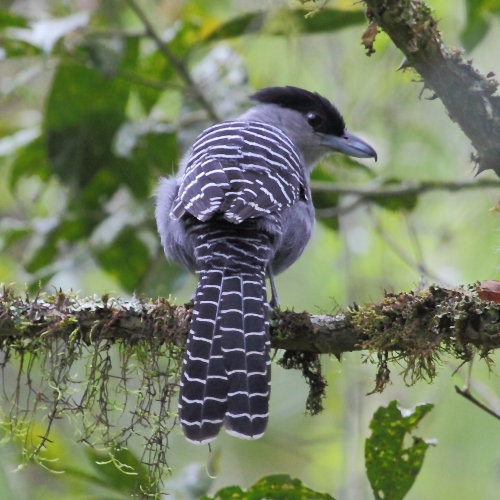


Birds Similar to the White-shouldered Antbird
These species are often confused with the White-shouldered Antbird due to similar appearance or overlapping range.