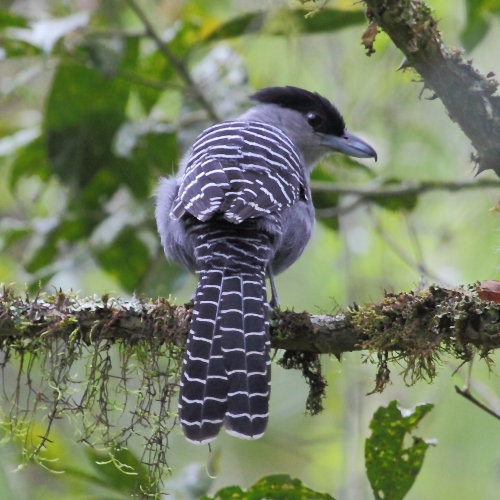
Amazonian Streaked-Antwren
Myrmotherula multostriata
Order: Passeriformes / Family: Thamnophilidae

Wikimedia Commons
About the Amazonian Streaked-Antwren
The Amazonian Streaked-Antwren, scientifically known as Myrmotherula multostriata, is a small but distinctive bird native to the lush rainforests of the Amazon basin. This bird is a member of the Thamnophilidae family, a group of birds often referred to as antbirds due to their unique feeding habits. The Amazonian Streaked-Antwren is predominantly found in regions such as Brazil, Peru, and Ecuador, where the vast and dense rainforests provide an ideal habitat for its survival. This bird plays a crucial role in its ecosystem, primarily by participating in mixed-species foraging flocks, which are common in the Amazon. These flocks often follow army ant swarms, capitalizing on the insects flushed out by the ants' movement. This behavior not only helps control insect populations but also maintains the delicate balance of the forest ecosystem.
Their presence in these flocks highlights their ecological significance as they contribute to the biodiversity of the region. The Amazonian Streaked-Antwren exhibits a preference for the understory and lower strata of the forest, where it actively searches for insects among the foliage. Their role as insectivores makes them vital in pest control, thus maintaining the health of the forest. They are non-migratory birds, and their populations remain stable as long as their habitat is preserved. Seasonal changes do not significantly affect their behavior, although breeding activities may be timed with the rainy season, ensuring an abundance of food for their young.
The Amazonian Streaked-Antwren's adaptability to its environment is noteworthy. It can survive in various types of forest habitats, including terra firme and várzea forests, as well as secondary growth areas, demonstrating a level of resilience. However, deforestation poses a significant threat to their habitat, which could lead to population declines if not properly managed. Despite their small size, these birds have a significant impact on their ecosystem as they help sustain the intricate web of life within their rainforest home.
The Amazonian Streaked-Antwren belongs to the family Thamnophilidae, within the order Passeriformes. These birds typically live average 5 years, with a maximum recorded of 8 years..
How to Identify a Amazonian Streaked-Antwren
The Amazonian Streaked-Antwren is a small, active bird measuring around 10-11 cm in length. Both males and females exhibit a distinctive streaked pattern on their plumage, which aids in camouflage among the dense foliage. The male typically has a black-and-white streaked head and upperparts with a more pronounced contrast, while the female displays a more subdued brownish coloration with similar streaking. The underparts of both sexes are paler, with the male showing a more noticeable white belly.
Juveniles resemble the females but with less defined streaking, making them somewhat challenging to distinguish without close observation. The Amazonian Streaked-Antwren can be confused with other similar antwrens, such as the White-flanked Antwren, but the latter lacks the distinctive streaked pattern on the head and back. In flight, the Amazonian Streaked-Antwren appears agile and swift, often darting through the underbrush with quick, flicking movements.
When perched, these birds often adopt a horizontal posture, which, combined with their streaked plumage, provides excellent camouflage against predators. Their active nature and constant movement make them a challenging subject for birdwatchers, but their distinctive vocalizations can help in locating them.
Having trouble telling birds apart? Upload a photo to our bird identification tool for an instant species match.
Amazonian Streaked-Antwren Habitat and Range
Preferred Habitat
The Amazonian Streaked-Antwren primarily inhabits tropical rainforests, favoring dense understories and lower canopies. They are especially prevalent in the Amazon basin, with specific habitats including terra firme forests, which are non-flooded areas, and várzea forests, which are seasonally flooded. These birds can also be found in secondary growth forests, indicating some adaptability to altered landscapes.
They typically reside at low elevations, usually up to 300 meters above sea level, although they may venture slightly higher in certain areas. Unlike some forest birds, the Amazonian Streaked-Antwren does not exhibit significant seasonal habitat shifts, maintaining a consistent presence in the rainforest throughout the year. Their preference for remote, dense forest habitats means they are seldom found in urban or highly disturbed environments.
Their reliance on the intact rainforest ecosystem highlights the importance of habitat conservation. As deforestation continues to threaten their natural environment, these birds may face increasing challenges in finding suitable habitats.
Geographic Range
The Amazonian Streaked-Antwren's range is largely confined to the Amazon basin, covering parts of northern Brazil, eastern Peru, southeastern Colombia, and the eastern regions of Ecuador. This bird is non-migratory, with populations generally residing year-round within these tropical rainforests.
High population densities are often found in well-preserved forest areas where army ant swarms are common, as the birds rely on these swarms for their foraging activities. Though the species is not considered migratory, local movements may occasionally occur in response to changes in food availability or habitat disturbances.
Despite its relatively limited range, the Amazonian Streaked-Antwren is widespread within suitable habitats throughout the Amazon basin. Conservation efforts in countries like Brazil and Peru are crucial to maintaining the health of these populations, as habitat destruction remains a significant threat.
Want to know which birds visit your area? Browse our backyard birds by location guides for region-specific species lists.
What Does the Amazonian Streaked-Antwren Eat?
The Amazonian Streaked-Antwren primarily feeds on insects, making it a crucial component of the forest's insect control system. Their diet consists mainly of ants, beetles, and caterpillars, which they expertly pluck from leaves and branches in the forest understory. They are known for their association with army ant swarms, taking advantage of the insects and other prey species that are disturbed by the ants' activity.
This foraging technique, known as ant-following, involves the bird actively moving through the dense foliage, often in mixed-species flocks, to capture insects flushed out by the ants. The Amazonian Streaked-Antwren's diet remains relatively consistent throughout the year, although the abundance and diversity of prey may fluctuate with seasonal changes in the forest.
Their feeding schedule is primarily diurnal, with peak activity occurring in the early morning and late afternoon. This pattern ensures they can take full advantage of the active army ant swarms, which are more prevalent during these times. The bird's small size allows it to access narrow spaces within the forest, where it can find prey that larger birds might overlook.
Amazonian Streaked-Antwren Behavior and Social Structure
The Amazonian Streaked-Antwren is a social bird, often observed in mixed-species flocks alongside other antbirds and insectivorous species. This behavior not only provides safety in numbers but also increases foraging efficiency. These flocks are typically centered around army ant swarms, with the antwren taking advantage of the insects flushed out by the ants.
Territorial behavior is less pronounced during non-breeding seasons, as the birds focus on foraging. However, during the breeding season, males may become more territorial, engaging in vocal displays to ward off rivals. The courtship display involves the male performing aerial acrobatics and vocalizations to attract a mate.
The Amazonian Streaked-Antwren is primarily active during the day, with peak activity occurring in the early morning and late afternoon. Their response to predators involves a combination of remaining motionless, relying on their cryptic plumage for camouflage, and retreating into dense cover if threatened. Although they are not migratory, local movements within their range may occur in response to environmental changes or food availability.
Amazonian Streaked-Antwren Nesting and Reproduction
The nesting habits of the Amazonian Streaked-Antwren reflect their adaptation to the rainforest environment. They typically build small, cup-shaped nests hidden within the dense foliage of the understory. These nests are often constructed from fine plant fibers, leaves, and spider silk, providing both camouflage and structural integrity.
Nesting sites are generally chosen for their concealment, with the nest suspended from a branch or vine about 1-3 meters above the ground. The clutch size usually consists of two eggs, which both parents incubate for a period of approximately 14 days. After hatching, both parents take an active role in feeding and caring for the young.
Fledging occurs around 12-15 days post-hatching, during which the chicks gradually gain independence. The Amazonian Streaked-Antwren may raise multiple broods per year, depending on environmental conditions and food availability. Parental care extends beyond fledging, ensuring that the young birds learn essential foraging and survival skills necessary for their development.
Amazonian Streaked-Antwren Sounds and Vocalizations
The vocalizations of the Amazonian Streaked-Antwren are a key identifying trait for birders. Their primary song consists of a rapid series of high-pitched notes, often described as a trill, which they use to communicate with mates and establish territory. This song is delivered with a rhythmic cadence, making it a distinctive sound within the dense rainforest.
In addition to their song, the Amazonian Streaked-Antwren also produces sharp call notes, which serve as contact calls between flock members or as alarms when predators are nearby. These calls are short and crisp, contrasting with the more melodious song.
During the dawn chorus, their vocalizations become more frequent, as the birds take advantage of the cooler morning hours to assert their presence and maintain social bonds. The Amazonian Streaked-Antwren's vocal behavior is comparable to other antbirds, though its song is often faster and higher-pitched, setting it apart from similar species.
Interesting Facts About the Amazonian Streaked-Antwren
- 1The Amazonian Streaked-Antwren is often found in mixed-species flocks, providing a dynamic birdwatching experience.
- 2Despite their small size, measuring only 10-11 cm, these antwrens play a large role in controlling insect populations.
- 3Their distinctive streaked plumage provides excellent camouflage, making them a challenge to spot in the dense forest.
- 4The Amazonian Streaked-Antwren's primary diet consists of insects, which they often catch by following army ant swarms.
- 5These birds are non-migratory, remaining in their Amazonian rainforest habitat year-round.
- 6Their nests are cleverly constructed with plant fibers and spider silk, blending seamlessly into the foliage.
- 7The rapid trill of the Amazonian Streaked-Antwren's song is often one of the first sounds heard at dawn in the rainforest.
Amazonian Streaked-Antwren Conservation Status
The Amazonian Streaked-Antwren is currently listed as Least Concern by the IUCN, with populations considered stable across its range. However, ongoing deforestation and habitat destruction in the Amazon basin present significant threats to their future stability. As primary forest habitats are cleared for agriculture and development, the availability of suitable environments for these birds diminishes. Conservation efforts are critical to preserving their habitat, with initiatives focusing on protecting large tracts of rainforest and establishing protected areas. Historically, the Amazonian Streaked-Antwren has maintained stable populations due to its adaptability to various forest types. However, continued monitoring is necessary to ensure that habitat loss does not lead to population declines. Efforts to mitigate deforestation, such as promoting sustainable land use practices and supporting reforestation projects, can help secure the Amazonian Streaked-Antwren's future. Raising awareness of their ecological role and the importance of biodiversity in the Amazon can also support conservation initiatives.