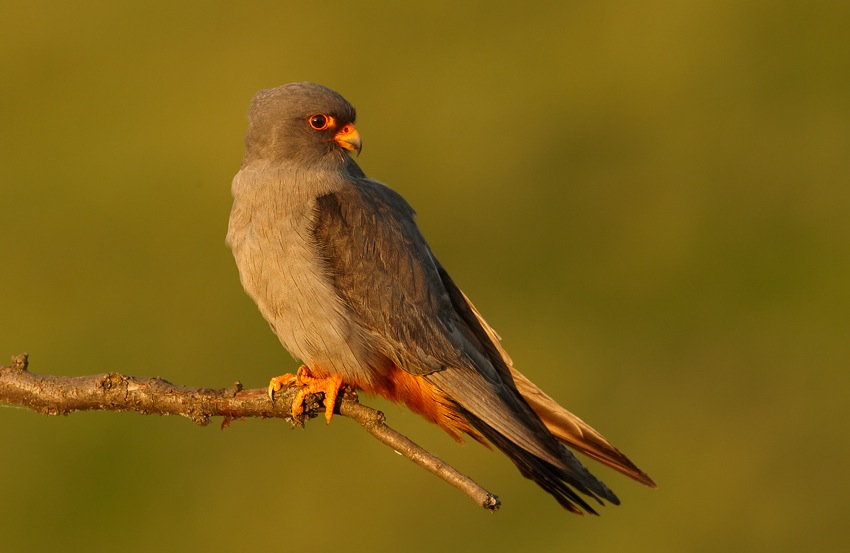
Amur Falcon
Falco amurensis
Order: Falconiformes / Family: Falconidae

Wikimedia Commons
About the Amur Falcon
The Amur Falcon (Falco amurensis) exhibits a remarkable natural history, marked by one of the most impressive migratory journeys in the avian world. This small raptor breeds in the temperate forests and grasslands of eastern Asia, particularly in regions such as southeastern Siberia, Manchuria, and northern China. Its ecological significance is profound, as this bird plays a vital role in controlling insect populations, especially during breeding seasons when it consumes large quantities of insects to feed its young. During migration, the Amur Falcon undertakes a monumental journey, crossing vast stretches of land and sea to reach its wintering grounds in southern Africa. Its migration route covers thousands of kilometers, crossing the Indian subcontinent and the Arabian Sea, showcasing its resilience and adaptability to diverse environments.
Amur Falcons are particularly significant for their role in fostering international conservation efforts due to their transcontinental migratory patterns. The annual gatherings of these falcons in Nagaland, India, en route to Africa, are a spectacular natural phenomenon. This event draws attention from bird watchers and conservationists worldwide, highlighting the interconnectedness of ecosystems across continents. In their wintering habitats in Africa, Amur Falcons continue to play a critical role in maintaining ecological balance by preying on locusts and other insects, which are agricultural pests.
The Amur Falcon's seasonal behaviors are closely tied to its migratory patterns. During the breeding season from May to August, these raptors are primarily insectivorous, hunting during the day. As their young fledge and the breeding season concludes, they begin their long migration southward. This journey is not only a feat of endurance but also a testament to their navigational abilities, as they travel over open seas and varied terrains. The falcons' ability to adapt to different ecological niches during their lifecycle underscores their significance in global biodiversity.
The Amur Falcon belongs to the family Falconidae, within the order Falconiformes. These birds typically live known to live up to 13 years in the wild, although average lifespan is likely shorter..
How to Identify a Amur Falcon
The Amur Falcon is a small raptor, measuring about 26 to 30 centimeters in length with a wingspan of approximately 63 to 71 centimeters. Adult males are striking with slate-gray plumage contrasted by a distinct white throat and dark red-orange legs. Females, while also gray, have a more barred underpart and lack the male's distinct white throat. Juveniles can be identified by their brown streaked plumage, which differentiates them from adults. In flight, the Amur Falcon displays pointed wings and a relatively long tail, typical of falcons, allowing for agile aerial maneuvers.
The differences between the sexes, particularly the contrasting plumage, aid in field identification. However, juveniles can sometimes be confused with other small falcons, such as the Eurasian Hobby. The Amur Falcon can be distinguished by its smaller size and the absence of the reddish undertail found in the Hobby. When perched, Amur Falcons often adopt an upright posture, showcasing their slender, streamlined bodies.
These falcons are generally observed in open areas during migration and are adept at catching insects on the wing. Their flight silhouette, characterized by swift, agile movements, is advantageous for hunting flying insects. Their perching posture, often on exposed branches or wires, allows for easy observation in areas where they gather in numbers.
Having trouble telling birds apart? Upload a photo to our bird identification tool for an instant species match.
Amur Falcon Habitat and Range
Preferred Habitat
Amur Falcons inhabit a variety of habitats throughout their lifecycle. During the breeding season, they prefer open woodlands, grasslands, and agricultural areas with scattered trees. In their breeding range, they are often found at elevations ranging from lowlands to mid-altitudes, where they can find ample food resources.
As migratory birds, their habitat preferences shift significantly during their long journey. They are frequently observed roosting in large numbers in wetlands and open fields during stopovers. In wintering grounds, particularly in southern Africa, they adapt to savannahs and open country areas, where insect prey is abundant.
The Amur Falcon's adaptability to both rural and urban environments allows them to exploit different ecological niches. They can often be seen nesting in urban parks or rural farmlands, indicating their flexibility in habitat selection. This adaptability is crucial for their survival during migration and in various seasonal habitats.
Geographic Range
The Amur Falcon's breeding range spans southeastern Siberia, Manchuria, and northern China, where they nest from May to August. As summer ends, these falcons embark on a remarkable migration southward, crossing the continent of Asia. They travel through regions such as India and Bangladesh, where large flocks are often sighted during stopovers.
Their migration corridor is notable for the vast distances covered, including a significant sea crossing over the Arabian Sea. This journey ends in southern Africa, where they winter in countries such as South Africa, Botswana, and Zimbabwe. In these wintering areas, they form large communal roosts, demonstrating their social nature.
Population density hotspots include the Nagaland region in India, where tens of thousands congregate during migration. These gatherings highlight the importance of specific regions as critical stopover sites, where conservation efforts are crucial to support their migratory success.
Want to know which birds visit your area? Browse our backyard birds by location guides for region-specific species lists.
What Does the Amur Falcon Eat?
The Amur Falcon primarily feeds on insects, with their diet largely comprising locusts, grasshoppers, and dragonflies. During the breeding season, they hunt extensively during daylight hours, taking advantage of the abundance of insects to feed their young. They are adept aerial hunters, capturing prey mid-flight with remarkable agility.
In their wintering grounds, their diet remains largely insectivorous, but they also consume small birds and other vertebrates when available. Seasonal diet changes are influenced by the availability of prey, with a preference for large swarms of locusts in Africa, where they play a role in controlling pest populations.
Foraging techniques involve both solitary hunting and communal feeding in large flocks, particularly in areas where insect populations peak. This flexibility in feeding strategy ensures that they can exploit various food resources throughout their extensive range.
Amur Falcon Behavior and Social Structure
Amur Falcons exhibit a social structure that is highly gregarious, especially evident during migration and winter months. They often form large flocks, sometimes numbering in the tens of thousands, where they roost communally in trees or on power lines. This flocking behavior provides safety in numbers, reducing the risk of predation.
During the breeding season, these falcons display territorial behavior, with pairs defending their nesting sites vigorously against intruders. Courtship displays involve aerial acrobatics and food exchange, strengthening pair bonds. Once settled, they focus on raising their young, with both parents contributing to feeding and protection.
Their response to predators includes alarm calls and communal mobbing, where multiple individuals may harass a predator to drive it away. Amur Falcons are primarily diurnal, with peak activity during early morning and late afternoon when insect prey is most abundant. Their daily activity patterns reflect their reliance on visual cues for hunting.
Amur Falcon Nesting and Reproduction
Amur Falcons typically nest in tree cavities or utilize old nests of other birds, such as crows and magpies. They do not construct their own nests but prefer sites that offer some protection and elevation. Nesting locations are often in open areas with scattered trees, providing easy access to hunting grounds.
Clutch size ranges from three to five eggs, with incubation lasting about 28 to 30 days. Both parents share incubation duties, with the female often taking the night shift. After hatching, the young fledge in approximately 28 to 30 days, during which both parents actively feed them.
Parental roles are shared, with both male and female contributing to feeding and protection of the chicks. Typically, the Amur Falcon raises one brood per year, although favorable conditions may occasionally support a second brood. Their nesting strategy reflects their adaptation to maximize reproductive success within a limited breeding season.
Amur Falcon Sounds and Vocalizations
The Amur Falcon's primary song is a series of high-pitched, rapid chattering notes, often described as a 'kik-kik-kik' sound. These vocalizations serve as communication between mates and are prominent during the breeding season.
Call notes are typically short and sharp, used to signal alarm or alert fellow falcons to potential threats. When roosting communally, especially during migration, their vocalizations can create a lively chorus, particularly at dawn and dusk.
Compared to other falcons, the Amur Falcon's vocal range is more varied, reflecting their social interactions within large flocks. This vocal communication plays an essential role in maintaining group cohesion and alerting to predators.
Interesting Facts About the Amur Falcon
- 1The Amur Falcon migrates over 14,000 kilometers from breeding grounds in Asia to wintering areas in Africa, one of the longest migrations of any raptor.
- 2During migration, Amur Falcons cross the Arabian Sea, flying nonstop for over 3,000 kilometers, a journey that can take up to three days.
- 3In Nagaland, India, the Amur Falcon's stopover is so significant that it has become a focal point for ecotourism and conservation awareness.
- 4Amur Falcons can consume up to 15 percent of their body weight in insects daily, playing a crucial role in pest control.
- 5The species was once heavily hunted in India, but conservation efforts have significantly reduced illegal hunting, showcasing successful international collaboration.
- 6Amur Falcons form some of the largest known roosting groups of any raptor, with up to a million individuals recorded in a single area.
- 7Despite being a small raptor, the Amur Falcon's endurance and navigational skills are on par with larger migratory birds, reflecting their adaptability.
Amur Falcon Conservation Status
Currently, the Amur Falcon is listed as Least Concern by the IUCN, with stable population trends thanks to successful international conservation efforts. However, they face threats from habitat destruction and hunting, particularly during stopovers in regions like India. Historically, large-scale hunting in Nagaland posed a significant threat, but awareness campaigns and legal protections have reduced these risks, allowing populations to recover. Continued efforts focus on habitat protection and reducing human-induced threats along their migratory route. Monitoring population trends and implementing conservation measures in key areas remain crucial to ensuring the Amur Falcon's long-term survival. Collaborative international efforts highlight the shared responsibility in safeguarding this remarkable migratory species.
Other Falconidae Species


Birds Similar to the Amur Falcon
These species are often confused with the Amur Falcon due to similar appearance or overlapping range.